
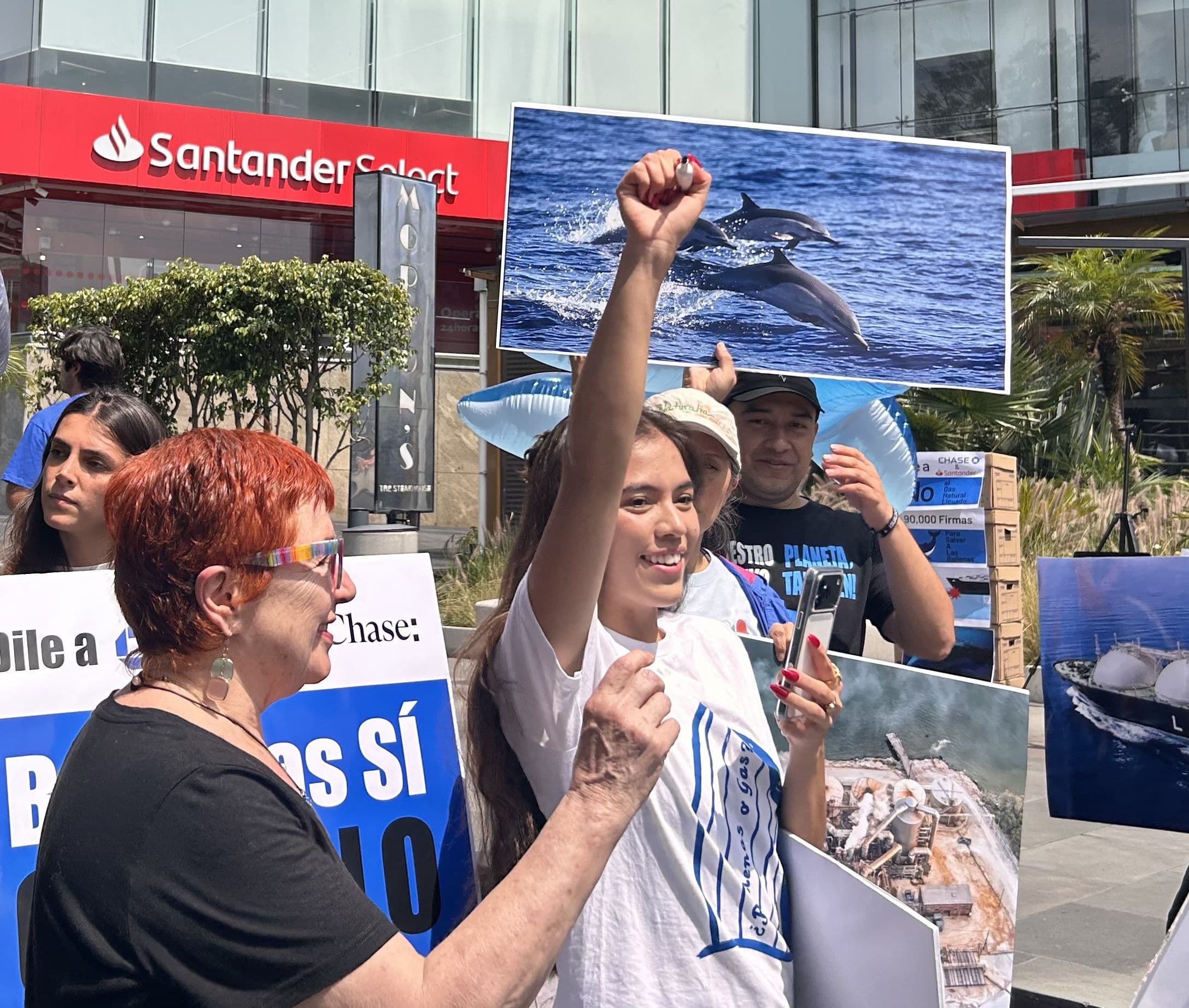
A Federal Court in Mexico City determined that the Security, Energy and Environment Agency (ASEA) and the Secretariat of Environment and Natural Resources (Semarnat) do have the legal power to carry out a Strategic Environmental Assessment (EAE) and establish moratoriums on liquefied natural gas projects in the Gulf of California, contradicting the previous position of the authorities themselves, who had maintained that they lacked such powers.
This ruling, derived from an amparo promoted by the Economic, Social and Cultural Rights Project (ProDESC) and the Mexican Center for the Defense of the Environment A.C. (DAN), requires the authorities to issue a “complete and exhaustive” response on the protection of the Gulf of California against the expansion of fossil gas infrastructure, including the Amigo LNG or Saguaro project.
You may also like: “President: Protect Topolobampo”: Greenpeace Scale protests ammonia plant in Sinaloa
The ruling considered that the responses issued by ASEA and the Presidency of the Republic were not consistent and confirms that the authorities already have the legal tools to carry out comprehensive analyses and must put them into practice, said Guillermo Torres, coordinator of Transnational Justice at ProDESC, in a statement.
For her part, Cecilia García, director of communication at DAN, said that to prevent “the irreversible, cumulative and synergistic damage caused by gas terminals on the shores of the Gulf of California, we should not expect new laws.”
“The judiciary recognizes that the current legal framework is sufficient to act now, revoke or deny those authorizations and not risk the lives of species and communities in the Gulf of California,” Garcia said.

In July of last year, ProDESC, DAN and other organizations sent a letter to the Federal Government to conduct a Strategic Environmental Assessment and issue a moratorium on fossil gas infrastructure in the Gulf of California. But, the official answer was that they had no authority to do so.
For this reason, a federal judge ordered to rescind them and, instead, to issue others, duly founded and motivated, according to the organizations' statement.
Strategic Environmental Assessment is an internationally recognized tool that makes it possible to identify in a comprehensive and preventive way possible cumulative impacts of a project.
Now, the initiative to reform the General Law on Ecological Balance and Environmental Protection (LGEEPA) of the President of the Republic proposes to incorporate Strategic Environmental Assessment as a key instrument to prevent damage, taking into account environmental justice and ecosystem restoration.


Comentarios (0)