
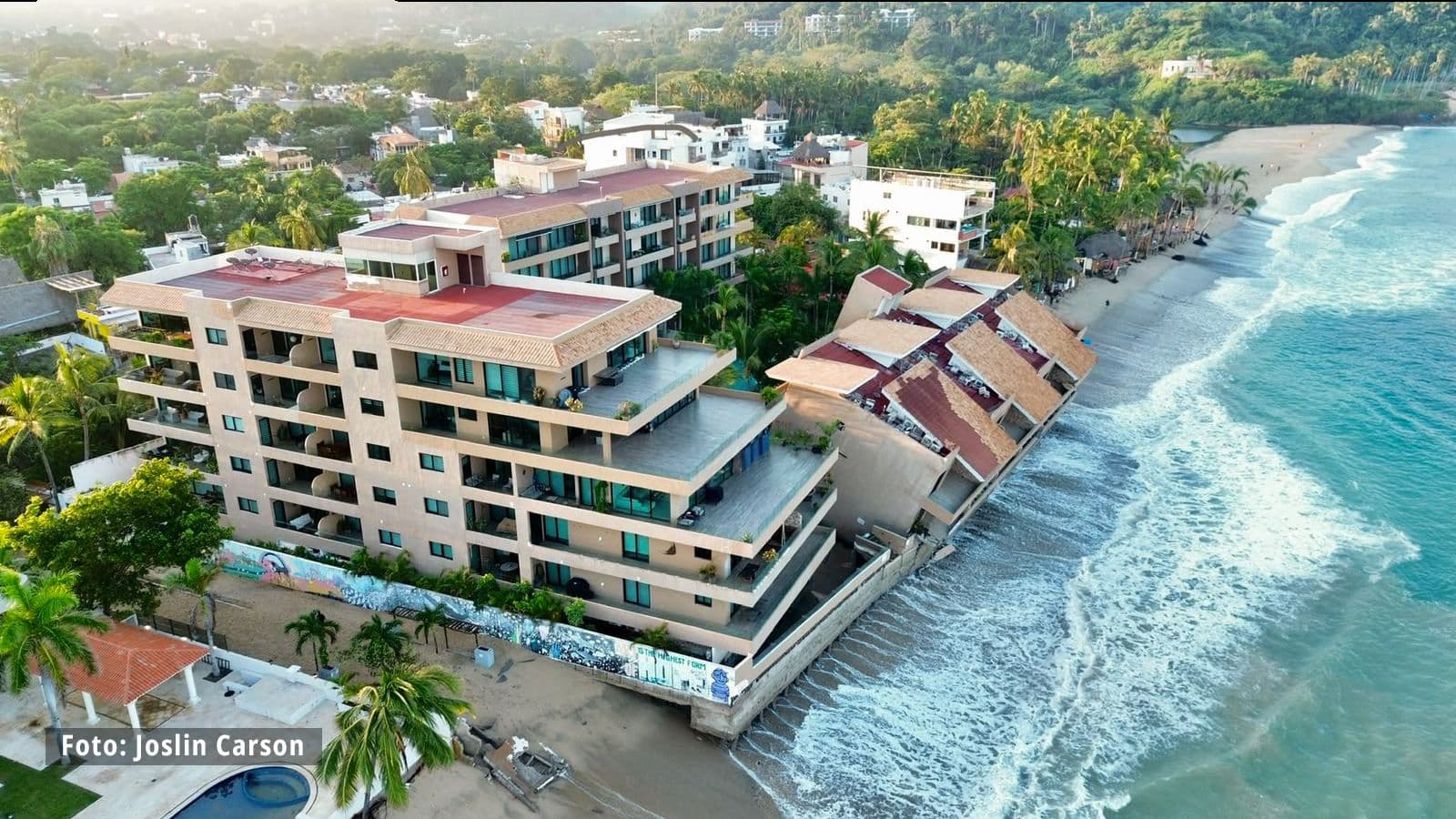
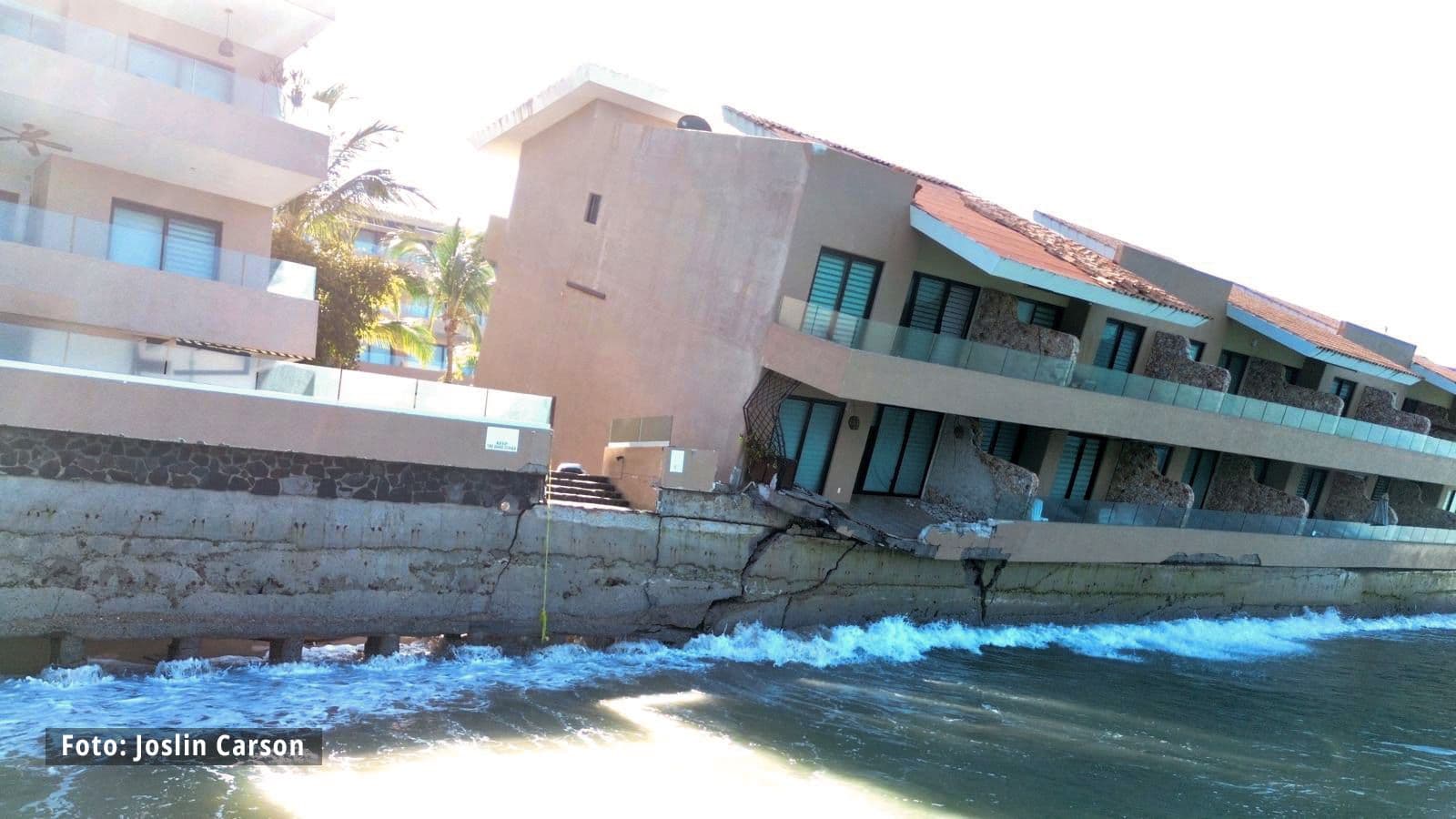
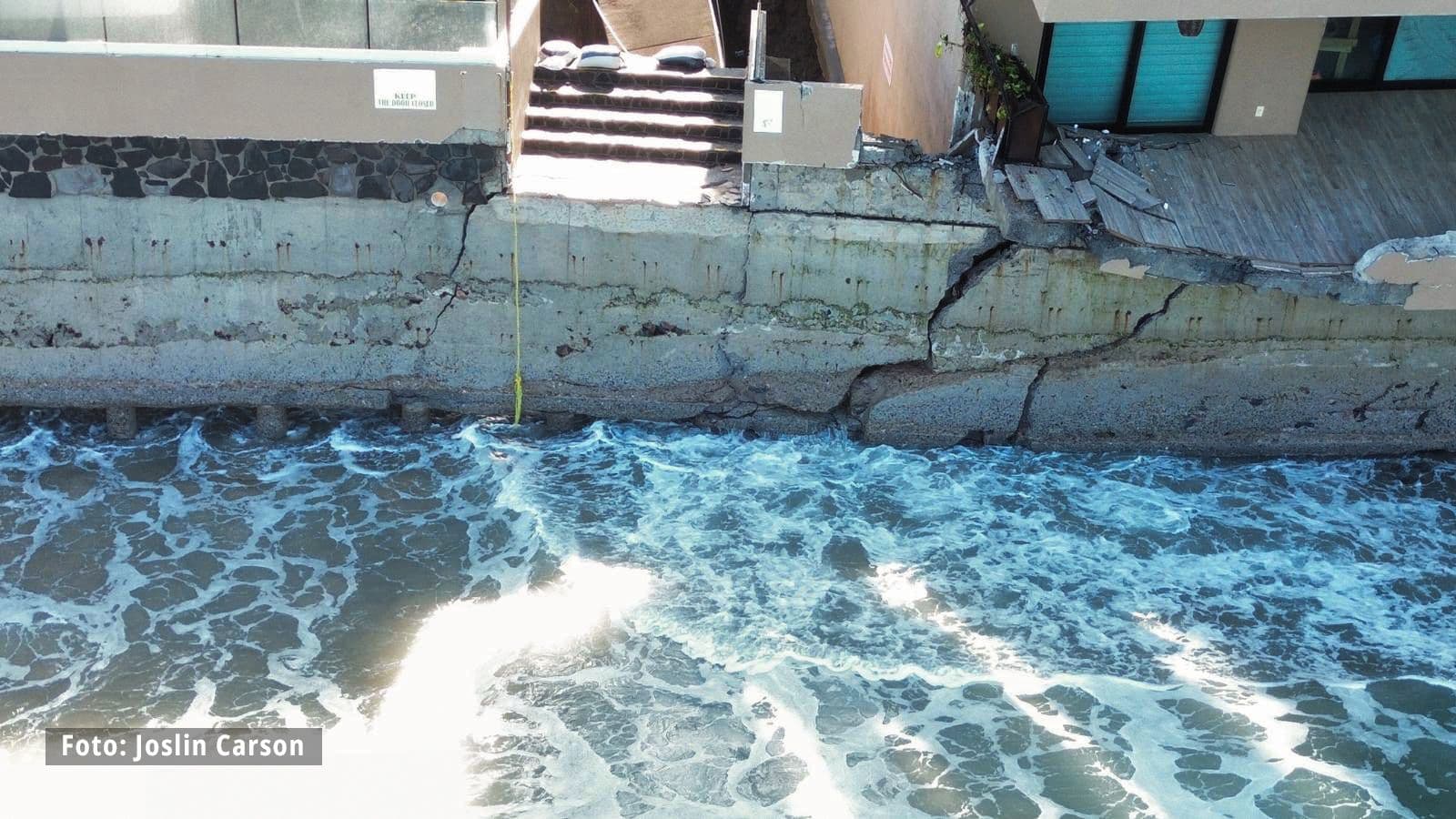
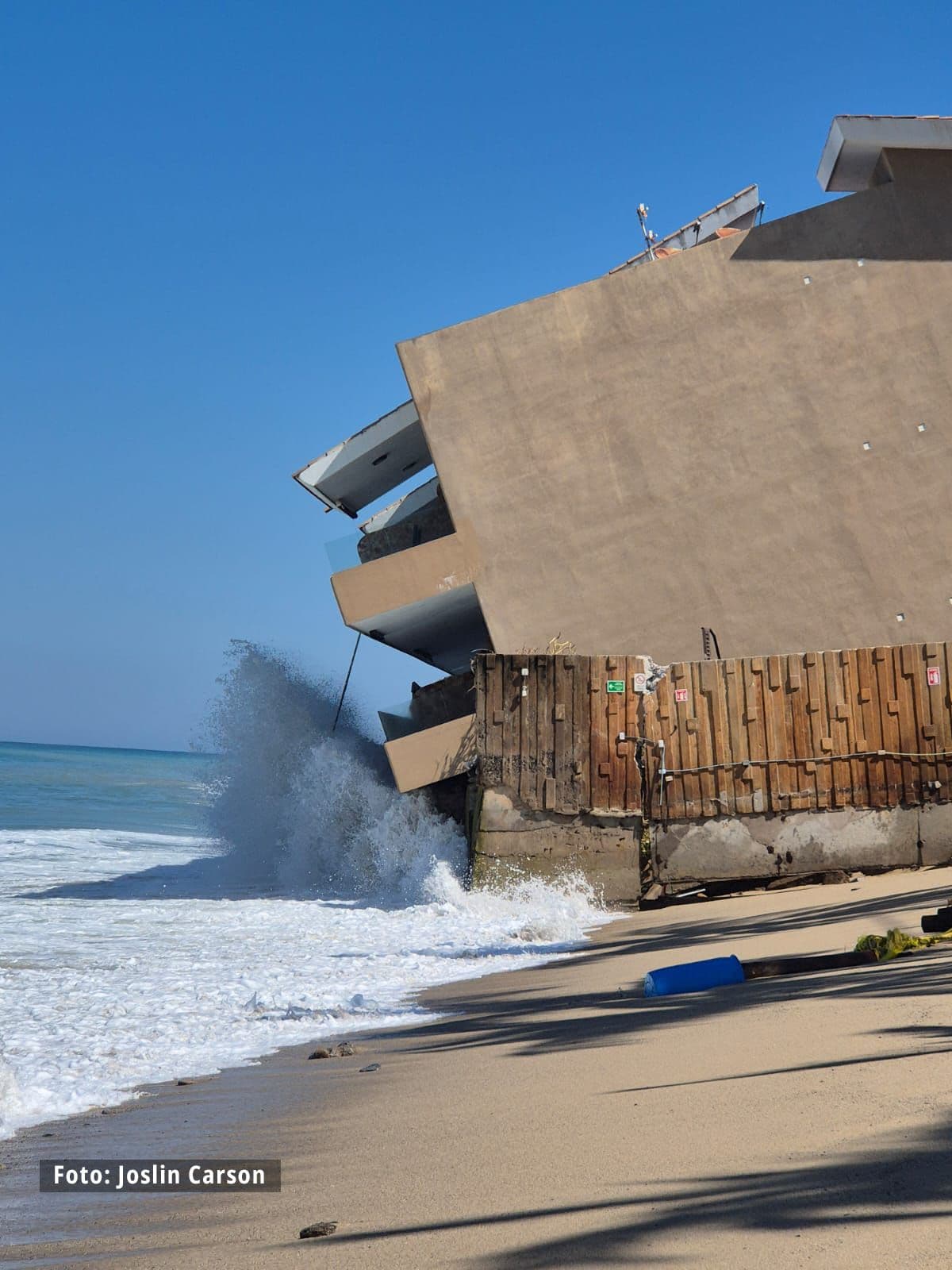
On October 21, 2026, part of the structure of the Punta Paraíso real estate development in San Pancho, Nayarit, built irregularly on the beach, collapsed on its perimeter fence after waves eroded the coast and undermined the foundations.
This is a project of the company Pacific Lifestyle Properties with a long history of judicial problems. In fact, the collapse occurred while a court order for demolition for sanctioned works on land seized from the sea is still in force.
“Coincidence or not, due to the El Niño phenomenon, conditions associated with climate change, Kelvin waves and multiple hurricanes ('Polo', 'Raquel' and 'Simon', among others), these instead of bringing sand like the previous ones ('Kena' and 'Patricia') began to erode the beach surgically. They undermined the foundations of the building because it was built 20 meters from the original Federal Maritime Terrestrial Zone,” says a resident in an interview, who asks for anonymity so as not to be exposed.
“The sea recognized its terrain and began to undermine until the first building — built entirely on national assets in a hurry, playing fait accompli — began to sink from the front and go face to face towards the ocean,” he adds.
After the collapse, Civil Protection evacuated residents and protected the building against the risk of new landslides.
The Story Behind Viral Images
The images of the collapse quickly went viral, but the controversy surrounding the complex dates back to 2017, when residents of the community filed complaints with the Federal Attorney for Environmental Protection (Profepa) for the construction of the beachfront condominium.
The conflict related to changes in the coastline and the delimitation of federal land. The source explains that several hurricanes favored the growth of a dune and, with this, changed the reference used to delimit the Federal Maritime Terrestrial Zone (ZOFEMAT). Based on a previous concession, a new delimitation was managed that moved the strip about 30 meters towards the sea.
“The beach — that set of dunes and sand — is a national asset that is classified as land gained from the sea, Federal Maritime Terrestrial Zone or free beach,” he says. “Back then, not everyone recognized that technical distinction. People said they were building on the ZOFEMAT, while the developer claimed that the ZOFEMAT was later on. This was because, based on a previous concession, they managed the delimitation of land gained from the sea and traveled the ZOFEMAT about 30 meters to the front, bordering the maximum high tide of a dune that had grown after several hurricanes.”
Thus, between private property and the new delimitation of the ZOFEMAT, land gained from the sea was identified. According to the neighbor, the developer began building on that strip, which prompted complaints from residents of San Pancho.
Profepa's first actions focused on a fence installed on the sand while construction was progressing. The administrative procedure resulted in a resolution that ordered the demolition of the sanctioned works and the restoration of 1,466,008 square meters of land gained from the sea.
Environmental assessment and land earned from the sea
Pacific Lifestyle Properties presented the Punta Paraíso project to the Ministry of Environment and Natural Resources (Semarnat) in 2017. During the environmental assessment, the agency requested additional information. On June 8 of that year, Carlos Lemus Mateos, the company's legal representative, provided the required documentation.
In the 2017 documentary review, an overlap of 1,695.20 square meters was detected between the property presented as private property by the company and the official area of land earned from the sea. In view of this finding, it was recommended to turn the review to the Directorate of the Federal Maritime Terrestrial Zone and Coastal Environments.
Years later, in an independent proceeding within the same case, Profepa ordered the return of 1,466,008 square meters.
Semarnat also requested clarifications about the deck-like terraces, a water mirror and planters projected near the federal maritime-terrestrial zone. The agency asked to explain the constructive characteristics of these elements and their relationship with the urban restrictions applicable to the site.
The requirements included the project's relationship with NOM-162-SEMARNAT-2012, which establishes specifications for the protection, recovery and management of sea turtle populations in their nesting habitats. In addition to the species present, their habitats, breeding and feeding areas, biological corridors and planned measures to prevent or mitigate impacts.
The vegetation inventory included in the project documentation counted 95 tree specimens. The proposal contemplated keeping 37, equivalent to 39%, and subjecting 58 to felling with prior municipal authorization; palms were considered for relocation.
Semarnat also requested to demonstrate that the site did not correspond to forest land in accordance with applicable legislation, to review the link between the project and the Banderas Bay Urban Development Plan and to clarify the restrictions on the property and the number of parking spaces.
In addition, he requested information on existing facilities, including temporary palapa-roofed structures and a small building, to determine if they required environmental authorization.
The company behind Punta Paraíso
Pacific Lifestyle Properties, S.A. de C.V., appears in the files of Semarnat and Profepa as responsible for the Punta Paraíso San Pancho project. The documentation submitted to Semarnat in June 2017 identifies Carlos Lemus Mateos as the company's legal representative.
Lemus is also linked to Lemmus Real Estate, a real estate firm that markets properties in Puerto Vallarta and the Riviera Nayarit. On its commercial site, the company presents Punta Paraíso among the developments related to its real estate activity.
Century West Realty's corporate page identifies Francis Bast as president of that company and of Century Management and Development Corporation. In presenting his career, Bast refers to a commercial partnership with Pacific Lifestyle Properties to develop properties in Mexico.
In December 2017, Profepa reported that a cyclone mesh installed outside the authorized polygon partially invaded the federal maritime-terrestrial zone and land gained from the sea, in addition to preventing free movement on the beach. The agency ordered a correction of the situation and imposed a temporary partial closure after verifying that the barrier remained installed.
In March 2018, the prosecutor's office reported that the mesh had been relocated and that approximately 210 square meters of coastal dune had been recovered, thus restoring public passage through that strip. At that time, the agency indicated that the corrective measure had been complied with and that the project could continue under the appropriate environmental authorization.
On December 1, 2021, Profepa carried out a comprehensive inspection of the area. The procedure culminated in a sanctioning resolution of August 15, 2022, which ordered the demolition of the sanctioned works and the restoration of the affected surface.
Pacific Lifestyle Properties challenged the determination before the Federal Court of Administrative Justice. On May 6, 2025, the Chamber Specialized in Environmental and Regulatory Matters recognized the validity of the Profepa resolution.
The company then promoted direct protection, which was denied in October 2026. The resolution confirmed the company's obligations for demolition and restitution, in addition to the fine of 96,220 pesos.
However, it was the sea that knocked down part of the structure.
“If the building falls into the sea, it will be contaminated”
“On October 21, we woke up with the news that due to the new waves the condominium hotel had succumbed, leaving face to face over its perimeter fence. Fortunately, the governor and the municipal president sent Civil Protection to evacuate the residents and guard the building,” says the resident who asked not to be identified.
Now, residents are concerned about the possible dragging of the remains of the building to the sea. “We are faced with an unprecedented event that is resolved at the time of the authority, with enormous pressure from nature that knocks down the building and from the terrified community because, if the building falls into the sea, the town's main source of income - sun and beach tourism - will be contaminated with glass, concrete, rods, furniture and appliances that they could not remove because they were living there until the last moment,” he adds.
Meanwhile, Profepa has the obligation to carry out the demolition of the sanctioned works and to restore federal land.


Comentarios (0)