
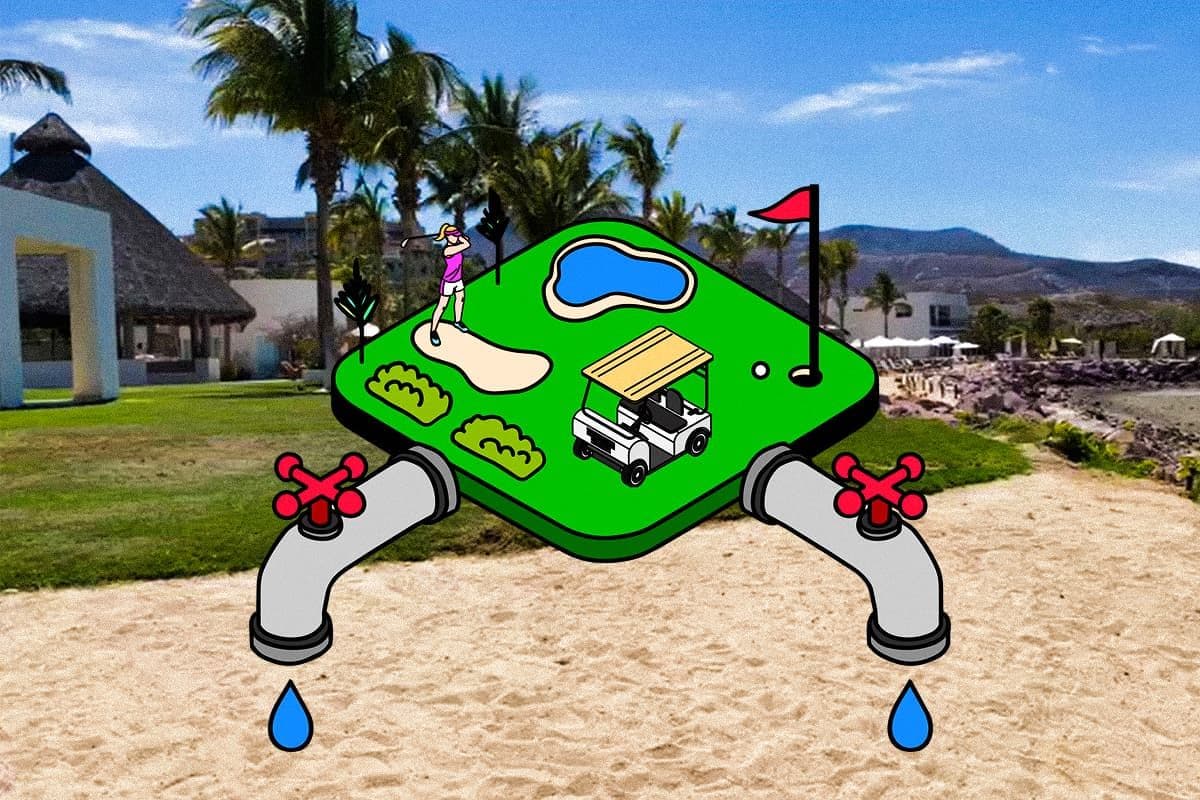
In the Miramar neighborhood, located in Los Cabos, Baja California Sur, water arrives every 30 days. In some cases, delivery may take up to six months. Very close to the Miramar neighborhood there are four golf courses and two large real estate developments. The daily irrigation of an 18-hole golf course alone equals the full household consumption of around 8,000 people, according to researchers.
While a single golf course absorbs 2.3 million liters of water per day, Delia Benítez Díaz waits those days to fill her house's water tank. He has lived in the colony for three years and is part of the families that receive their supply through pipes.
When the water arrives, it must be stored and made to last until the next distribution. And when it's not enough, the family has to buy more. “We are 150 families and a pipe is coming on Monday, Wednesday and Friday. Right now, sometimes one comes on a Saturday, but sometimes it comes and sometimes it doesn't,” she says.
Maricela says that the problem existed before she arrived in this popular colony. Their neighbors have been following the same routine for years: they rely on pipes, even when they pay their water bill. “Up to 500 or 800 pesos a week they charge us for a pipe, we make the effort, but there are neighbors who don't have the same possibilities.”
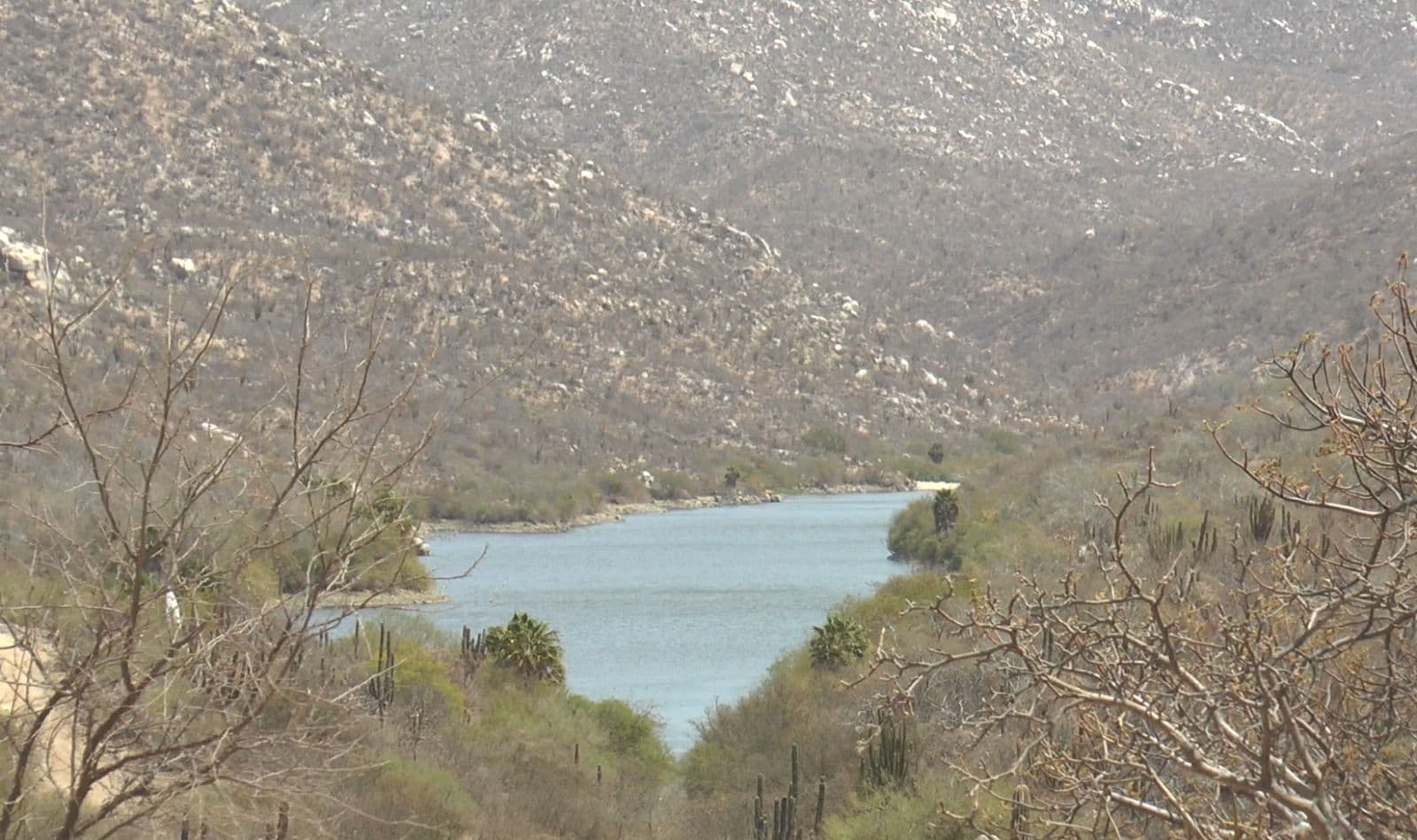
What happens in this colony is not isolated, it is part of the conditions of the territory where it is located. Baja California Sur is an arid entity, with little rainfall and no permanent rivers, so it depends mainly on groundwater for its supply.
The weight of concessions
The National Water Program 2026-2030 places Hydrological-Administrative Region I, corresponding to the Baja California Peninsula, under a water pressure of 89.7%, classified as high. The region has 4,968.2 million cubic meters of renewable water per year, but it has 4,456.6 million concessions.
The availability of renewable water per capita has a narrow margin, one of the largest in the region, with 961.2 cubic meters per inhabitant per year, compared to 3,566.2 cubic meters nationwide.
Tatiana Davis Monzón, director of the State Water Commission, explains that the natural conditions of Baja California Sur play a direct role in this situation.
“Baja California Sur is one of the states with the highest water stress in the country because it is located in a desert strip, it rains little and has no rivers, so its only source of supply is groundwater, hence the problem of overexploitation, because the population is growing and economic development also demands more water resources.”
According to experts, Baja California Sur already has a problem of overexploitation of groundwater, since more liquid is extracted than it can naturally infiltrate. Of the 39 aquifers delimited in Baja California Sur, 22 are in a condition of overexploitation, according to data from the National Water Commission.
María Z. Flores López, academic director of the career in management and water sciences at the Autonomous University of BCS, says that in the case of La Paz the deficit is 13 million cubic meters, while the aquifers of San José del Cabo and Cabo San Lucas are in a borderline situation.
“In the case of the La Paz aquifer, the deficit is -13 million cubic meters, a critical figure that compromises the sustainability of supply in the state capital. But this is not the only worrying case; the aquifers of San José del Cabo and Cabo San Lucas also face a borderline situation, with levels of extraction that far exceed the recharge capacity,” says the specialist.
Growth is not only reflected in hotels and large developments, it can also be measured in authorized construction licenses in La Paz.
Gabriela Ramírez is the coordinator of the Territorio de Cómo Vamos La Paz program, an organization that systematized information obtained through transparency from the Directorate of Integral City Management to know what is being built, where and in what quantity. The data reveals that between 2018 and 2025, more than 6 thousand construction licenses were registered.
More than 80% correspond to new construction with authorized use of housing, apartments or housing. The sharpest jump occurred in 2025. While just over 3,000 licenses were registered between January 2019 and December 2024, more than 2,700 were authorized during 2025 alone.
For Ramírez, the data also requires us to review what happens to these buildings once they are built. The organization detected that in the Centro area there are apartments authorized as housing that, due to their characteristics and operation, could be operating as a lodging, such as Airbnb, so it proposes to review the difference between authorized use and actual use.
Most of the new licenses are located in the Centro area, but also in El Esterito, El Manglito and El Centenario.
In a state where 22 of its 39 aquifers are overexploited, each new development represents a demand that must be considered when talking about the availability and distribution of water.
The water footprint of tourism
Data from the Public Water Rights Registry allow us to observe part of this growth from authorized volumes. An analysis of the public database of the REPDA corresponding to Baja California Sur identified 507 titles under the category of Services, which together cover 17.7 million cubic meters per year.
Of these titles, 127 correspond to development companies, hotel chains, residential complexes and private trusts identified in the analysis. Together, these securities represent 13.4 million cubic meters annually.
In other words, 75.7% of the volume granted under the use of Services included in the analyzed database is concentrated on those users linked to tourism, real estate and service activities.
The owners include GRE Hansa Baja Investments, GFR Business Real Estate, Comercializadora Vista Ballena, Promociones Turística AV, Banco J.P. Morgan in its trust division and Constructora Los Arcos del Cabo, among others.
The volumes also show important differences between dealers. GRE Hansa Baja Investments has 4.5 million cubic meters concessions per year; GFR Inmobiliaria de Negocios has just over 3 million and Comercializadora Vista Ballena, 1.6 million.
A tourist can consume almost four times more water than an inhabitant
María Z. Flores López estimates that an inhabitant of Baja California Sur uses around 120 liters of water a day for personal hygiene, household cleaning and food preparation. In contrast, a tourist staying in Los Cabos can consume up to 450 liters per day. “That is, almost four times more,” he says.
The specialist relates this increased consumption to specific activities and services within tourist establishments, including the filling and maintenance of swimming pools, the use of spas and hot tubs, high-pressure showers and the frequent washing of towels and bed linen. Added to this is the irrigation of green areas and the water used in the rooms themselves.
“Pools must be maintained with constantly clean water, spas require large volumes to operate, and excessive use in rooms creates a very high demand,” he says.
A golf course may require 2.3 million liters per day
In Los Cabos, tourism consumption is also related to an infrastructure that has been incorporated into the region's development model since the 1990s, golf courses.
Linked to hotels, residences and developments aimed at the high purchasing power market, these spaces require large amounts of water for maintenance.
A study published in the Journal of Land Use Science by Juan Carlos Graciano, Manuel Ángeles and Alba E. Gámez analyzed the effects of tourism growth in Los Cabos on land and water use.
The researchers estimated that an 18-hole golf course requires an average of 2,300 cubic meters of water per day. That's 2.3 million liters a day. To measure that volume, the authors compared it with the domestic consumption of around 8,000 people.
Consumption of this magnitude also raises a question about the origin of the water used to maintain these spaces. However, María Z. Flores López points out that there is a lack of information on the origin of the water used by these complexes, since, according to the researcher, there is no official record that allows us to know precisely which fields use treated wastewater and which use drinking water.
In addition, he argues that the only way to ensure that drinking water is not used is to require that developments have their own infrastructure to treat or desalinate water.
“Regulation is insufficient and, in many cases, non-existent. There are no clear regulations that require tourist developments to report the origin of the water they use to maintain their golf courses. This leaves open the possibility that they continue to use drinking water without restrictions,” says the specialist.
The water future of Baja California Sur will depend on knowing precisely who uses it, how much they consume, where they get it from and what limits exist to continue increasing demand.


Comentarios (0)