
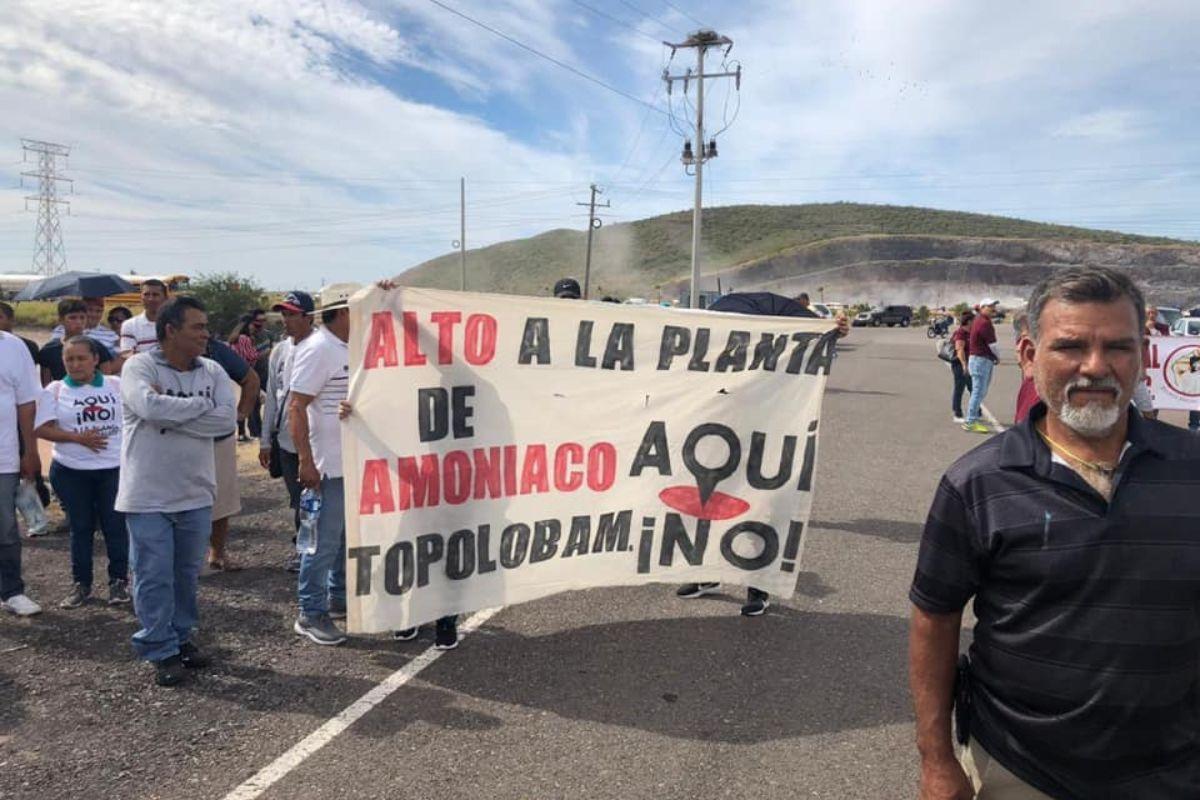
The mapahui, made up of the estuary and a hill in Ohuira Bay, Sinaloa, is a sacred place for the enjoyment of the Mayo-Yoreme community. For generations, they fished, cooked and ate there under the mangroves.
Between 2014 and 2015, they saw part of that space being dismantled and filled in, according to the testimony of Claudia Quintero, an indigenous woman from the Mayo-Yoreme community. They didn't know who was doing it or what it was for, until in 2017 they found out that the company Gas and Petrochemistry of the West (GPO) intended to build the largest ammonia plant in Latin America there.
In 2014, the Ministry of Environment and Natural Resources (Semarnat) authorized the ammonia plant project, however, due to various legal remedies filed by the Mayo-Yoreme community, the works were delayed and, by the end of April, the plant had an overall progress of 88%.
“According to the current planning of the project, the start of operations is scheduled for the end of the first half of 2027, once the remaining stages of construction, technical tests and the gradual start-up of systems have been completed, in accordance with applicable safety and operating standards,” answered Proman GPO, the group of companies that GPO is part of, to the questionnaire sent by Causa Natura Media via email.
Despite this progress, members of the community say they will seek to stop the operation of the plant, due to the risk it represents for the environment and for their culture.
“If it continues to be built, we will continue to fight so that the operation of the plant stops completely and completely. We have already stopped its construction for 10 years and who tells us that we cannot stop its operation as well,” said Quintero.
The Ramsar site versus the industry
The plant is under construction on the Santa María-Topolobampo-Ohuira lagoon system, a Ramsar site of international importance for migratory birds and local fishing. This system has been under threat from gas projects since the El Encino-Topolobampo gas pipeline was built to power different projects, including the ammonia plant, as explained by Claudia Campero, climate justice coordinator at the organization Climate Connections.
The authorization granted by Semarnat includes the construction and operation of a plant for the production of anhydrous ammonia with a capacity of 2,200 tons per day, a gas pipeline of 1,830 meters in length; and a pipeline for the transport of ammonia of 9,000 meters in length.
In addition, it includes a desalination plant that will discharge about 812 cubic meters per hour to the bay; a wastewater plant; and seawater pipeline and wastewater discharge pipes. All in a plot of 202.57 hectares.
“The Ramsar designation... by itself does not imply an automatic prohibition of productive activities, but rather the obligation to ensure sustainable use in accordance with the characteristics of the site... It was concluded that the project is compatible with the identified ecological values, to the extent that the committed prevention, mitigation, compensation and monitoring measures are implemented,” said Proman GPO.
During 2025, the construction of the plant progressed and faced strong questioning from the Mayo-Yoreme indigenous communities in the region, who say that indigenous consultation on the project was irregular, as the area to be consulted expanded and thus obtained support for other communities, according to Quintero's testimony.
“Under that pretext, construction was promoted, but the Mayo-Yoreme people are still not giving their consent,” Campero said.
In response to these statements, Proman GPO stated that, “it has always acted in strict accordance with the Mexican legal framework and international standards on indigenous rights... the project was preceded by a formal process of indigenous consultation, coordinated and conducted by competent federal authorities, in accordance with current regulations, guaranteeing timely information, participation and spaces for deliberation”, and that, “beyond legal compliance, the company maintains permanent channels of good faith dialogue through its Link Community, in coordination with traditional authorities and different community groups”.
Compensation measures
During the environmental impact assessment process, the company stated that mangroves would not be removed, pruned or transplanted in the installation area, so it would not violate Article 60 TER of the General Wildlife Law, which contradicts what was observed by the Mayo-Yoreme people.
In addition, in accordance with the Official Mexican Standard NOM-022-SEMARNAT-2003, all productive activity must be located 100 meters from the vegetation of coastal wetlands. However, Semarnat authorized an exception to this measure and compensation that includes the reforestation of mangroves in an area of 21,000 square meters.
“It's like telling someone to have their leg amputated and that the remedy plan is to put prostheses on them. But it's something they've already destroyed. They are invading my being, my body by invading my territory, because I am the territory. Because the territory lives in me, I live in the territory,” said Quintero.
When questioned, the company promoting the project maintained that there was no vegetation on the site before its installation.
“The technical-legal analysis of the site identified that the surface is located on a property previously transformed by existing infrastructure, with mostly zero vegetation cover or non-forest vegetation... In a specific way, it is specified that, during the work of the project, no mangrove was removed... At the end of 2013, personnel from Semarnat and Profepa went to the site to verify the situation of the mangrove in the specific area of the project, confirming that there was no presence of this type of vegetation inside the property,” Proman replied.
Campero reported that within the analysis carried out by the authority, external impacts of the project are not considered, since both the company and the authority have only evaluated the impact on the site where it will be installed, and not on the surroundings of the project, nor the sociocultural impacts.
“By affecting the bay, the indigenous worldview is also affected, which has a very strong connection with this site in an integral way,” Campero said.
The search for support in Germany
Over the past 10 years, the community has undertaken various strategies, including community meetings, campaigns to disseminate information about the project, and the application of amparos. The most recent strategy was to travel to Germany, since the company promoting the project is mainly financed by the German bank KFW-Ipex.
“The total investment of the project amounts to approximately 1.8 billion dollars. The project has a structured international financing scheme, with the participation of top-tier financial institutions and a banking union headed by KfW Development Bank, supported by the German Government's export guarantee system,” confirmed Proman GPO.
On March 24, 2026, a delegation from the collective in defense of the territory and the environment ¡Aquí No! submitted a formal complaint to the KfW-IPEX bank, in an attempt to make visible the deficiencies and risks of the project that they identify in the country that finances it.
“The German bank is public, so there is government support for the project because the money ultimately ends up being public,” Campero said.
What they expect from this whole strategy is for the bank to divest from the project, considering it unfeasible for the bay and the people who live there.
“The right thing to do would be to divest, and if the flow of money stops, that would put the GPO company in a lot of trouble to continue the project,” Campero said.
Expectations for the future
Topolobampo is an industrial and tourist port in Sinaloa where not only is there interest in building an ammonia plant, but recently they were also looking to install a fossil gas export terminal powered by Sempra Infrastructure, which canceled the project in March 2026.
“The most notable victory right now is definitely the cancellation of Vista Pacifico. And if Vista Pacifico fell, Saguaro, Amigo LNG and the ammonia plant can easily fall, and that's what we're working on,” Campero said.
Also in Ohuira Bay, the Mexinol plant is under construction, which will produce methanol, will require a supply of fossil gas and which, according to Rubén Rocha, governor of Sinaloa, will be the largest in the world.
“In the same space there were three projects. You already got rid of one (Pacific View), but you have two (GPO Plant and Mexinol) that are strong threats to life and are totally related to an interest in placing the remaining gas in the United States, giving it added value and selling it,” Campero explained.
Quintero points out that the amparos they have filed have reached the Supreme Court of Justice, exhausting all national instances, so they now wait for the cases to be admitted by the Inter-American Court of Human Rights, an international court responsible for protecting fundamental rights in the American continent, and they are waiting for this to be admitted.


Comentarios (0)