
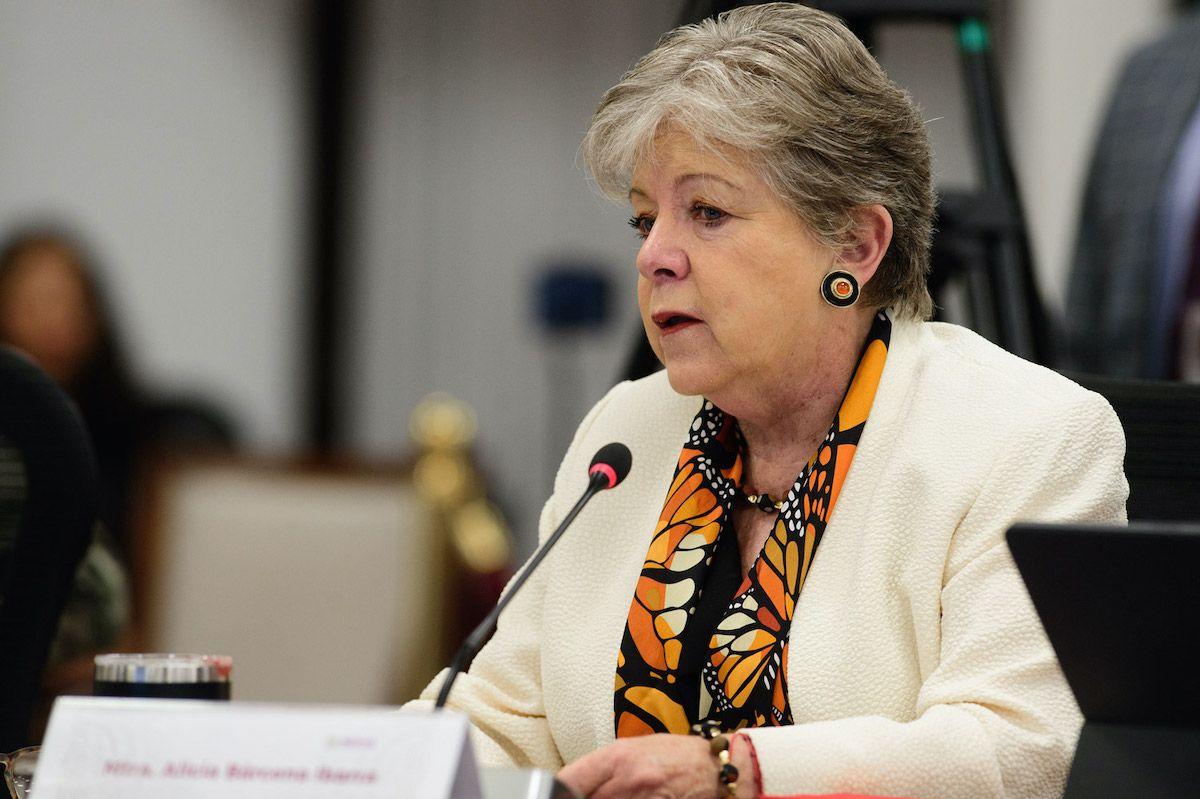
The head of the Ministry of Environment and Natural Resources (Semarnat), Alicia Bárcena, expressed concern about the Saguaro Energía gas project in Sonora.
“We are very concerned because we really think that the peninsula and that the Gulf of California are the world's great aquarium. This is how Cousteau described it. It's not our invention, it's just that that's where the greatest marine diversity in the world occurs,” said Bárcena during her participation in the National Conference on Environmentalism in Mexico held in the Chamber of Deputies on April 9.
The megaproject envisages an 800-kilometer gas pipeline to bring gas from Texas to Sonora, a liquefaction terminal in Puerto Libertad and a fleet of methane vessels.
President Claudia Sheinbaum, although she has recognized the biodiversity of the area, has insisted that the work has no irregularities and that it is being reviewed by various agencies, including Semarnat. Now Bárcena's statements give an account of the positions within the cabinet.
“Having a liquefied gas project that will cross the entire territory, will go down to Puerto Peñasco (177 km from Puerto Libertad) and will cross the peninsula, yes, to us, the truth, if it causes us enormous concern and that's why we think that citizen participation is very important,” said Bárcena.
Animal Político reported that the company behind the Mexico Pacific megaproject is facing 10 lawsuits against this infrastructure.
“What's in the best interest of the country? A project that will last 15 years, at most liquid natural gas or a project that will last a lifetime, which is to protect the Gulf of California. These are today's dilemmas for our secretariat,” said the secretary.
Reforestation of 200,000 hectares
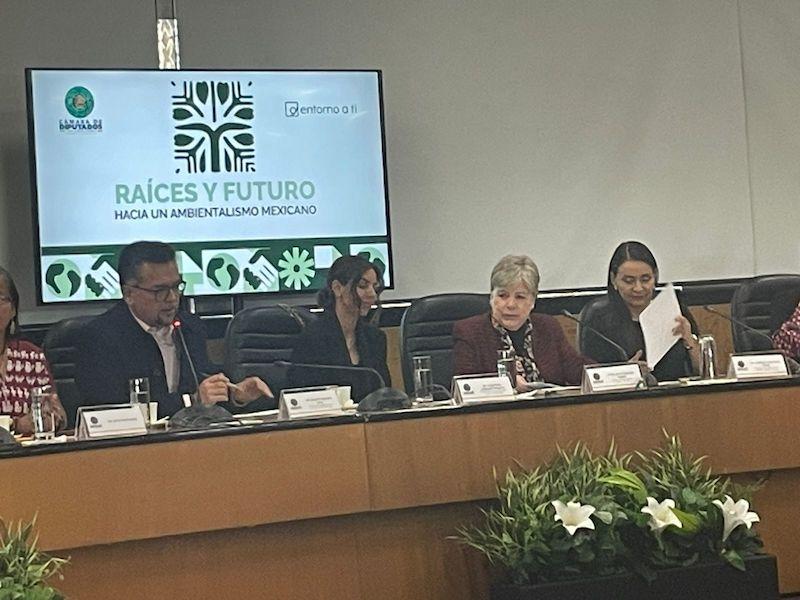
The event was convened by Morena's deputy Joaquín Zebadúa. Photo: Juan García.
Regarding forests, Bárcena reiterated in the Chamber of Deputies the federal government's commitment to reforest 200,000 hectares of forests.
“We are looking to reforest 200,000 hectares of forest. We do want to do that next year and 18,000 hectares of mangroves, because they really are very important,” said the secretary.
During this event, the topic of forests was highlighted by deputies who emphasized that forests in Mexico capture 180 million tons of CO2 per year. Mexico is positioned as the ninth country in the world with the highest absorption.
“And from humanistic, ecological and humanistic environmental policy, which is where what we are proposing with Dr. Claudia Sheinbaum really starts, what we are talking about is precisely the first, I would say, of reversing the deterioration of 5% of the territory,” said Bárcena. This is the equivalent of 9.5 million hectares.
If Mexico's contributions have a global preponderance, so are its regressions. In her speech, the official deputy Alejandra Chedraui Peralta said that in 2024 the loss of primary forest in the country amounted to 93 thousand 91 hectares.
“Entering among the 10 countries with the highest forest loss in the world. 60% of the damages were due to forest fires, with more than 8,000 incidents recorded in the country,” said Chedraui.
Bárcena took the opportunity to call on the deputies to promote a national forest inventory.
“It has been stopped and we can't, the country needs the national forest inventory, which was of course created with Enrique Beltrán in the late 1950s and early 1960s. If we could give continuity to this national inventory, we would be clear about what has happened to forests in recent decades,” said Bárcena.
Protecting hectares
The federal government remains firm in its interest to increase the number of protected hectares from 100 million to 153 million hectares in compliance with the Kunming-Montreal Global Biodiversity Framework, which aims to protect 30% of the lands and seas by 2030.
Although various groups have emphasized that the increase in protected natural areas in the country has not been accompanied by budgetary increases, Bárcena emphasized that protecting more areas can be done under different regimes.
“It can be protected under different regimes, that's what we're proposing in this new law of ecological balance. Not all of them can be biosphere reserves, as was Sian Ka'an or El Vizcaíno at the time or even the monarch butterfly. Perhaps they can be voluntary conservation areas, where sometimes private individuals say: 'I want to conserve my land and I want to join it'. Or also biological corridors that can be incorporated,” said the official.


Comentarios (0)