
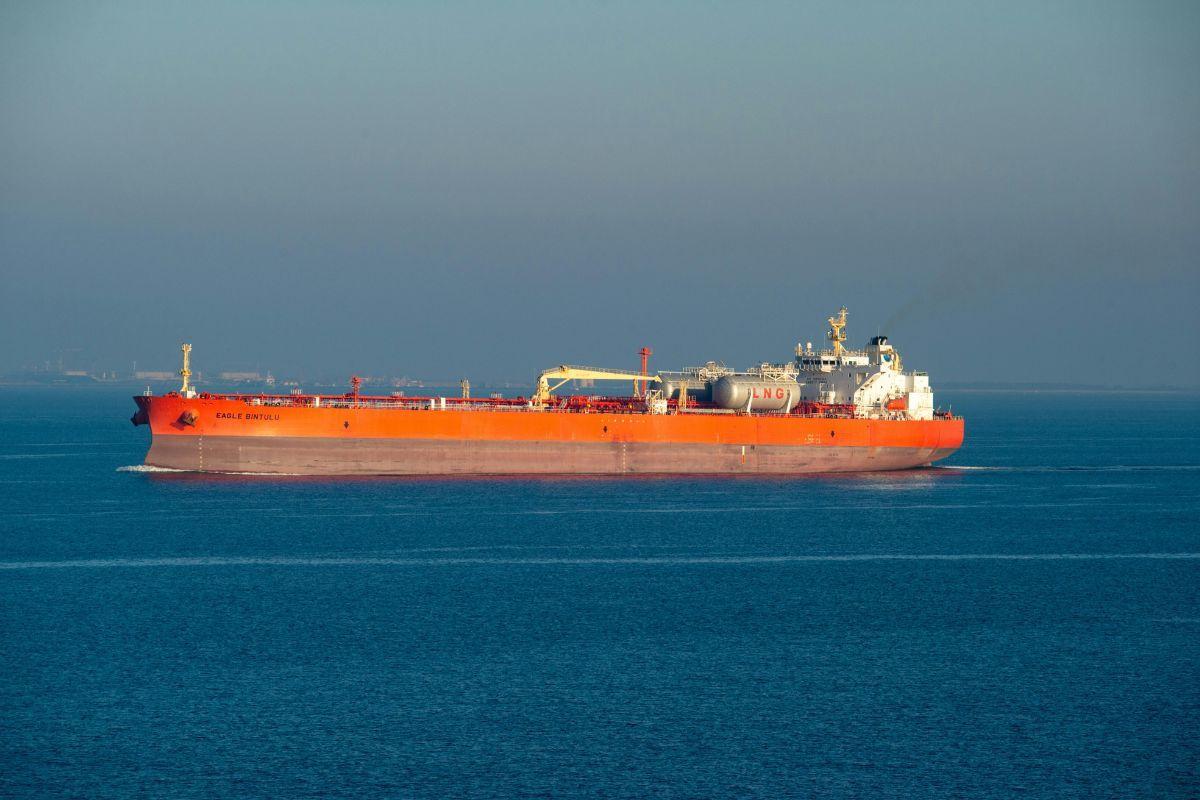
A gas pipeline, a fossil gas liquefaction plant and a floating platform are threatening to be installed off the coast of Guaymas, Sonora, in northwestern Mexico to export gas to Asia in methane tankers across the Gulf of California.
“It is very similar to Saguaro, it has some differences, for example, the characteristic of being a floating plant and that it is a smaller volume of gas that is intended to be liquefied, but after all it is a project that has the same logic of removing the gas surplus that the United States has through Mexico,” explained Claudia Campero, climate justice coordinator at the organization Climate Connections.
For the construction and operation of the project, the company Amigo LNG needs authorization from the Ministry of Environment and Natural Resources (Semarnat), however, Cecilia García, a member of Es Fossil Gas, a campaign that seeks to disseminate information about gas projects, reported that during this process the right to access information and participation of local communities has been violated.
Without information there is no participation
The Amigo LNG Liquefaction and Storage Terminal project entered the Environmental Impact Assessment to obtain authorization from Semarnat in November 2025. At that time, Climate Connections requested that the Environmental Impact Statement (MIA), which is the document that evaluates potential damages and preventive measures for the project, be made public, but they were denied the document.
Due to several requests received and after being postponed several times, on February 12, 2026, the Security, Energy and Environment Agency (ASEA), a decentralized body of Semarnat responsible for regulating and supervising projects in the hydrocarbon sector, announced the opening of public consultation for this project.
At that time, the authority made the MIA public and provided a period of 20 days for the population to review the document and issue proposals for prevention and mitigation measures, as well as comments on the project via email.
“A very limited space was opened to participate in the public consultation and with a very small format. It was important to participate to show our disagreement, but we want to emphasize that this format of participation is insufficient and is not a meaningful participation,” said Campero.
Both García and Campero agree that the population of Guaymas has had no access to more information about the project than that presented in the MIA, which is also incomplete.
“In the MIA there is not enough information because everything is covered up. There are entire pages that cannot be read, which contravenes our right to participate and our right to access information. This is the first violation of rights with this project,” Garcia said.
He added that it also violates the Escazú Agreement, an international treaty to which Mexico is a signatory, through which it undertakes to guarantee access to information and participation in projects that may violate environmental human rights.
A vital piece of information that has not been provided is the location where the project would be installed and where the gas pipeline would pass, to analyze its proximity to the port and the population.
Currently, the project is still under evaluation by ASEA and at any time it could issue a resolution authorizing it—with or without conditions—that rejects it or even fails to resolve it for a long time.
“From the perspective of the authority, the easiest thing is not to grant authorization because that way the company has no tools to claim anything, so it would be great if that authorization does not prosper. There is no way to do this project, there is no way for it to be a good project, and it should not be carried out,” Campero said.
Main irregularities and impacts
The project aims to receive excess gas from the state of Texas, United States to convert it to a liquid state at the Guaymas plant, reduce its volume, make it more manipulable and put it in methane tankers.
“Gas has consequences throughout its life cycle, because gas generates damage from its extraction, which is mainly fracking; in its processing, when it burns it is highly polluting and causes harm to health; on its journey on methane tankers it would have many consequences for the general ecosystem of the Gulf of California; and when it reaches Asia it generates pollution because the rest of the gas burns there, in addition to the leaks that may exist throughout this chain,” Campero explained.
Collaterally, the project would have an impact on economic activities related to biodiversity, such as coastal fishing and tourism, which support many families in the Gulf of California, according to Garcia.
The biggest irregularity detected in the MIA of the project is that it is not clear what infrastructure it will require to transport gas from Texas to Mexico.
The document says that an existing gas pipeline will be used that is located through Sásabe, a border community in Sonora that borders Arizona, United States. Meanwhile, Claudia Sheinbaum, president of Mexico, stated during a press conference that she would use the gas pipeline that enters through the municipality of Naco, Sonora and that reaches Hermosillo, so an extension would be required to reach Guaymas.
“The accounts of gas pipeline capacity with the gas demand that already exists in the region call into question whether this is feasible. The gas pipeline the president is talking about is very small, and the Sásabe pipeline already has several demands for use. Even adding the two gas pipelines together, it doesn't meet the volume required by the plant,” Campero explained.
This could mean the possibility of building a new gas pipeline with a larger diameter, which would represent a greater environmental impact and an inconsistency, since it is assumed that the federal government is trying to eliminate fossil fuels, Campero added.
According to García, these projects only respond to the need of the United States to commercialize its surplus gas, while Mexico lays the territory to process it and is left with the impacts.
“The United States seeks to sell its gas to other countries using Mexican territory, impacting communities, ecosystems and putting its own supply at risk, because the gas pipelines through which they want to pass the gas are the ones that keep northwestern Mexico with electricity. It's a conflict by all accounts, there's no benefit,” Garcia said.
“For us it is very important to highlight that this is not a project to which we have to say what the alternatives are. Why? Because this project does not respond to a local need, it responds to an outside need and brings local harm. The energy that would be generated with that gas would be generated on the other side of the world,” Campero added.
The future of gas projects
Like Amigo LNG, there are other projects in northwestern Mexico, such as Saguaro in Puerto Libertad, Sonora, and Vista Pacifico in Topolobampo, Sinaloa, that were seeking authorizations to be installed on the shores of the Gulf of California with the same objective: to liquefy gas and bring it to Asia in ships.
In the case of Vista Pacifico, the company released a statement in March 2026 announcing the cancellation of the project, however, the organizations are waiting for Semarnat to issue a document confirming this to be official.
While Saguaro is currently a very unstable project, according to Campero, since it does not yet have the investment it needs to operate and the company has changed its owner and management.
In the area, there is also another threat to communities and biodiversity: the Western Gas and Petrochemistry (GPO) ammonia plant, a megaproject that has been seeking to be installed in Ohuira Bay, Sinaloa, for 10 years to export this toxic gas through ships.
During 2025, construction progressed and has been strongly questioned by the Mayo Yoreme indigenous community in the region, who argue that there were also irregularities during the citizen consultation process, and are seeking its cancellation.


Comentarios (0)