
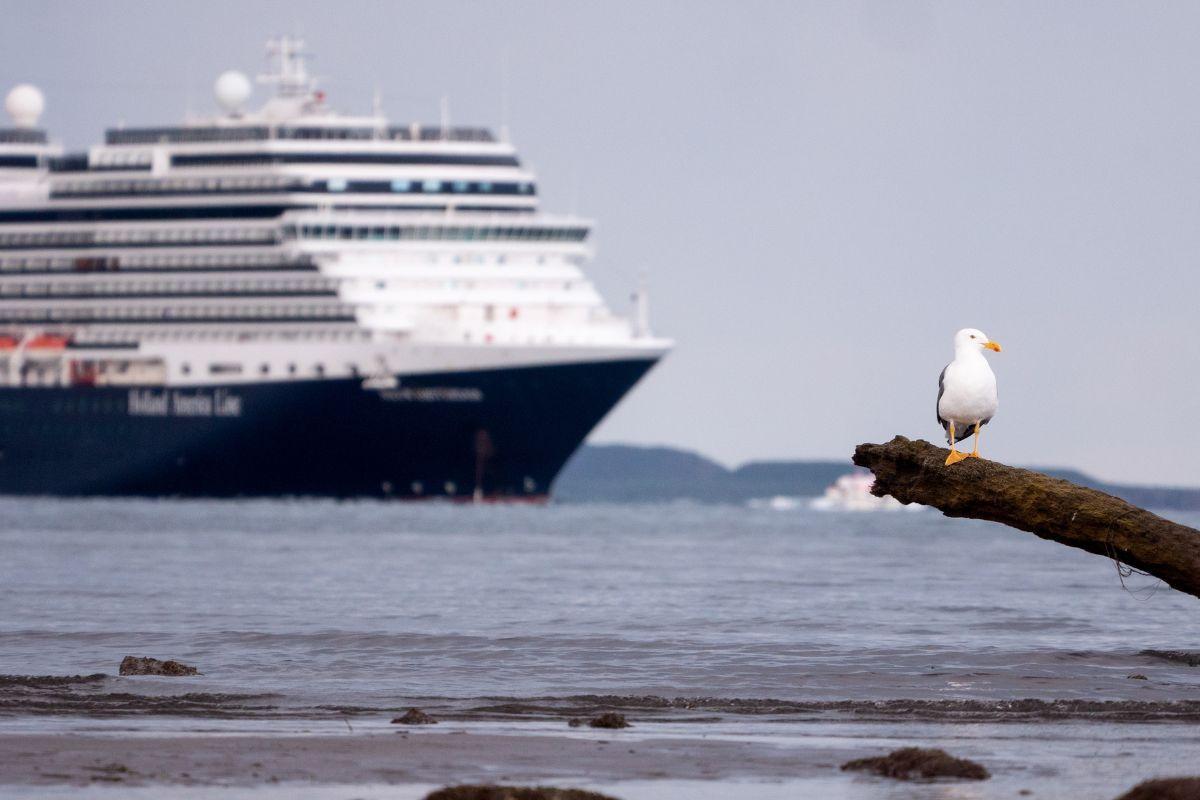
“Luxury is nature”, is the slogan used by tourist service providers who work in the Loreto Bay National Park, in the north of Baja California Sur, one of the most important places for the feeding, reproduction and rearing of blue whales, and a refuge for other marine mammals such as humpback whales, dolphins, orcas and sea lions.
Now, that unique site, on which 80% of the community that benefits from ecotourism depends, is at risk in the face of a federal decree that formally converts it into an offshore and cabotage port.
Among the various strategies that have been undertaken, a court has just rescinded the decree, while government authorities insist that it is an administrative procedure that does not involve changes in the port.
The amparo rescinded by the decree
The organization México Unido por sus Playas promoted an amparo against the decree in which the Second District Judge, in the incidental file 692/2026, granted him a provisional suspension.
“Amparo as a constitutional action is promoted against the decree that was issued without taking into consideration the possible negative impacts on the environment and not having the best scientific evidence on this, since port development cannot be conceived in isolation in accordance with international treaties that exist in environmental matters,” said Rafael Vázquez, legal representative of Mexico United for its Beaches.
The suspension has the consequence of suspending the legal consequences of the decree, such as the impossibility of granting permits or concessions of any kind to provide port services to the Secretariat of the Navy and the General Directorate of Ports.
“The final result [of this protection] would be to declare the decree illegality because it was issued violating fundamental rights of society linked to the environment, such as the human right to live in a healthy and adequate environment, and the right to public participation in decisions affecting environmentally important ecosystems,” Vázquez explained.
Nature tourism or mass tourism?
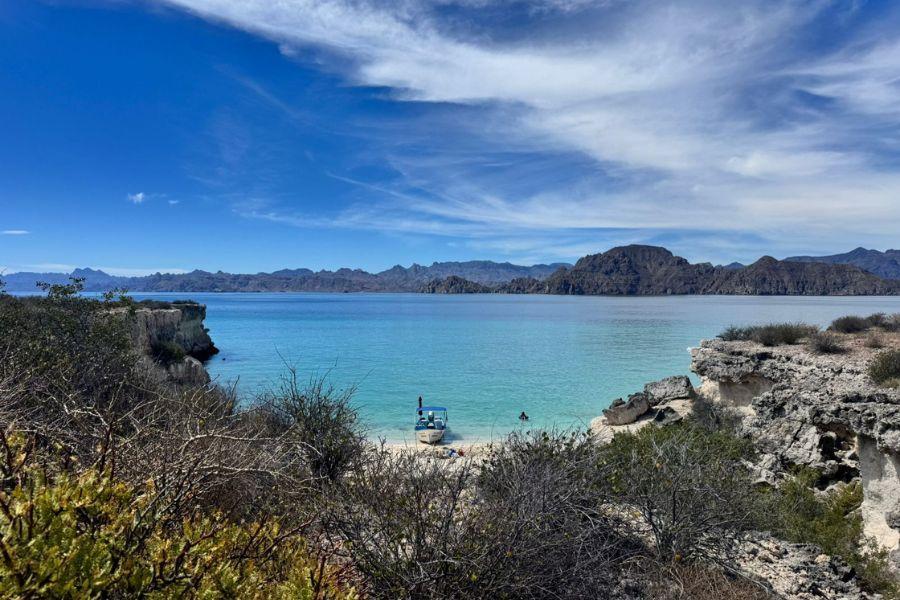 Loreto Bay National Park. Source: Noé Gaona.
In 2003, cruise ships of up to 400 people began to arrive at the port of Loreto, whose number and size were increasing.
“This activity was irregular because cruise ships are not allowed to arrive under the regulations of the marine park,” said Noé Gaona, president of the Loreto Blue Whale Group Cooperative Union (GBAL).
At the time, the Marine Park Advisory Council, made up of representatives from various sectors whose function is to issue opinions and recommendations on issues affecting the ANP, requested that cruise ships not be allowed to arrive during whale season, according to Gaona, and although this agreement was respected for some years, since 2025 cruise ships began to arrive again during the whale season.
“In the last three or four years, cruise ships began to concentrate during the whale season and increased dramatically,” said Fernando Velazco, a member of the SoundLab project that documents the underwater sound of the bay. “There was already a strong push to increase this type of maritime traffic.”
The Integral Port Administration of Baja California Sur (API-BCS), a state company responsible for managing and operating the port infrastructure, said that the 2026 season sees the arrival of 17 cruise ships to Loreto from California, United States.
“On average, 2,200 cruise passengers descend, with the largest of 3,035 passengers being the Emerald Princess. Not all cruise ships arrive at their maximum capacity and of these cruise passengers disembark approximately more than 80%. Of the 8 cruise ships that arrived in the 2026 season (January to March), around 17,608 cruise passengers disembarked,” the API-BCS social communication department responded to Causa Natura Media.
Tensions regarding the presence of cruise ships in the marine park increased when the decree formalizing the port of Loreto as a deep-sea and cabotage port was published on April 10.
Loretanos and Loretanos are unhappy with this decree, since they point out that the decision did not take into account the community that, for the most part, lives on nature tourism and fishing. There were no consultations with cooperatives, tourism providers or representatives.
“This decree confirms not only this tendency to increase the presence of cruise ships, but also of maritime traffic in general. Loreto becomes part of this industrialization plan for the Gulf of California, which includes increasing maritime traffic, although there is no protocol for mitigating underwater noise either in the Gulf, in the Pacific, or in the country,” said Velazco.
They also point out that the decree on offshore ports and cabotage contrasts with the 1996 decree declaring Loreto Bay as a Protected Natural Area with the character of a National Marine Park, since maritime traffic has consequences such as air and water pollution; noise that interferes with the communication and feeding of marine species; increases the risk of collisions with whales —this being their greatest cause of unnatural death—; and alters their only known breeding site in the area.
Even the ANP Management Program pointed out since 2021 that cruise ships, mega-cruises, yachts and other types of vessels are a threat to the proper development of biological processes in whales during the winter months, especially due to the presence of calves.
“The noise caused by the transit of vessels greater than 12 meters in length close to the aggregation, feeding, reproduction and breeding sites of marine mammals, such as the blue whale, causes them to change their behavior, moving away from these vital sites for their development, to where the nutritional needs of the species are not necessarily met, which results in a decrease in the energy content necessary to carry out migrations and the maintenance of energy for breastfeeding and reproduction,” the document states.
Velazco explained that there is also a specific federal instrument for the protection of the species. “The Action Program for the Conservation of the Species, published in 2019, specifically states that it is recommended to avoid cruises in Loreto during whale season. This is a guideline that the Mexican government itself has established to take care of the species.”
“The main factor in anthropogenic death of blue whales are collisions with large vessels,” Velazco warned. “Blue whales and fin whales are particularly susceptible to the noise of large boats.”
In addition, Gaona points out that there has been displacement of the local community when cruise ships arrive, because they make almost exclusive use of the port, and the rest of the users are relocated to a secondary pier.
They also fear that public services such as drinking water, drainage and waste collection and disposal will be saturated with the mass arrival of passengers, in addition to possible renovations or extensions to the port.
However, API-BCS clarified that the decree is an administrative and operational act that allows vessels with international navigation to carry out arrival and dispatch procedures in Loreto, without depending on another authorized port.
“It should be noted that the determination of a high-altitude port does not, in and of itself, involve the construction of industrial infrastructure, cargo terminals or port expansions. It is primarily an administrative authorization for international maritime operations. Therefore, the term Altitude Port must be differentiated from physical dimensions such as megaports and other operational names such as cargo port, commercial port, etc.”, clarified API-BCS.
He added that there is no consideration in expanding the port infrastructure of the port of Loreto.
Repeal requirement
 Demonstrators outside the extraordinary meeting of the Bay of Loreto National Park Advisory Council, on May 7, 2026. Source: Keep Loreto Magical.
Faced with the decree, organizations such as the one represented by Gaona, undertook public meetings, demonstrations, and the collection of physical signatures to demand the repeal of the decree.
“In general, the population of Loreto is very united in the sense that they don't want the decree. What we want is its repeal. We want there to be real consultation with the community when considering these types of projects. We don't want imposed decisions. We are not against progress, but we want transparency in the decisions that are made,” Gaona said.
On May 7, at an extraordinary meeting, the Marine Park Advisory Council unanimously rejected the decree. The meeting was not attended by the main authorities such as the Secretariat of the Navy or the Government of the state of Baja California Sur.


Comentarios (0)