
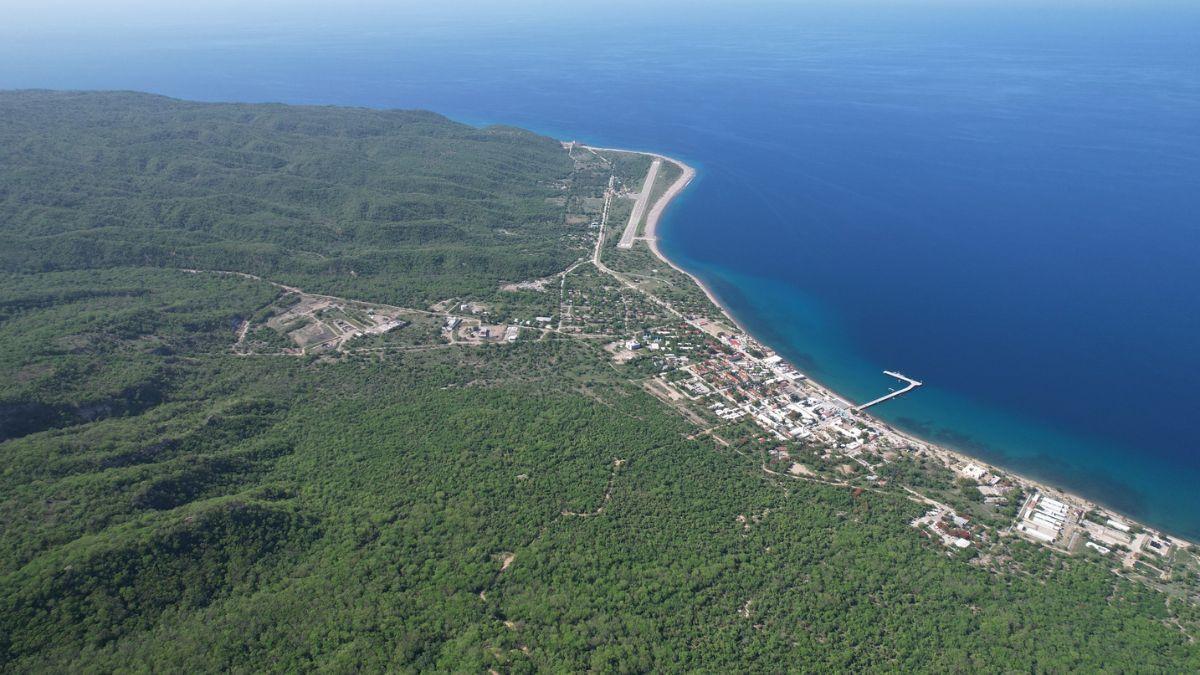
The Las Marías Blue Cup 2025 tournament held in the archipelago of Islas Marías, Nayarit, under the capture and release modality, was presented as a “100% sustainable” event supported by the capture and release of weevils and the use of marking tags. However, specialists in marine ecology point out that, even when fish are returned to the sea, this practice does not guarantee their survival nor does it represent a necessarily minor impact, due to the physical damage and stress associated with the catch.
The head of the coastal and reef fish ecology laboratory at the Autonomous University of Baja California Sur (UABCS), Emelio Barjau, explained that the catch causes significant physiological alterations.
“There are immediate deaths, but there are also deaths that can last from a week to ten days and that is not quantified in tournaments,” he said. He added that, after release, fish can be left in a state of extreme vulnerability. “When they recover slowly, they can easily be prey to other organisms and that event is not counted either,” he said.
The tournament in Puerto Balleto, in Isla María Madre, brought together up to 55 boats with five fishermen per team between December 4 and 7. It had a maximum of 55 boats that had to document each capture using photographs and videos showing the species, the state of the fish, the placement of the tag and the release process, as well as radio and GPS reports to validate the location.
Reviews of studies with satellite labels on marlins and sailfish have found post-release mortalities ranging from values close to 0 to above 30%, depending on the species, fishing gear and environmental conditions, according to a synthesis published in the journal Fisheries Research on weevils, marlins, sailfish, and others.
In the specific case of Atlantic white marlin, a study with emerging satellite tags led by researchers from NOAA and the University of Maryland estimated that about a fifth of the specimens released died in the following days, and that this proportion could approach a third if some tags that stopped transmitting very early are considered probable deaths.
The tournament regulations established the capture of blue, black and striped marlin, while tuna was excluded because it was banned. In June 2025, the Ministry of Agriculture and the National Aquaculture and Fisheries Commission formalized in the Official Gazette a temporary ban on commercial tuna fishing in the Eastern Pacific, including yellowfin tuna and bigeye, with a general closing period from July 29 to October 8, 2025.
Although catch and release is often promoted as a low-impact practice, UABCS researchers explain that the actual survival of fish exposed to this technique is variable and depends on factors such as the intensity of the fight, the time spent out of water, handling, accumulated stress and the level of exhaustion.
This subsequent vulnerability is greater in large, migratory fish such as marlins, whose metabolism is affected by peaks of acidity in the tissues caused by the great stress of being attached to a hook that penetrates their organs and a considerable decrease in energy, which can compromise their ability to swim, predation and escape. In open ocean areas, where the tournament took place, this recovery phase can last hours and increase the risk of deferred mortality, even if the organisms have apparently been released in good condition.
The Billfish Foundation's technical recommendations to reduce the impact of catch and release on beaked fish agree on three basic points: do not remove the fish from the water, use circular hooks and minimize fighting and handling time on board. Manuals from regional organizations such as ICCAT and guidelines for marking programs indicate that keeping the fish submerged at all times, avoiding touching the gills and cutting the leader as close to the hook as possible reduces physical damage and physiological stress.
The tournament organizers claim sustainability based on the marking of fish with conventional Billfish Foundation (TBF) tags. The director of the event, Diego Castañeda, said in an interview with Causa Natura Media that the objective is to generate population data and locate possible illegal fishing lines. However, according to the information provided by himself, the devices purchased do not have satellite technology or tracking capabilities. Its operation depends entirely on the fish being caught again by another vessel.
The TBF guide itself explains that these tags are conventional (dart/spaghetti), with a unique code, and that without recapture, only the initial record remains; useful information (movement/growth) comes when a third party captures and reports the code.
Dr. Barjau noted that these types of labels have a very low global recapture rate. “It makes me very deluded to think that the possibility of re-capturing the same organism in an area, given the migration distances of the weevils, is very, very remote,” he said. In addition, marks can come off if they are not inserted precisely, which further reduces the possibility of obtaining data. As a result, most marked organisms do not generate information and the scientific cycle remains unfinished.
Major weevil marking programs, including TBF (the labels for this tournament), report recapture rates generally between 0.5% and 2.4%, with values around 1% for blue marlin and ~ 1.2% for white marlin in historic cooperative bases.
Prior to the tournament, Castañeda explained that the operation would take place outside the Protected Natural Area (ANP) polygon and under coordination with the Secretariat of the Navy, the Port Authority and the National Commission for Protected Natural Areas (Conanp).
“Care must be taken to ensure that it is outside the polygon, to the north and to the south, at perfectly delimited distances,” he said. He added that the organizing team held meetings with different federal institutions to define navigation protocols.
The director of the Protected Natural Area, Marisol Amador, confirmed that fishing is not allowed inside the Islas Marías Biosphere Reserve, but that the National Commission for Protected Natural Areas does not participate in authorizing the tournament because it will take place outside the polygon.
“There is no authorization from the protected natural area because it will be carried out outside the polygon. Fishing is not allowed inside, but outside of it we have no competition,” he said.
Amador also explained that although the activity occurred outside the reserve, the area functions as a biological corridor for highly migratory species, making any extractive activity in the adjacent areas relevant.
Castañeda said that the tournament's resources will be used for environmental projects in Islas Marías, including restoration of native flora, management of feral goats and the possible donation of equipment to Conanp via Turimar. However, the environmental agency informed through director Amador that there is no formal request related to these projects or an operational link between the tournament and conservation programs within the ANP. In this context, Barjau indicates that if the data provided by brands are scarce or uncertain, the goals set by the organizers lack mechanisms to evaluate them.
The tournament had a strong economic component. The registration cost 5,500 dollars and the accumulated bag amounts to around 245 thousand dollars (about 4.4 million pesos); in similar events, the total stock exchange usually ranges from 500 thousand to one million pesos, according to public calls this year. For example, one of the tournaments with the most participants and the greatest economic impact in Baja California Sur, “Maja El Grande”, awarded 1 million pesos to first place.


Comentarios (0)