
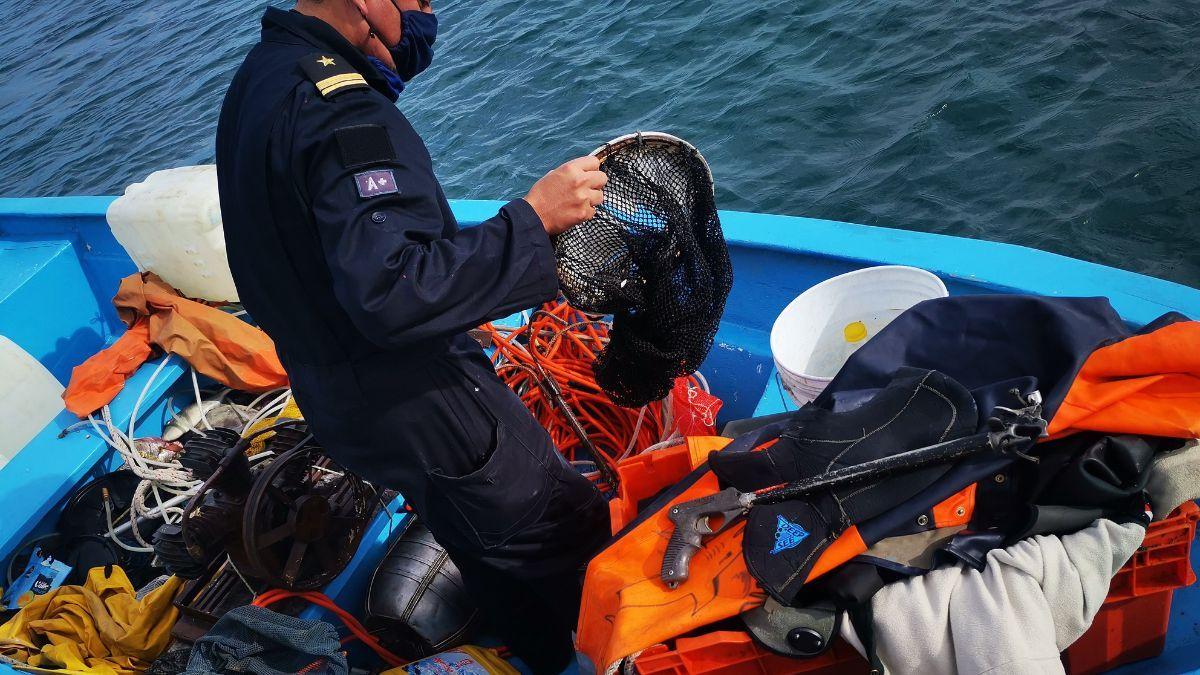
Between 12 and 16 tons of marine product could be illegally extracted every week off the coast of La Paz using hookah equipment, according to estimates from the Citizen Observer Network (ROC).
The figure, based on field records, considers catches of up to 800 kilograms per boat in a single night, with operations that are repeated three to four times a week for at least five active pangas. The volume, concentrated in reef areas and night days, shows the scale reached by the recent revival of this practice.
In a span of three months, illegal fishing using hookah equipment (also known as “pistoleo”) went from being kept at controlled levels to reactivating with at least five groups operating constantly in the coastal area of La Paz.
According to the Network of Citizen Observers (ROC), this uptick not only reflects a reorganization of poachers, but also a failure in the surveillance mechanisms that for years contained this activity more effectively.
“In three months, five boats that had been outside returned to gun fire,” Alberto Guillén, ROC's chief operating officer, explained in an interview. The increase in activity, between December 2025 and February 2026, coincides with a decrease in inspection actions and a greater presence of vessels in areas where activity had previously been reduced as documented by the civil association.
From containment to rebound
During the previous years, illegal hookah fishing had been partially controlled through coordinated operations between authorities and ROC. During that period, activity was kept at minimum levels, with one or two vessels detected on a recurring basis.
However, the scenario changed towards the end of 2025. According to the organization's own records in joint operations between ROC and Conapesca, between 2022 and 2025, inspection actions by the fishing authority had shown an upward trend, although with variations: three actions in 2022, 17 in 2023, six in 2024 and an increase to 21 in 2025, which was associated with a greater surveillance presence in the field.
This trend broke in 2026, when so far only three actions have been documented, in contrast to at least 16 citizen reports of possible illegal activities in the same period. For ROC, this difference reflects a lack of correspondence between complaints generated from community surveillance and the institutional response. “We started to see too much movement, too much activity, and we automatically started to receive citizen reports as well,” Guillén said.
In this context, ROC currently identifies at least five active groups — comprised of between four and five divers each — operating in the region, some with more than one vessel. This framework represents significant growth compared to the previous months, when activity was contained with one or two vessels in operation.
How they operate: night fishing, unlimited air and intensive extraction
The method used by these groups combines adapted technology and night operation to maximize capture in short periods. The hookah system consists of a compressor installed in a boat that supplies continuous air to divers through hoses, allowing them to remain underwater for a long time without the need for tanks.
“It's one of the most predatory fishing methods, it's prohibited for extracting all types of fish, there are no lobster extraction permits in the Gulf of California, and only some clam and sea cucumber anglers have specific permits for hookah equipment,” Guillén explained.
The days start in the afternoon-night. The boats move to coastal areas or rocky reefs, where divers descend equipped with harpoons, modified Hawaiians and nets adapted to catch fish quickly. During the night, they visit different points (islets, lowlands or reef areas) extracting species of high commercial value such as parakeet, snapper and goat, as well as other organisms such as lobster, snails and sea cucumbers.
The operation is continuous for approximately 10 to 12 hours. Before dawn, the groups return to land, where the product already separated by species is moved for distribution. “Nobody saw them, very few found out,” Guillén summarized.
Where it happens: from La Paz Bay to protected areas
The activity is concentrated in areas close to the coast, generally less than a kilometer away, where rocky reefs with high biodiversity are located. The corridor identified by ROC runs from Punta Coyote, north of La Paz Bay, to communities such as Agua Verde, including intermediate points such as San Evaristo, El Portugués, Los Burros, Punta Alta, Los Dolores and Tembabichi.
Incursions into islands and areas of high ecological value have also been documented, such as San José, San Francisquito, El Pardito and La Catalana, the latter within a Protected Natural Area.
“They go through islets, islands, small streets, small lows... the truth is that they do a lot of damage,” Guillén said.
*Causa Natura Media has sought to contact the representative office of Conapesca in the fishing inspection and surveillance area of Baja California Sur for this note without yet obtaining a response. This article is part of a series of publications on illegal fishing in Baja California Sur.


Comentarios (0)