
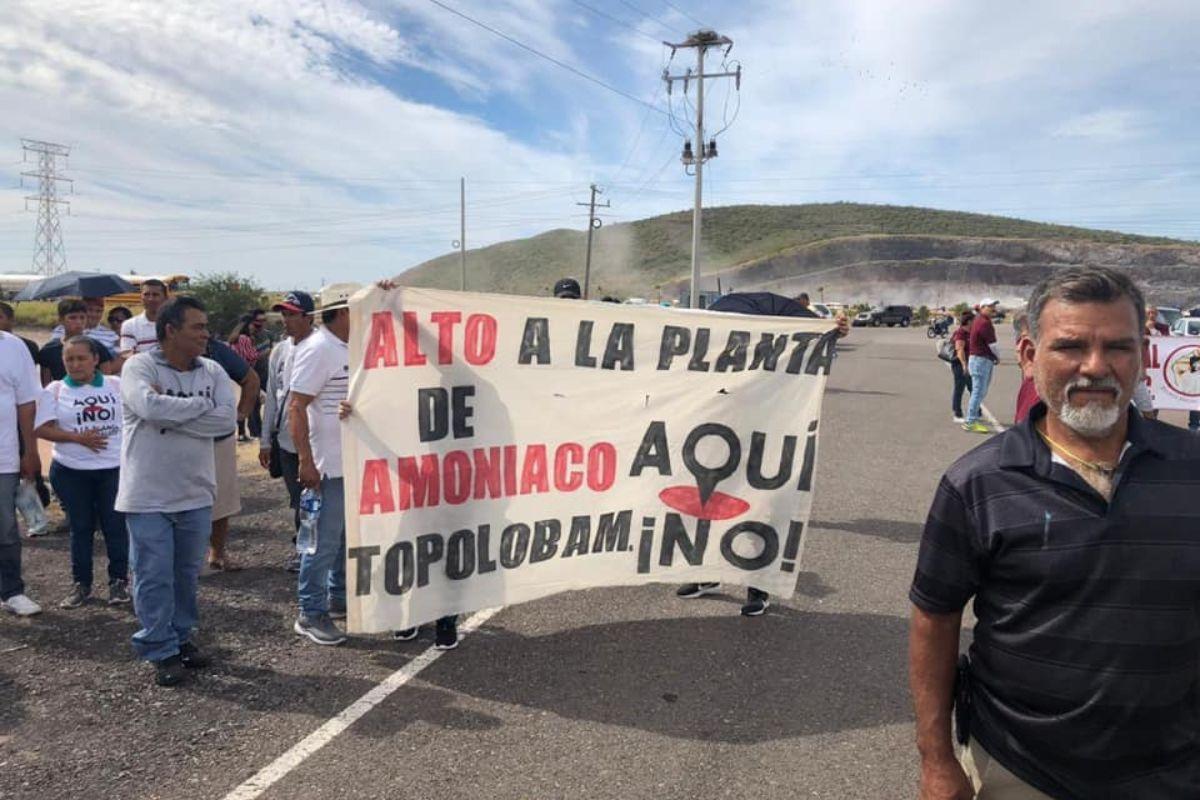
The largest ammonia plant in Latin America is under construction in Sinaloa, with strong public opposition demanding its cancellation, because it was installed on the Santa María-Topolobampo-Ohuira lagoon system, a Ramsar site of international importance for migratory birds and local fishing.
For the preparation of this article, an interview was requested from the company GPO Fertilizer Plant, but until the time of publication, the answers to the questionnaire sent were not received.
Mayo-Yoreme delegation in Germany
Gas y Petroquimica de Occidente, the sponsoring company, is part of the Proman group of companies, and is mainly financed by the German bank KFW-Ipex.
On March 24, a delegation from the collective in defense of the territory and the environment ¡Aquí No! traveled to Germany and filed a formal complaint with the KfW-IPEX bank, in an attempt to make visible the deficiencies and risks of the project in the country that finances it.
“The German bank is public, so there is government support for the project because the money ultimately ends up being public,” Campero said.
What they expect from all this strategy is for the bank to divest from the project because they consider it to be an unfeasible project for the bay and the people who live in it.
“The right thing to do would be to divest, and if the flow of money stops, that would put the GPO company in a lot of trouble to continue the project. When a project is already under construction, the battle is more difficult, but that doesn't mean it's impossible. There are projects that have been stopped at different times and in which it has been achieved that they do not materialize,” Campero said.
About the project
The project was announced in 2013 by the promoting company and that same year it requested environmental impact authorization from the Ministry of Environment and Natural Resources (Semarnat), which conditionally approved it in April 2014.
According to the resolution, the project was authorized to build and operate a plant for the production of anhydrous ammonia with a capacity of 2,200 tons per day, including a gas pipeline of 1,830 meters in length; and a pipeline for the transport of ammonia of 9,000 meters in length.
In addition, a desalination plant that will discharge about 812 cubic meters per hour to the bay; a wastewater plant; and seawater pipeline and wastewater discharge pipes. All in a plot of 202.57 hectares.
According to the company's website, the plant will help reduce the country's dependence on imported fertilizers and will support national agricultural sustainability by providing a stable and sustainable supply of fertilizer to farmers across the country.
In 2025, the plant made progress in its construction and has faced strong questioning from Mayo-Yoreme indigenous communities in the region, who say that the public consultation of the project was tricky, expanding the area to be consulted and thus obtaining votes in favor of other communities.
“Under that pretext, construction was promoted, but the Mayo-Yoreme people are still not giving their consent,” said Claudia Campero, climate justice coordinator at the organization Climate Connections.
The impact of the plant on Ohuira Bay
“Ohuira Bay has been under threat from gas projects since the El Encino - Topolobampo gas pipeline was built, which aims to power different projects, including the GPO ammonia plant,” Campero explained.
The plant aims to produce 2,200 metric tons of ammonia per day when it is finished. However, its operation would mean the ecological-social collapse of the Santa María-Topolobampo-Ohuira lagoon system, which is a wetland considered a Ramsar site due to its high ecological value, according to the statement published by the German Coordination for Human Rights in Mexico.
Eventually this would cause the loss of the livelihood and environment of local indigenous communities, he adds.
“It's a project that seeks to export through huge ships that have a very serious impact at the bay level, because it's a very shallow bay where people live by artisanal fishing for shrimp, crab and mollusks both for food and for sale. And that whole way of life is at risk,” Campero said.
During the environmental impact assessment process, the company stated that mangroves would not be removed, pruned or transplanted in the installation area, so it would not violate Article 60 TER of the General Wildlife Law, which was supported by the municipal presidency and the state government.
According to the Official Mexican Standard NOM-022-SEMARNAT-2003, all productive activity must be installed 100 meters away from the vegetation of coastal wetlands. However, Semarnat authorized it not to comply with this measure and to compensate for it with the reforestation of mangroves in an area of 21 thousand square meters.
The project states on its website that it was installed on the site because it was a developed area, without vegetation or fauna, and therefore, it does not affect the ecosystem services of the Ramsar site.
Also, because the area, the shrimp's habitat, was deteriorated by industrial activity, the project committed itself to recovering the bay by improving water quality, rehabilitating the habitat and repopulating the blue shrimp.
However, Campero points out that both the company and the authority only evaluate its impact on the site where it will be installed, and not on the surroundings of the project, nor on the sociocultural impacts.
“By affecting the bay, the indigenous worldview is also affected, which has a very strong connection with this site in an integral way,” he said.
Expectations for the future
Topolobampo is an industrial and tourist port in Sinaloa, where not only is there interest in building an ammonia plant, but it was also recently looking to set up a fossil gas export terminal, however, Sempra Infrastructure, the promoting company canceled the project in March 2026.
“The most notable victory right now is definitely the cancellation of Vista Pacifico. And if Vista Pacifico fell, Saguaro, Amigo LNG and the ammonia plant can easily fall, and that's what we're working on,” Campero said.
Also in Ohuira Bay, the Mexinol plant is under construction, which will produce methanol, will require a supply of fossil gas and will be the largest in the world, according to Rubén Rocha, governor of Sinaloa.
“In a single space you had three projects. You already got rid of one (Pacific View), but you have two (GPO Plant and Mexinol) that are strong threats to life and are totally related to an interest in placing the remaining gas in the United States, giving it added value and selling it,” Campero explained.


Comentarios (0)