
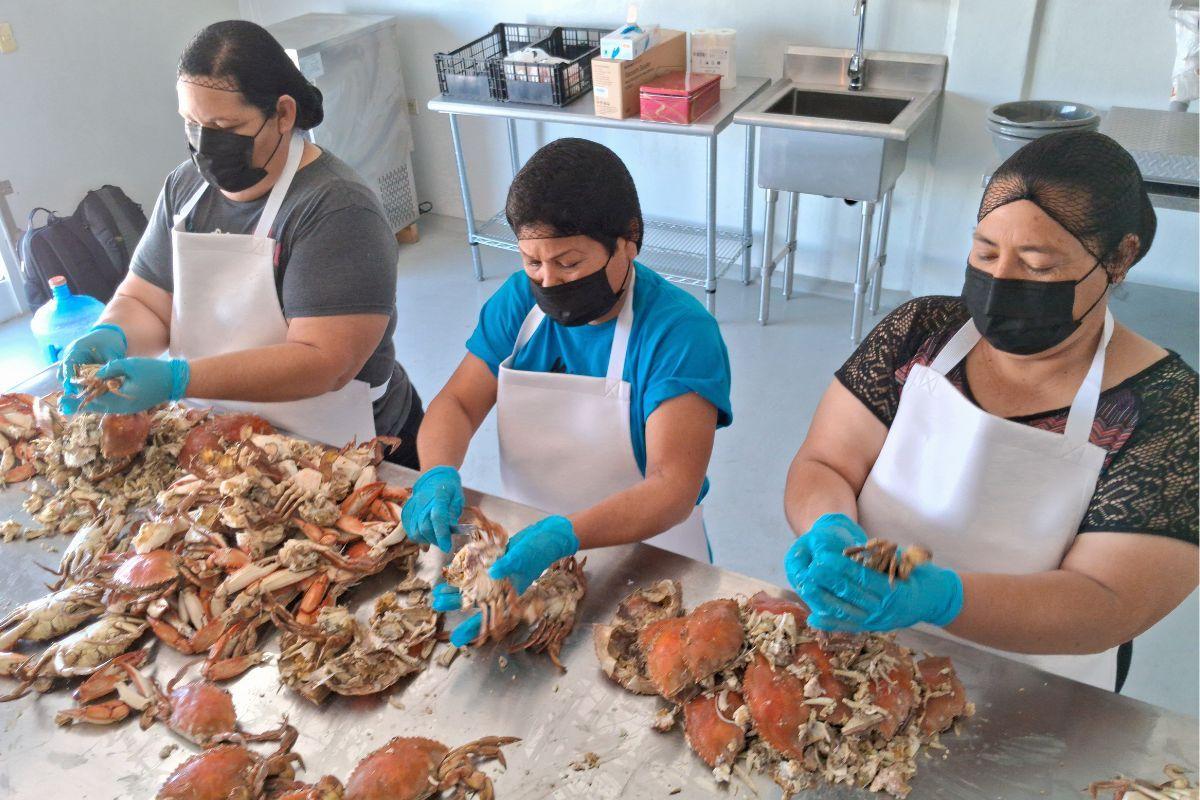
The Bahia San Jorge Fishery Production Cooperative had a processing plant for its fish product that employed dozens of women; however, due to the cooperative's mismanagement and the pandemic, the plant was abandoned.
The women of the Rodolfo Campodonico ejido, in the municipality of Caborca, Sonora, who were wives of the fishermen of the cooperative, began to process the crab in their homes and that knowledge lived on.
Five years ago, a group of 12 of them came together under the Cooperativa Mujeres del Desierto y Mar to build the dream of becoming processors of fish products, creating jobs for other women in their community and exporting their products.
“Right now we want to dream of one day exporting and employing many women here. Right now we have come a long way,” said Guadalupe Flores, treasurer of the cooperative.
With the support of the Intercultural Center for Deserts and Oceans Studies (CEDO), they have managed to materialize part of this dream by obtaining the processing plant as a commodate and rehabilitating it, at the same time that they are on the verge of undertaking their first pilot test that will mark the future of their project.
For sustainable crab fishing
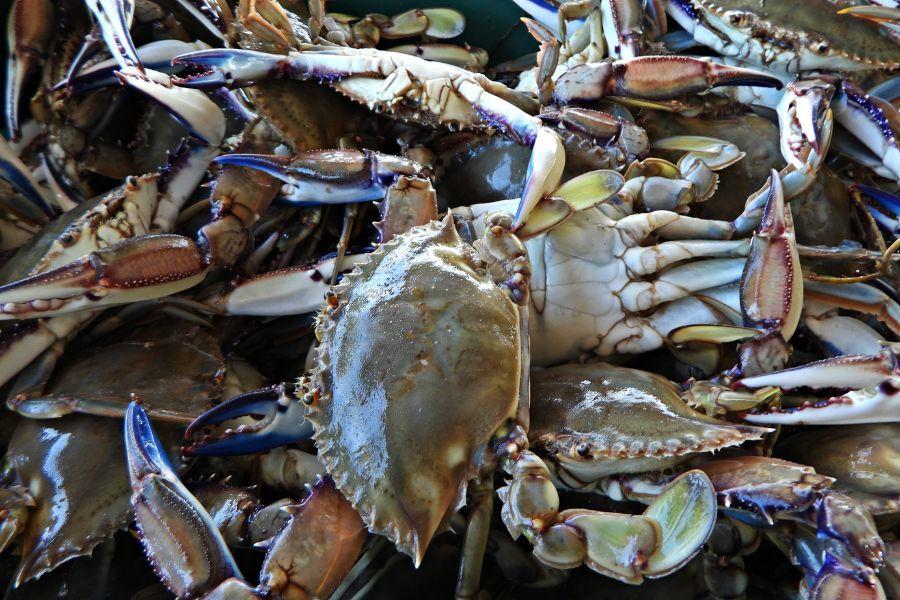 Crab production. Source: CEDO.
“This region was extremely productive. Around 800 tons were caught per year per season in San Jorge Bay, but for many reasons, such as climate change, overfishing and mismanagement, the catch has greatly decreased,” said René Loaiza, CEDO's manager of sustainable fishing and aquaculture.
For this reason, since 2015, CEDO has promoted sustainable fishing in the region from Puerto Peñasco to Puerto Lobos, to regenerate fish production in an area that has been identified as a biological and fishing corridor of great importance.
In the area there are six communities that are mainly dedicated to coastal fishing, including the Rodolfo Campodonico ejido. With these communities, the design of a proposal for fisheries management in the corridor began, where, among others, two major solutions to problems related to fishing were identified: one was the establishment of fishing refuge areas and the promotion of a crab fishing improvement project.
As for the FIP, the fishermen of the Bahia San Jorge Cooperative have improved their fishing method and gear and started a monitoring program. They currently use traps with biodegradable staples so that, if lost, the staples degrade, the trap opens and does not remain on the seabed capturing species.
As for fishing refuge areas, these are delimited areas where fishing is restricted to safeguard the breeding and breeding areas of species important for fishing. The final proposal was to create 12 partial fishing refuge areas in the corridor, and although their creation has not yet been formalized, fishermen are already implementing and respecting it to ensure that the population of the species recovers.
“The proposal has already been reviewed and verified by Conapesca. Let's hope that this year it will already be published in the Official Gazette of the Federation and will officially enter into force,” said Loaiza.
From fishing to processing
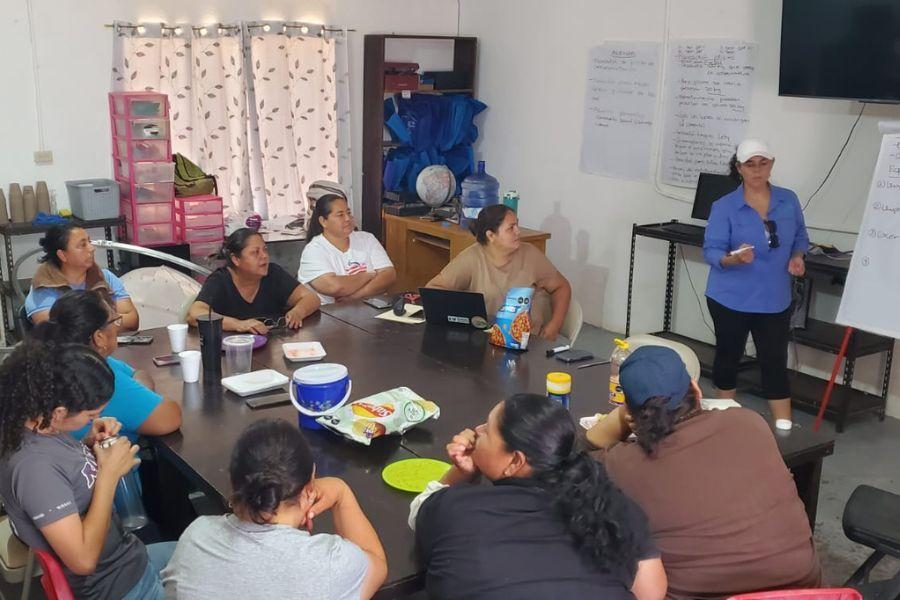 Cooperativa Mujeres del Desierto y Mar in training. Source: CEDO.
Although not as visible as fishermen, women have always been present in fishing, usually receiving the product, processing and marketing it.
For this reason, they are an important link for the continuity of the sustainable fishing efforts undertaken by fishermen.
In this sense, the women of the Women of the Desert and Sea cooperative aim to continue the work that their husbands have been undertaking for 10 years to make sustainable fishing for crab and other species, and to close the value chain so that all benefits remain within their community.
It was in 2021 that CEDO explored the possibility of taking the next step in the crab value chain towards processing, where it is prepared for commercialization and includes cooking, stripping and vacuum packaging.
“We know that it is very important to have good practices for sustainable fishing, but what do we do to make these fishermen do better and that the community benefits?” , said Paloma Valdivia, education manager at CEDO.
So in collaboration with the ProEmpleo Foundation, which is dedicated to providing tools to grow businesses, they identified potential ventures focused on women in the ejido that could be strengthened.
In that call, the group of 12 women between 40 and 50 years of age raised their hands to form a cooperative initially dedicated to the processing of crab. So since 2021, they have been trained in both technical and practical manufacturing and food handling issues required by law, and in matters of internal organization and soft skills. “Because they are ultimately crab processors. They are not businesswomen,” Valdivia said.
They are currently about to begin the production, processing and commercialization phase, Loaiza said.
The SmartFish organization has accompanied the group by advising them on value-added and markets, and also provided them with funding to train in the value rescue model, in which they are still in.
“This organization is dedicated to seeing how to give added value to these fish products so that fishermen who have these good practices can access markets that pay them more for a well-caught and processed product,” Valdivia said.
Another major step they have taken has been the rehabilitation of the processing plant of the members of the San Jorge Bay Cooperative, who are the ones who sell crab to them. They gave them the plant as a commode and with the support of CEDO, they have managed to rehabilitate it.
The process involved reconnecting the light, restoring walls, ceilings, buying freezing equipment, vacuum packing equipment, an ice maker, water pumps, covering the floors with epoxy paint, setting up a reception area for cooking and cold rooms.
“The cooperative and the ejido gave them authorization to rehabilitate a space in the old processing plant that was all deteriorated because no one is using it. It has already been achieved, it is equipped, some minimum things are missing that we will gradually acquire. That was last year's great achievement,” Valdivia said.
The last jump
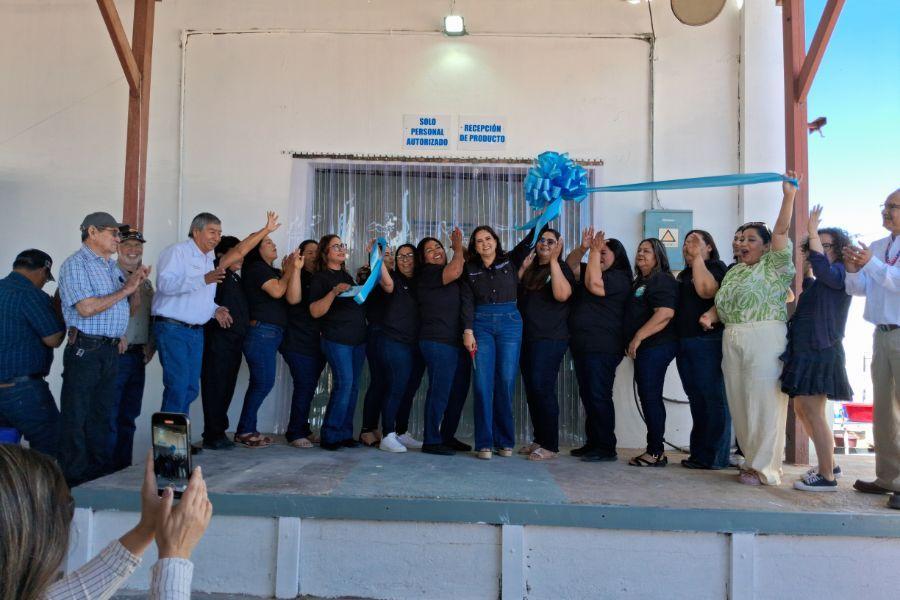 Inauguration event of the processing plant of the Cooperativa Mujeres del Desierto y Mar. Source: CEDO.
Despite the long journey taken by the cooperative in the last five years, some challenges remain, such as formalizing the cooperative before the Ministry of Finance so that they can invoice and other administrative details.
They will also seek certification from the Federal Commission for Health Hazard Protection for processing and from the U.S. Food and Drug Administration (FDA) for export.
And the most immediate challenge is to get buyers to start commercial production. So far they have done some pilot productions of 50 and 100 kilograms, but in March 2026 they want to process 750 kilograms of crab to obtain 120 kilograms of meat.
In addition, this production will include a different stripping technique, which involves packing the crab pieces separately.
“It's the most ambitious project we have, but it's the best option right now to self-employ and give work to more women. We are ready,” said Citlali Flores, a member of the cooperative.
Although currently the pilots have been using crab, the women say they don't want to limit themselves and intend in the future to process all the seafood that is taken out in the region in order to have work most of the year.
“We want everything to revive, to have more movement all year round because the town has been very depressed due to lack of income. The biggest motivation is that it benefits the entire community, and not only now, but also for future generations,” said Citlali Flores.


Comentarios (0)