
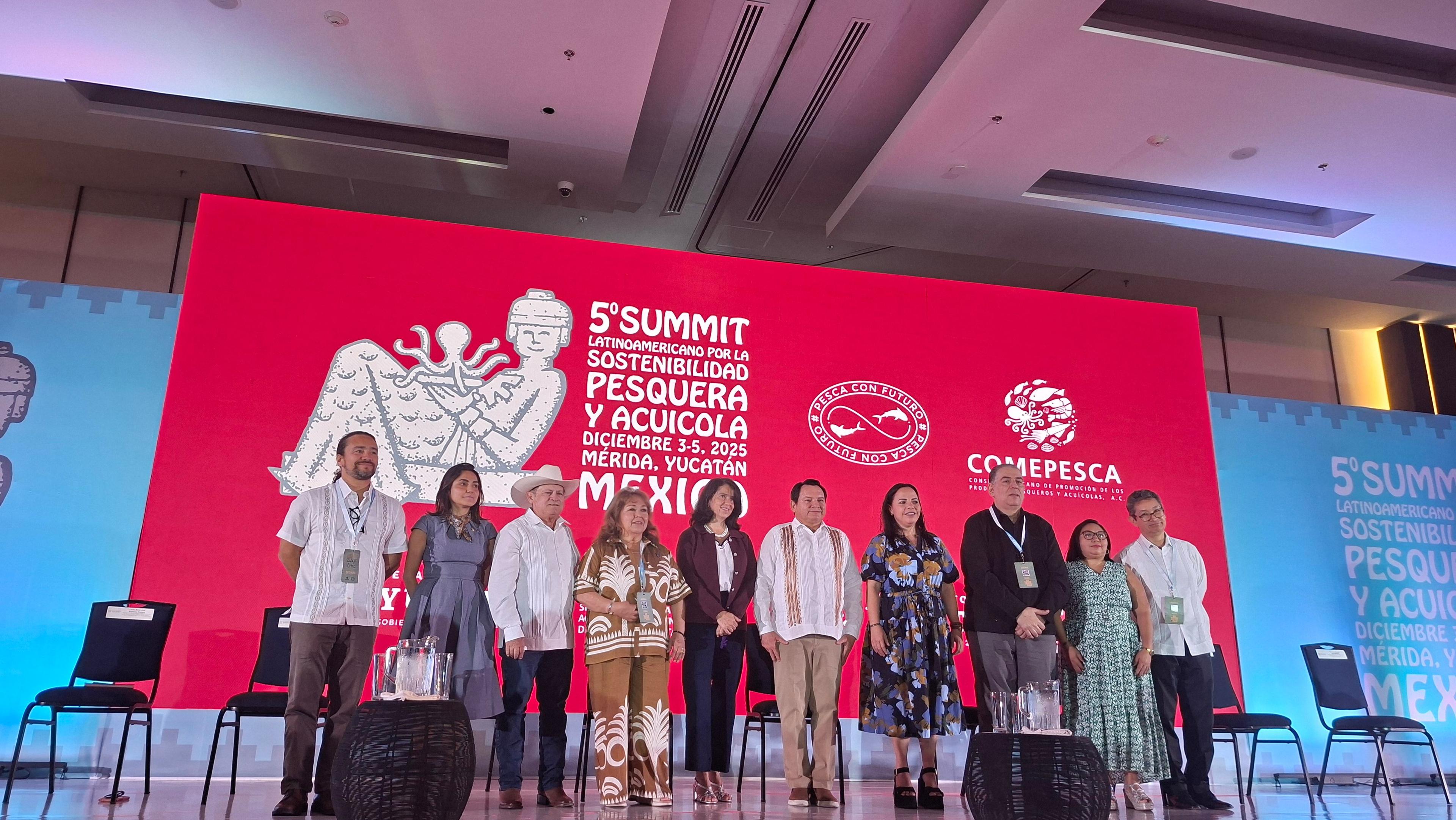
With representatives of the fishing sector from 16 countries meeting in Mérida, Yucatán, the 5th Latin American Summit for Fisheries and Aquaculture Sustainability opens a space to rethink the future of the sea. These are two days of dialogue to propose sustainable fishing, fair to communities and capable of facing the challenges imposed by climate change.
At this meeting, specialists, government institutions, community leaders and fishing chambers will rethink the productive model of fishing in the region and the forms of traceability.
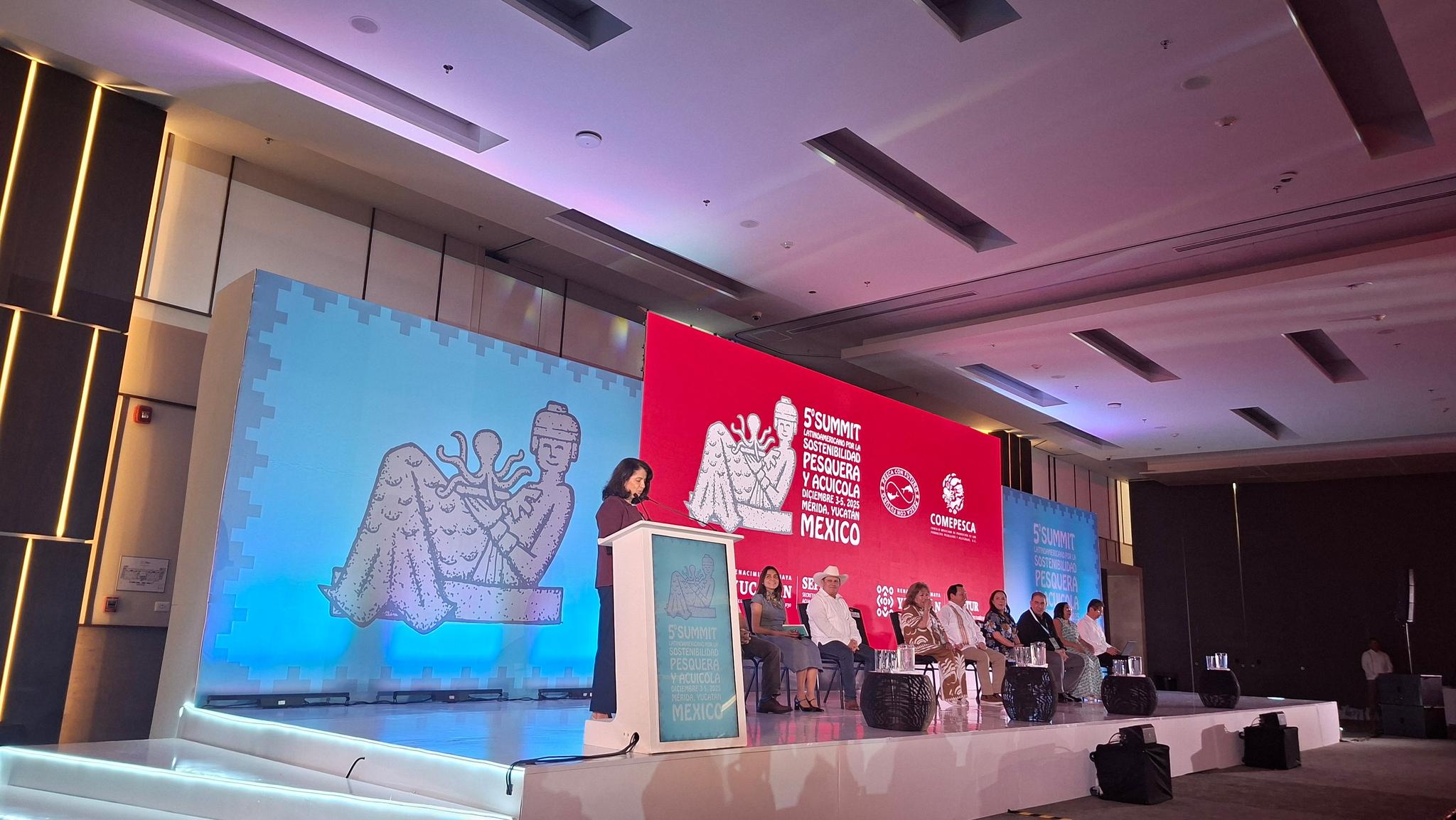 At the Summit, attendees will engage in dialogues on the problems faced by the seas. Photo: Zayra López.
At the inauguration, the president of the Mexican Council for the Promotion of Fishery and Aquaculture Products (Comeesca), Citlali Gómez Lepe, emphasized the collaborative nature of the meeting and the presence of more than 25 strategic allies, including civil society organizations and national fisheries chambers.
“We came to build community because in our current context we need to act, not only to talk but to have solutions and direct directions, that's why we're here. We are experiencing systemic change that has to be through collaboration because we understand that markets are fundamental and we need them to be sustainable and to demonstrate them with traceability,” he described.
Mexico in the face of a blue transformation
Representing the National Fisheries and Aquaculture Commission (Conapesca), María José Espinosa Romero, the institution's general coordinator of Operation and Institutional Strategy, stressed that Yucatán was chosen as the headquarters for its fishing growth and strategic location.
For his part, Víctor Vidal, director general of the Mexican Institute for Research in Sustainable Fisheries and Aquaculture (Imipas), warned that Mexico is going through a decisive moment, marked by the increasing effects of climate change and the urgency of strengthening management and surveillance.
“These problems cannot be ignored, but neither should we see them as barriers, but rather as catalysts. Mexico has many high-value species and the blue transformation brings tools for regenerative mariculture, blue carbon credits and green finance models to the table. The country needs solutions based on the protection of ecosystems, with a non-extractive but regenerative approach. We need to see the ocean as an ally,” he said.
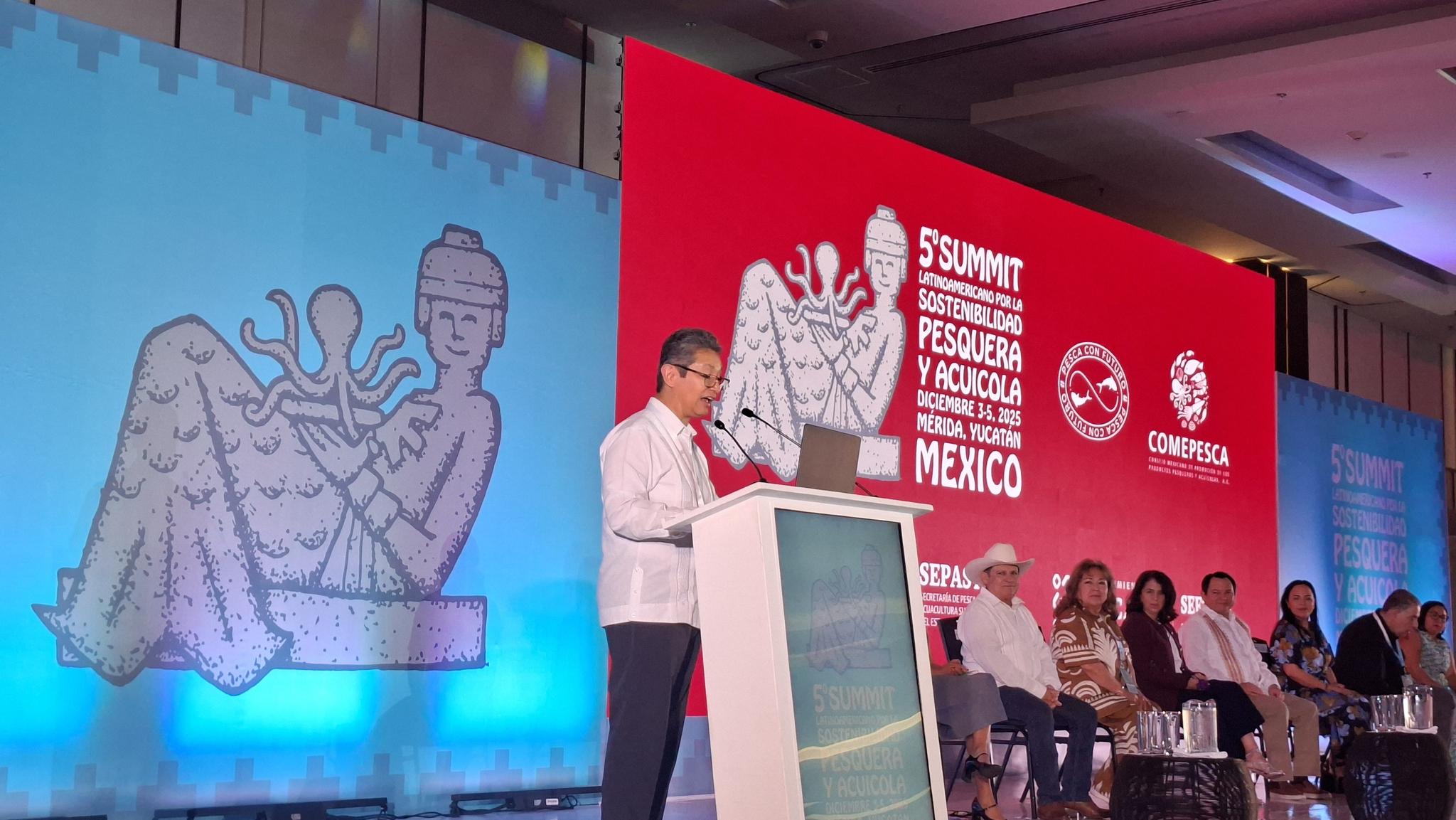 Víctor Vidal, director of Imipas, mentioned that there are challenges that serve as catalysts to transform fishing. Photo: Zayra López.
In Yucatán, the sea is identity
In the presence of attendees from Japan, Italy and Spain, the main consumers of Mayan octopus, the governor of Yucatán, Joaquín Díaz Mena, recalled that more than 20,000 Yucatecan families are directly dependent on fishing, a fact that highlights the social dimension of the sector.
The president highlighted that in Yucatán, the first Special Climate Action Program for Fisheries and Aquaculture is being developed, aimed at the conservation of commercial species such as grouper, octopus and lobster, in addition to community-driven Fishing Refuge Zones.
“Today we are united by the sea that teaches us, gives us identity and nourishes families. If we don't act, if we don't sow, the next generation could open their networks and find them empty,” he added.
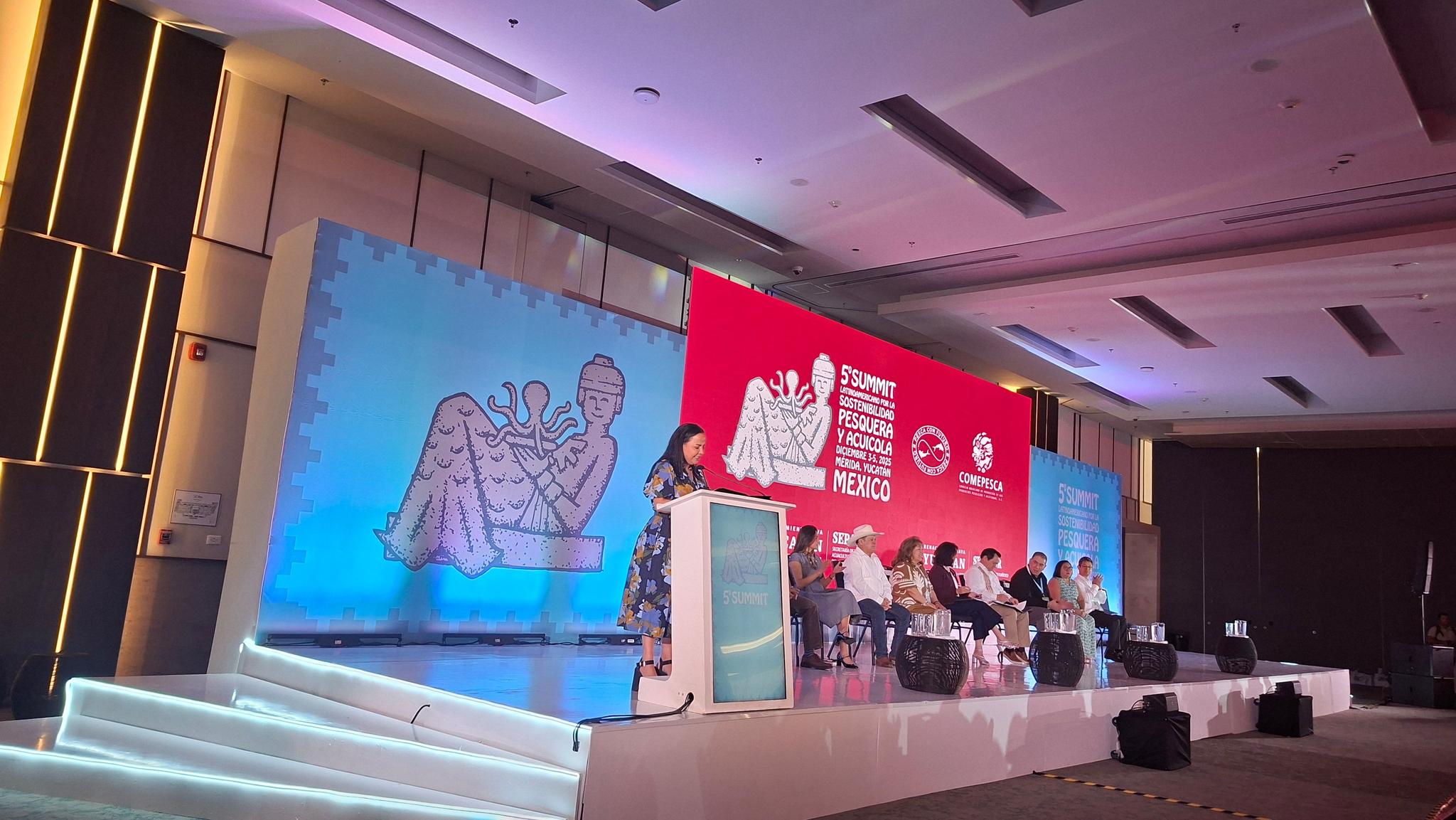 Lila Frías, Secretary of Sepasi, celebrated that the Summit was taking place in Yucatán. Photo: Zayra López.
The Secretary of Sustainable Fisheries and Aquaculture of Yucatán (Sepasy), Lila Frías Castillo, stressed that science, community and tradition converge at the Summit, capable of guiding a new direction for the sector.
“The Summit recognizes us as a crossroads of knowledge between community, government, industry and this weaves links with the sea and its people. We make efforts so that the future of communities does not depend on chance or indifference, but rather that the protagonists are those who are born from the sea,” he said.
*This article was written by Itzel Chan, who covers coastal communities thanks to the support of the Report for the World program.


Comentarios (0)