

Faced with the lack of resources to monitor the habitat of the vaquita marina, the Mexican government reduced the area of prohibition of gillnets from 11,106 to 1,562 square kilometers, representing a reduction of 86.5% compared to the polygon set in 2020.
Lorenzo Rojas Bracho, a cetacean specialist and president of the International Committee for the Recovery of the Marine Vaquita (CIRVA), explains that reducing the polygon would make it possible to concentrate efforts on areas where the presence of the species has been registered, instead of allocating resources to areas where no specimens have been detected.
In September 2020, an extension of the restriction polygon for the use of gillnets was consolidated, which reached 11,106 square kilometers. Then, in October 2023, the Government of Mexico and the Sea Shepherd organization signed an agreement that expanded the active patrol and protection zone within Operation Miracle by more than 60%, reinforcing surveillance in the Zero Tolerance Zone against illegal networks.
However, in October 2026, the Government of Mexico modified the protective surface. Through an agreement published in the Official Gazette of the Federation on October 14, the prohibition polygon for networks was reduced and left more than 9,500 square kilometers outside that restriction, under the official argument of safeguarding the economic well-being of coastal communities.
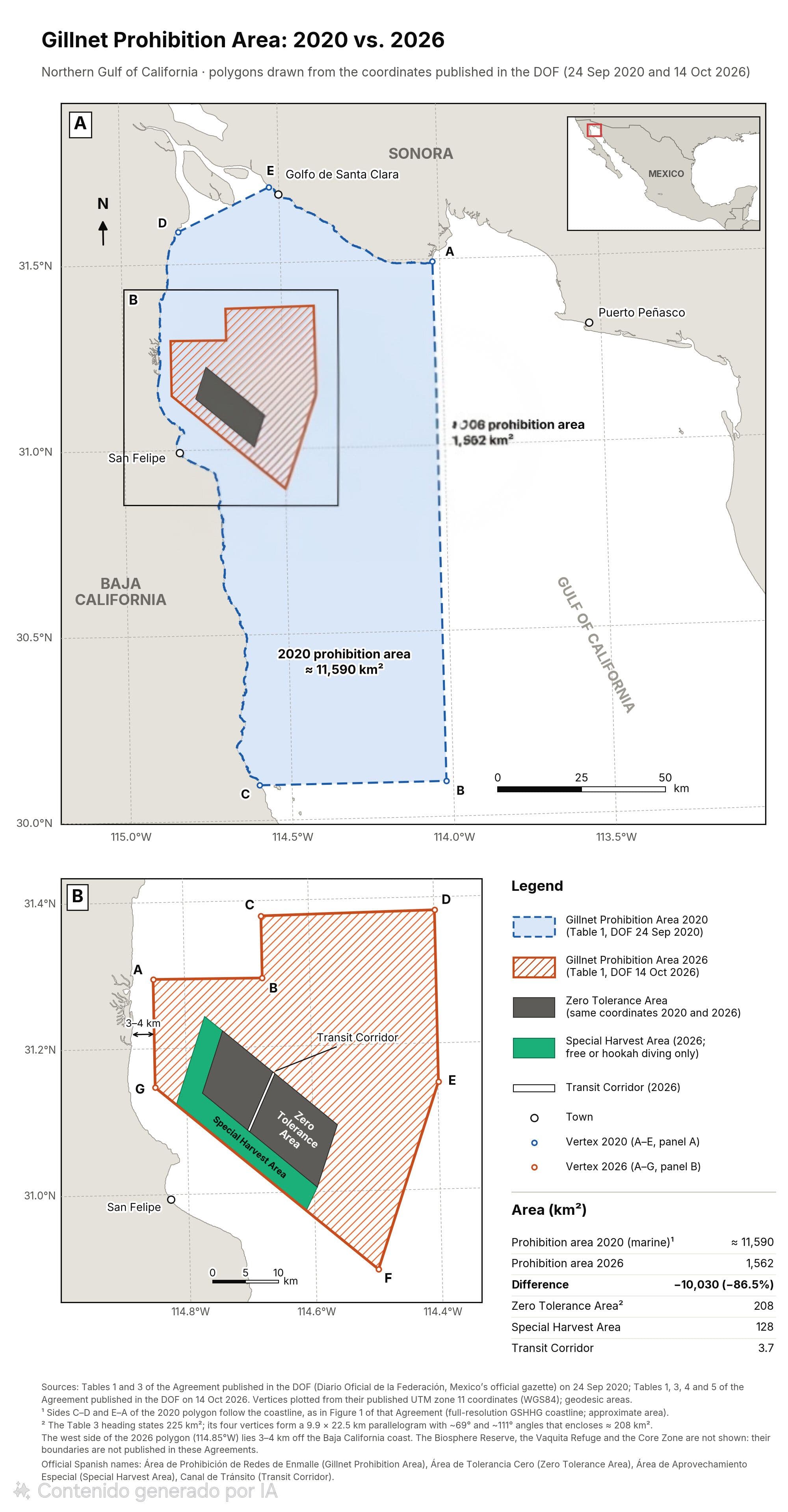
Rojas Bracho argues that the extension of the previous polygon did not necessarily translate into effective protection of all that surface, because, he said, there were not enough resources to monitor and there had been no marine vaquitas outside the area that remains protected. “I think there are 12,000 square kilometers that were never monitored,” said the specialist.
He also explained that since 2015 there have been no detections of specimens outside the currently protected area. The observation cruises and the monitoring carried out annually made it possible to identify that the specimens are concentrated in the area delimited by the recent amendment of the regulatory agreement.
“What you are going to do is concentrate the effort and the few resources that exist where there are vaquitas and not waste resources where there are no vaquitas,” he reiterated.
Also read: Invasive species, another threat posed by gas ships in the Gulf of California
What was the change in the area of the Vaquita Marina protection park?
The polygon for the prohibition of gillnets and gills is located in the Upper Gulf of California, between Sonora and Baja California. Before the modification, it ranged from the Ciénaga de Santa Clara, Sonora, to El Muerto Island, south of Puertecito, Baja California.
With the agreement published on October 14, the restricted area increased from 11,106 to 1,562 square kilometers. This left 9,544 square kilometers outside the prohibition of these networks, an area equivalent to 6.5 times that of Mexico City.
The modification maintains the 225-square-kilometer Zero Tolerance Zone, where restrictions continue to protect the marine vaquita. In that area, a transit channel 3.39 kilometers long by 383 meters wide was set up to allow smaller vessels to pass through, without them being able to stop.
According to the document, the change does not eliminate all restrictions on the species' habitat, but it does allow the use of gillnets and gills on a large area that was previously subject to prohibition.
What conditions are needed to protect the vaquita marina?
The researcher clarified that the reduction of the net prohibition area does not in and of itself guarantee greater protection for the vaquita marina. Its effectiveness will depend on whether the areas where the species is concentrated remain free of gillnets and gills, as this is the main reason why they become entangled and drowned when they cannot free themselves, and that the authorities enforce fishing restrictions.
Rojas Bracho explained that one of the fundamental measures is the satellite monitoring of smaller vessels, with real-time access for the National Aquaculture and Fisheries Commission (Conapesca) and the Secretariat of the Navy (Semar), in order to detect violations and intervene in a timely manner.
“Installing the equipment is not enough, the information must be used to enforce the measures,” he warned.
However, vigilance is not the only condition. The specialist pointed out that it is also necessary to develop alternative fishing gears that are safe for the vaquita marina, economically viable for anglers and available at a scale sufficient to serve the different fisheries.
“This transition is essential so that communities can continue fishing without putting the vaquita at risk and can maintain their economic level or raise their standard of living,” he said.
Rojas Bracho explained that the recovery of the species is linked to the management of fishing activity, since communities need options that allow them to maintain their income without resorting to practices that threaten the vaquita.
For this reason, he said, the success of the reduction of the polygon will depend on a decrease in the presence of nets in areas where the species is concentrated, restrictions are met and progress is made towards fishing that allows the protection of the vaquita marina without compromising the livelihood of the communities.
“The success of the agreement will depend on how it is implemented,” he concluded.
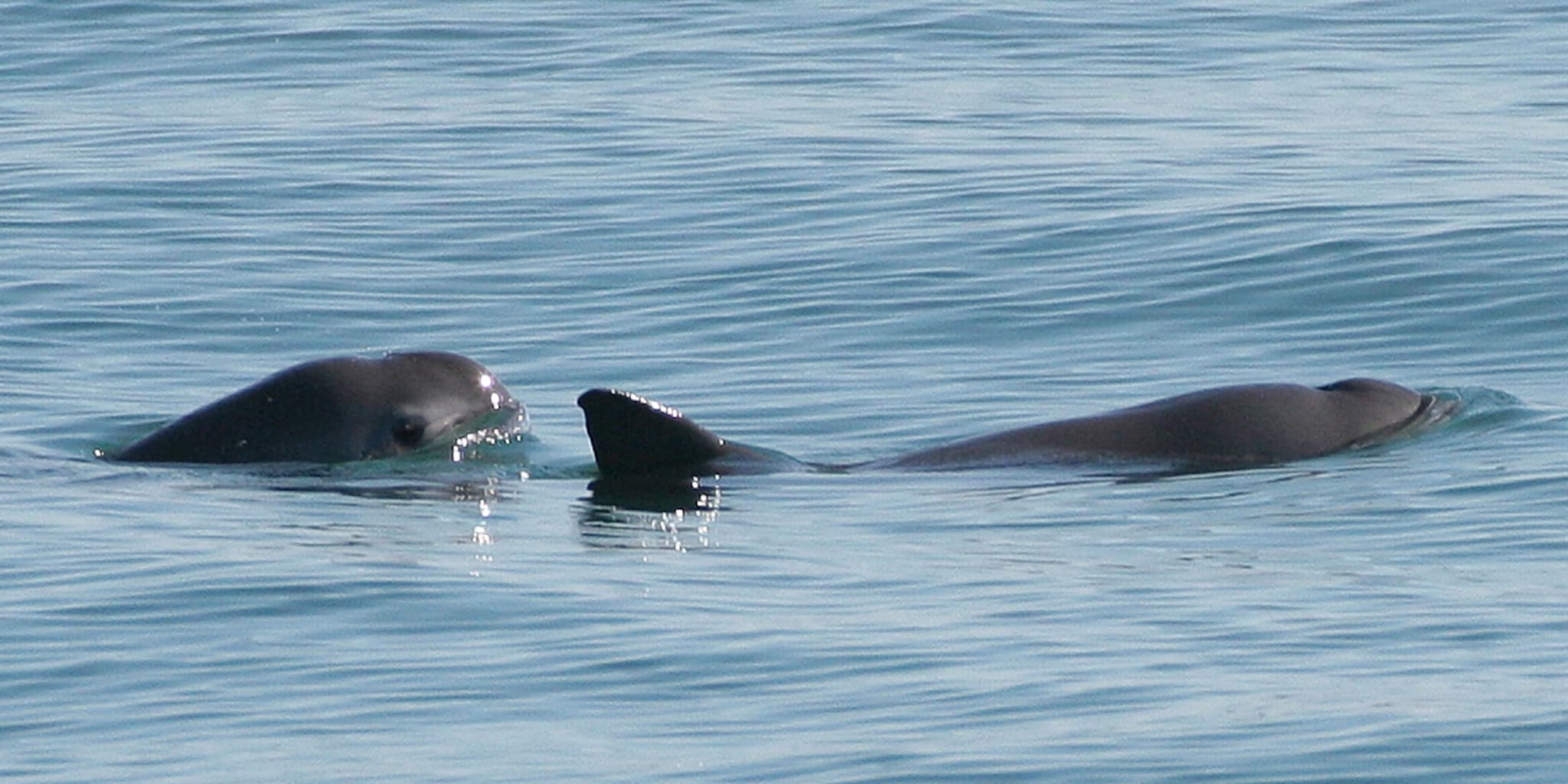
Sheinbaum justifies polygon reduction
Faced with the controversy, President Claudia Sheinbaum defended the reduction of the gillnet prohibition polygon in the Upper Gulf of California. He noted that the measure seeks to reconcile the conservation of the marine vaquita with the economic needs of fishing communities, particularly in San Felipe, Baja California.
During the morning conference on October 15, the president explained that prolonged fishing restrictions create economic difficulties for those who depend on this activity, so the federal government carried out an analysis to adjust the protection zones.
“A very important study was carried out on how biodiversity is protected and, at the same time, it allows fishermen to live properly,” he said.
Sheinbaum argued that fishermen in the region are not responsible for the decline in the marine vaquita population and assured that the federal government has worked with communities to meet their economic needs.
Finally, he stated that the measure seeks to improve the well-being of fishing families without neglecting the protection of the species and the conservation of the environment.
Don't miss: Illegal fishing without offenders: impunity begins on paper
The controversy over the reduction of the protection area
While the Center for Biological Diversity, Natural Resources Defense Council (NRDC) and the Animal Welfare Institute rejected the measure.
In a joint press release, they regretted that the new rules eliminate the protections adopted in September 2020, “which were never fully implemented, but which would have significantly improved the species' chances of recovery.”
“When there are only a few vaquitas left, it's outrageous that the government is dismantling their protection instead of redoubling efforts to save these small porpoises,” said Alejandro Olivera, representative in Mexico of the Center for Biological Diversity.
For his part, Zak Smith, senior lawyer at NRDC, said that the use of gillnets in the vaquita habitat is incompatible with the survival of the species, much less with its recovery.
“Mexico's mismanagement of gillnet fishing brought the vaquita to the brink of extinction. Now, the decision to allow these networks in a larger portion of their habitat reduces their chances of survival and could seal their sad fate,” he added.


Comentarios (0)