
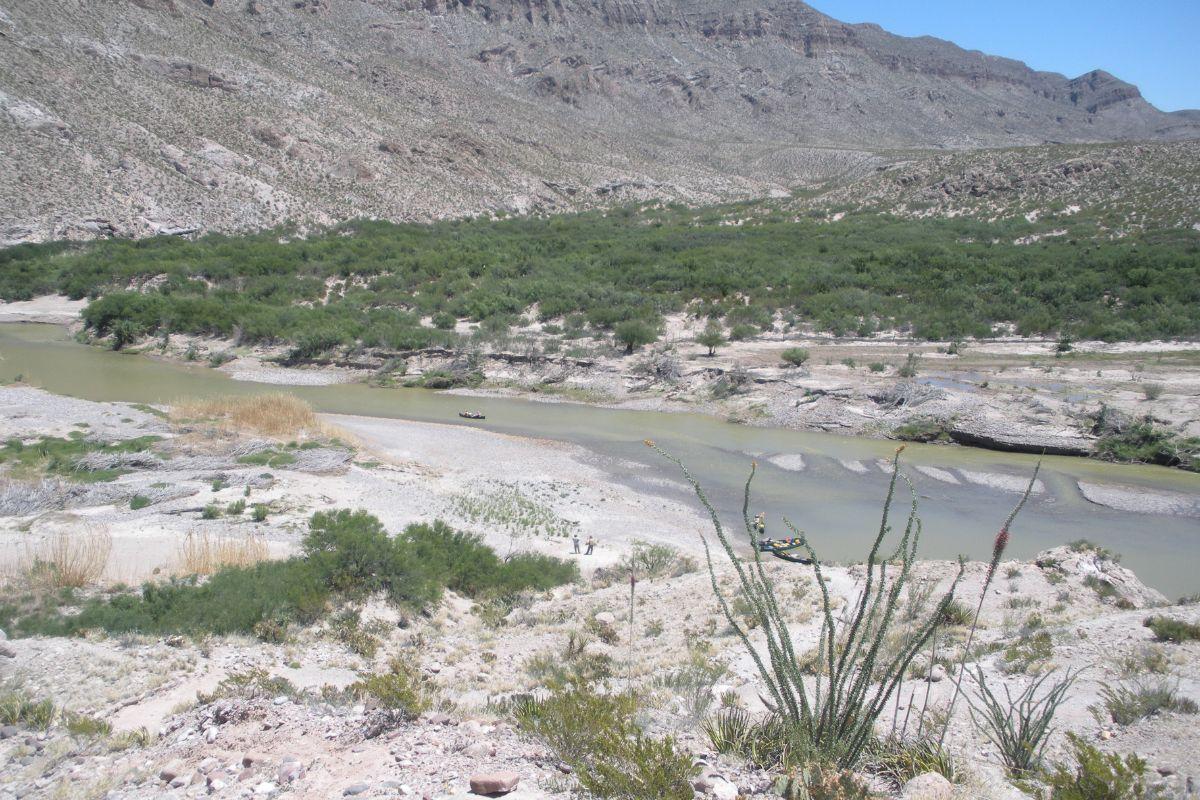
Mexico and the United States share three large bodies of surface water: the Bravo, Tijuana and Colorado rivers. Since 1944, both countries have been governed by the Water Treaty, a binational agreement designed to distribute border water resources in an equitable manner. However, more than eight decades after its signing, compliance with the treaty is facing one of its most complex moments.
Although the treaty states that the delivery of water from the Rio Grande is carried out in five-year cycles, geopolitical pressures have escalated. Mexico handed over 249 million cubic meters of the 986 it owes after a threat from President Donald Trump who set a deadline of January 30 to cover that volume, even though the treaty itself allows the volumes to be covered during the current five-year period.
Now President Claudia Sheinbaum is negotiating with the U.S. government and with the governors of northern Mexico, a plan that will allow her to meet international commitments without affecting supply to cities or economic activities.
This is a scenario marked by drought, climate change and the growth in water demand that already put Mexico in serious difficulties in the last five-year cycle, 2020-2025, which closed on October 24.
A treaty designed for another time
When the Water Treaty was signed 82 years ago, the region's water reality was very different. Agricultural activity was intense, the population was small and the central problem was how to manage water surpluses.
“The agricultural activity was very large and the population's demand for water was very low. At that time, excess water was being managed, however, for 25 years what has been administered has been the water deficit,” explains Alfonso Cortez, senior research professor at El Colegio de la Frontera Norte (Colef) and director of the Mexicali Unit.
At that time, the volumes allocated were based on historical averages of river flows, as well as on existing populations and productive activities. Today, that balance has changed substantially.
“Agricultural activity has been reduced, mainly on the Mexican side. On the other hand, urban and domestic public use of water has grown, and that demand comes even from cities that are outside the basin areas,” says Cortez. For example, he mentions that San Diego, Tijuana and Rosarito rely heavily on water from the Colorado River, despite being outside their watershed.
Added to this is the impact of climate change. In recent decades, the conditions that feed the region's large water systems have changed dramatically.
“The conditions have definitely changed. In the last 25 years, temperatures have not been low enough at the headwaters of the Colorado River basin for snow to accumulate and melt efficiently, which has reduced the amount of water that flows through the river and reaches the dams,” explains Roberto Alejandro Real Rangel, hydrologist for the Colorado River Delta at The Nature Conservancy (TNC).
The prolonged drought
One of the most determining factors in the reduction of water resources is the drought that has affected northern Mexico and the southern United States since the late nineties.
“Another significant observable change has been the prolonged drought, we're talking about a mega-drought,” Cortez says. This phenomenon is characterized by longer, more frequent and intense periods of scarcity, which require a rethink of the way in which water resources are managed.
Real details that, although short-term drought maps - such as those for the last quarter of 2025 - do not always show extreme conditions, the analysis of extended periods reveals a more critical picture. By looking at cumulative 24-month statistics, severe impacts are identified, especially in the basin that feeds the Rio Bravo.
The lack of rain and increased temperatures cause aquifers to depletion, reduced flows in rivers and lower levels in lakes and lagoons.
“Based on this information that is publicly available, we can see that there are conditions of water deficit, that is, of a prolonged, severe drought,” adds Real, who stresses that the increase in evaporation further complicates compliance with the treaty.
The water deficit affects agriculture and industry, but Real points out that it also has significant environmental consequences. In the Colorado River, for example, the deficit is managed through proportional cuts in deliveries, which directly impacts the volumes destined for the environment, a water user.
Previous Crises and Solution Mechanisms
The current dispute is not the first crisis faced by the Water Treaty. In the past, similar conflicts have resulted in negotiated solutions.
“There have been other previous crises due to lack of compliance or non-compliance in a timely manner,” recalls Edgar Carrera, project coordinator in the Colorado River Delta for TNC, who mentions the problem of salinity in the Colorado River as a key precedent in the 70's.
This conflict gave rise to Minute 242, entitled Permanent and definitive solution to the problem of salinity in the Colorado River, through which salinity standards and compensation and water management mechanisms were established that gave rise to investment in infrastructure and technology to divert salt water. This is an example of how the treaty has mechanisms to adapt, according to Carrera.
Cortez also recalls the episode of the year 2000, during the governments of Vicente Fox and George W. Bush, when Mexico failed to meet its full payment for the five-year period. The solution came through three acts of the treaty and a funding of 80 million dollars for hydroagricultural infrastructure in Chihuahua.
From this background, for specialists, the discussion is not necessarily about replacing the Water Treaty, but about using and strengthening its adaptation mechanisms.
“It's a document about 80 years old, but it has tools that allow it to be updated and adjusted to current conditions,” says Real, who highlights the role of minutes as amendments that make it possible to address specific cases.
Cortez agrees that changing the treaty would be risky for Mexico. “It is better to keep that treaty and to work much better technically and diplomatically on the minutes of the treaty,” he says, recalling that there are more than 300 minutes that have allowed adjustments over time.
For the researcher, a key element is to expand participation in negotiations, incorporating local, academic, social and government actors. “The water crisis is very much a water management crisis,” he concludes. Even in the face of drought, he points out, demand can be modified with a more intelligent and equitable management of the resource.
Latest updates
To settle the water debt, President Claudia Sheinbaum has indicated that it is planned to deliver water from Chihuahua and Nuevo León, as well as from Tamaulipas and Coahuila. According to Cortez, this strategy takes advantage of hydrological differences within the north of the country and the natural connectivity of rivers and tributaries to the border.


Comentarios (0)