
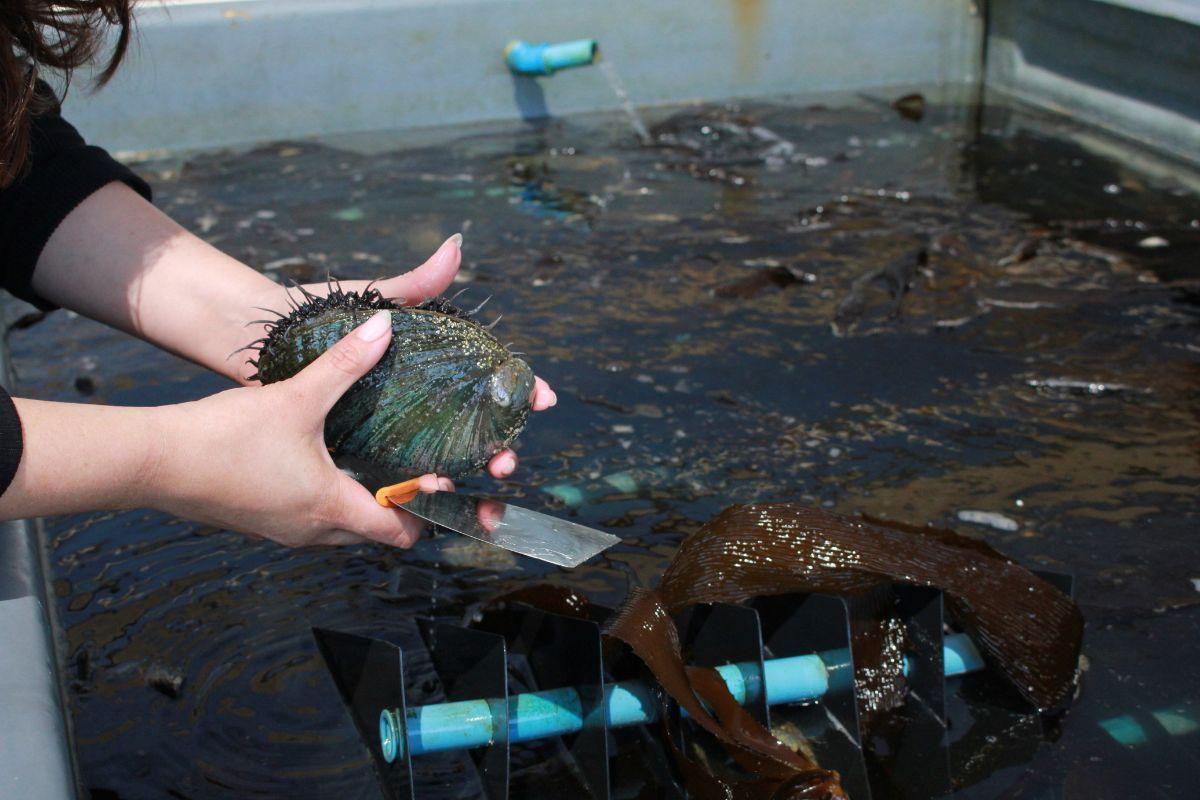
More than four decades ago, Daniel Aguilar returned to La Bocana, Baja California Sur, after studying Oceanology in Ensenada with an idea that seemed to go against all logic: to cultivate on land a species that for generations had been obtained exclusively from the sea.
That commitment promoted by the Progreso Cooperative Society for Fisheries Production has become the only blue abalone farm in the world that produces commercial-size specimens and exports living organisms to China. Now, its members are seeking to take the next step: to develop a mariculture system in the waters of La Bocana.
From the land to the sea
The directors of the Progreso Cooperative recently paid a visit to China, where they learned about cultivation technologies used in that country and established agreements to strengthen production in Baja California Sur. The intention is to start the first tests in the open ocean this year.
 Signing of the agreement between the Progreso Cooperative and Chinese producers. Source: Facebook Cooperativa Progreso.
“We don't know if a storm surge comes and takes it away, what plans we're going to have with hurricanes or where we're going to keep them. But this year we want to start with tests,” said Angella Verdugo, who runs the cooperative's blue abalone farm.
The new phase they seek to develop would combine the experience gained over decades on land with marine cultivation systems.
The idea of advancing the mariculture of blue abalone for commercial purposes, according to Verdugo, is to lower the cost of production so that it ceases to be an exclusive product for foreigners and is more accessible to the domestic market.
The first tests could be carried out in areas close to the La Bocana estuary, although there are still unresolved questions about Pacific conditions.
“Maybe it doesn't work for us or maybe we say, 'Why didn't we do it before? ' We'll find that out,” Verdugo said.
They are currently being supported by researchers from the Center for Scientific Research and Higher Education of Ensenada and the Center for Biological Research of the Northwest to carry out genetic analysis and strengthen the bioeconomic part of the project.
A unique farm in the world
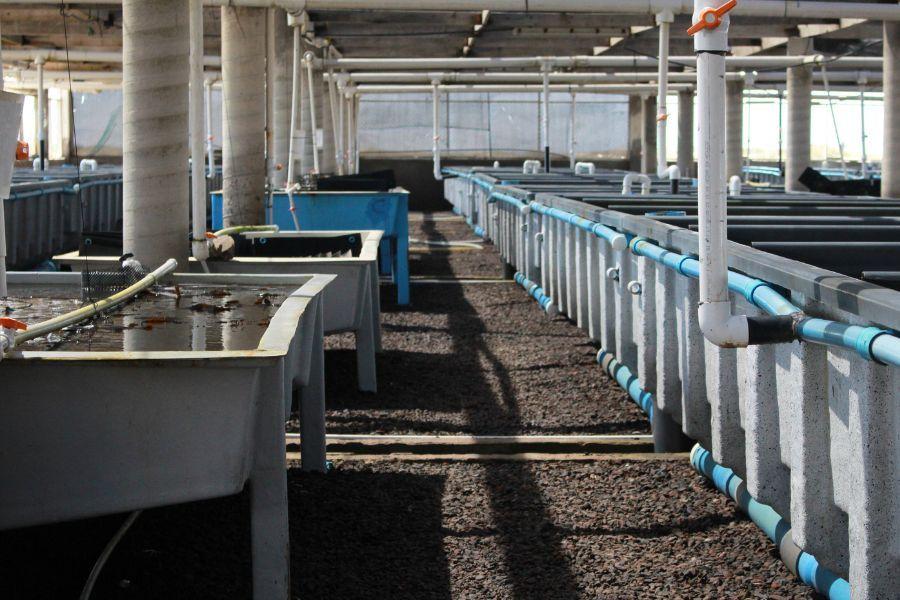 Blue abalone farm in La Bocana, Baja California Sur. Source: Daniela Reyes.
When Aguilar began talking about the reproduction and cultivation of abalone, in the mid-eighties, the species was still abundant in the region and the cooperative was dedicated to capturing this and other wild species in the sea.
“It was a very contrary to traditional thinking because the fishermen said: 'How are we going to get out of the sea and take it to land if we have product in the sea? ' They were taking out hundreds of tons a year and no one was wondering what was going to happen when there were no more tons,” Verdugo said.
The situation changed drastically after a red tide that affected natural populations and highlighted the vulnerability of relying exclusively on fishing and on a species.
“You have no control over the sea. You can imagine a lot of scenarios, but you can't say how much you're going to capture,” he said.
With information from Chile and Japan on reproduction techniques, Aguilar began the first efforts to produce abalone with the objective of repopulating natural banks. Decades later, in 2014, the cooperative put into operation the facilities that today make up the only terrestrial blue abalone farm in the world that markets its product.
The farm operates with an open system that uses pumped seawater and mechanical filters, without resorting to chemical treatments. The animals are fed algae collected through pruning to avoid affecting natural banks.
“We try to intervene as little as possible and simulate what abalone life would be like in the sea. It's not that you have all the conditions under control, but you can control them more than at sea,” Verdugo explained.
Abalone growth is slow. The organisms grow by only one and two millimeters per month and require between three and a half and four years to reach the commercial size of 7 to 8 centimeters, which involves a significant investment of money and time.
The production began to be marketed in 2020 and is currently mainly exported to the Chinese market. The organisms travel alive from La Bocana to Ensenada and are then flown to Xiamen, a city located on the west coast of the China Sea. They have also managed to market abalone and other products in the Chedraui retail chain.
Although they are still learning and perfecting the cultivation of blue abalone, they have reached a point where it has worked and has allowed them to generate income for the cooperative.
Diversify to reduce risks
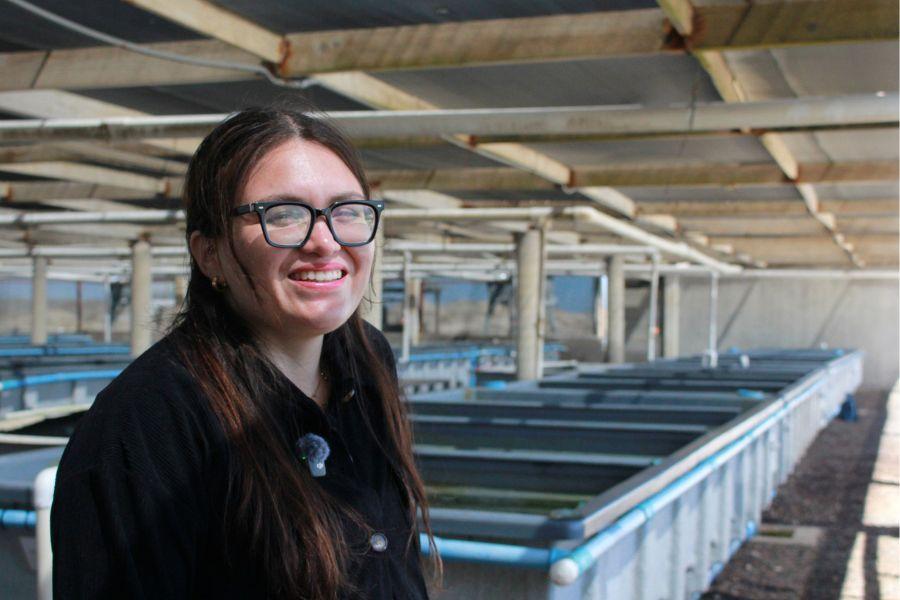 Angella Verdugo, in charge of the cooperative's blue abalone farm. Source: Daniela Reyes.
For the cooperative, the cultivation of abalone represents a way to reduce dependence on traditional fisheries and face the uncertainty derived from climate phenomena and market fluctuations.
“The main catch is lobster, but a weather phenomenon or even a conflict between countries can change everything. It's very unstable,” Verdugo explained.
Although it is not a substitute for fisheries, abalone production works as an economic backup during low-income seasons.
“We want to keep growing, but in a sustainable way. In the end, it's not just about one's benefit, but about looking for other ways to relate to the sea,” Verdugo concluded.


Comentarios (0)