
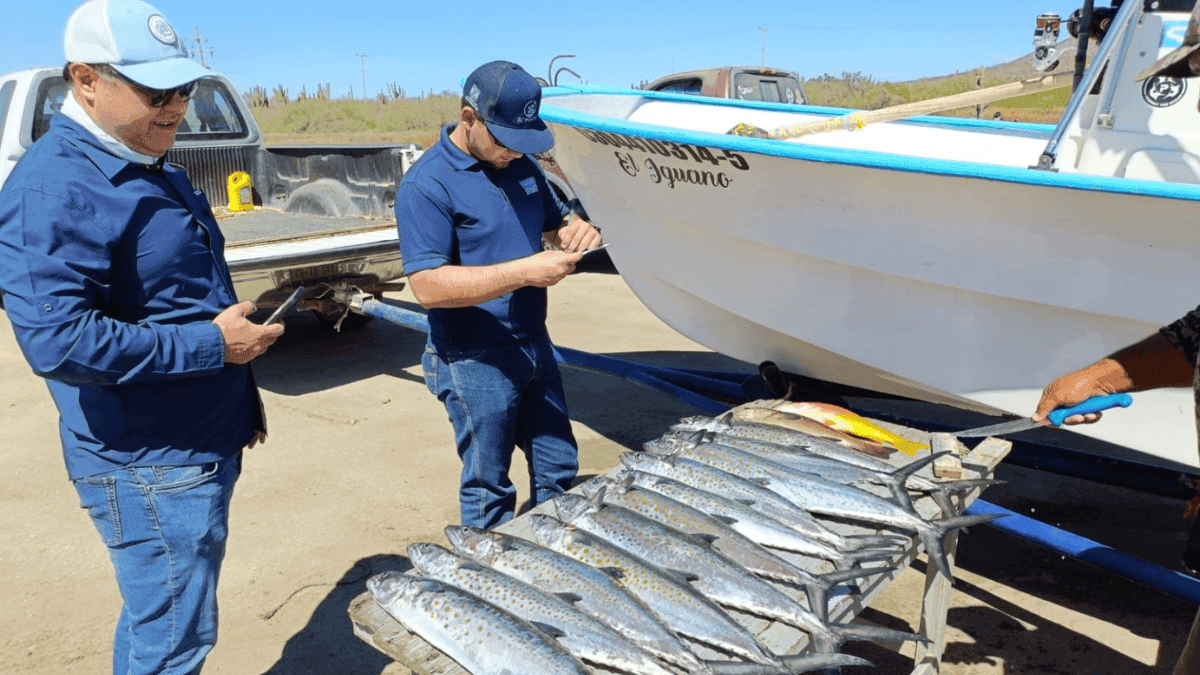
Almost a year after the government of Baja California Sur and the Fund for the Protection of Marine Resources (Fonmar) announced a study to “know the state of sport fishing” in the entity that would be carried out by the Mexican Institute for Research in Sustainable Fisheries and Aquaculture (Imipas), a request for public information reveals that this effort has not been formalized.
According to the response issued by Imipas through the National Transparency Platform, between January and February 2025 both agencies “considered and analyzed the possibility of collaborating in the joint monitoring of sport fishing activities in Baja California Sur”, concluding that the exercise was technically feasible. However, the federal institute specified that so far there is no formal collaboration or a joint work plan to carry out the study.
“So far, the collaboration has not been formalized and no joint planning has been carried out, resulting in an agreed work plan,” said José Rodríguez, deputy director of administration and economic analysis of the Imipas Pacific Fisheries Research Directorate, who clarifies that, for this reason, there are no public versions of the inputs requested for transparency.
This position contrasts with the bulletins released by Fonmar and the government of the state of Baja California Sur in February and March 2025 regarding the study.
On February 7, 2025, both bodies announced in a statement that a sampling program in five municipalities would be launched in the ports of five municipalities. Later, a second bulletin stated on March 11 that the program had started in February at different points of disembarkation, with more than a thousand copies evaluated in municipalities such as Los Cabos, La Paz, Comondú and Loreto.
However, today Imipas recedes from this scenario and emphasizes that, although there is interest and willingness on the part of both institutions to collaborate, the definition of a joint work plan and the formalization of collaboration are still pending.
“We can confirm the current interest and willingness of both institutions to collaborate and proceed with the planning, definition of a joint work plan and formalization of collaboration; as soon as their agendas allow them to do so,” Rodríguez points out.
For its part, a request for information addressed to Fonmar yielded a different response. The state agency avoids answering if the study or program lacks formalization. However, it is limited to providing specific monitoring reports carried out during a short period of 2025: a total of six sport fishing censuses, with no indication that the exercise was carried out in all five municipalities of the state, as publicly announced.
The documents provided by Fonmar correspond to specific records collected between February and April 2025, concentrated on three months of work: two in February, three in March and one in April. The formats include information on species caught, sizes and weights at specific sites —such as Ensenada de Muerto—, but they do not account for state deployment or continuous coverage in the five municipalities of Baja California Sur.
Although the data provide biological inputs such as species, length, weight and sex, the Imipas response itself indicates that these exercises are not part of a formalized program or of a joint work plan previously agreed between the two institutions.
For this article, Causa Natura Media requested an interview and position from Fonmar with prior knowledge of the topic and the publication deadlines; however, until the close of this edition, no response was received from the state agency.


Comentarios (0)