
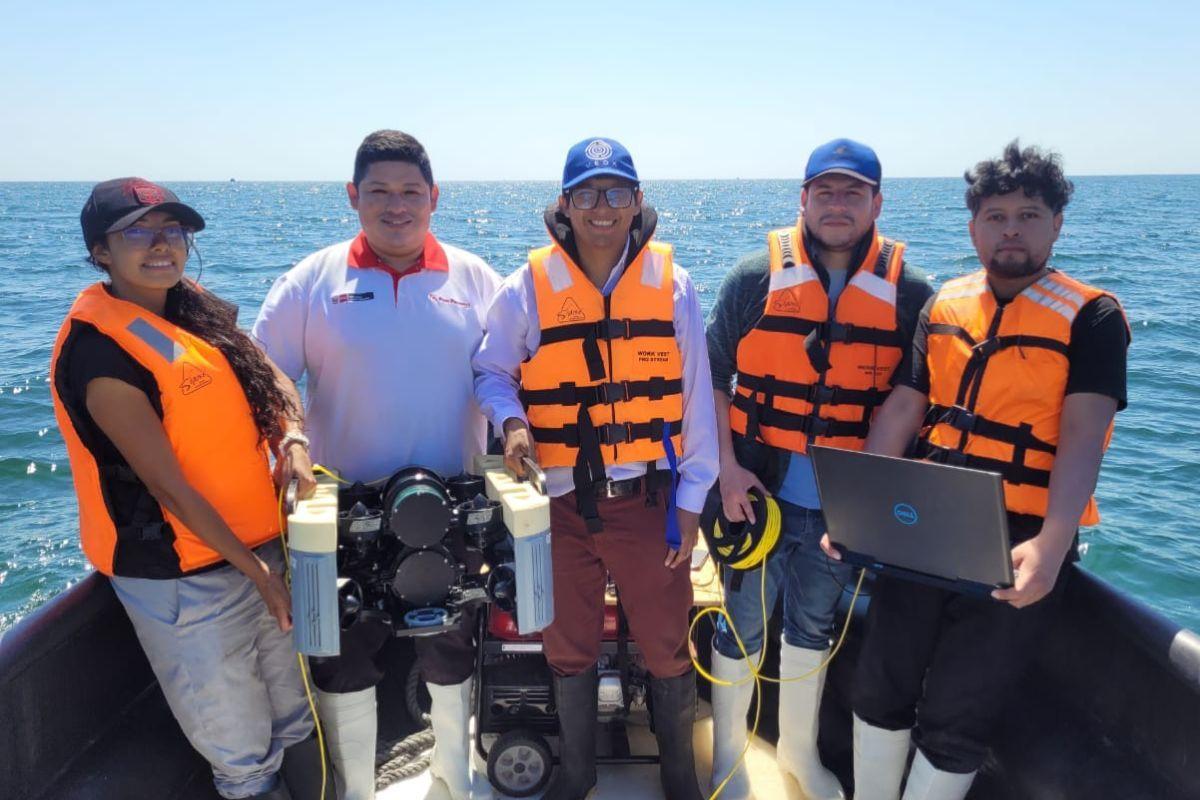
In aquaculture, estimating the number of species cultivated on the seabed usually involves removing them from the water, subjecting them to stress and even causing their death. It also exposes those who dive into the sea to carry out the monitoring, since they often do not have the right training or equipment.
Faced with this scenario, the Peruvian startup Nereuz developed a technology that works with artificial intelligence, cameras and computer vision, which makes it possible to measure and count aquaculture species without extracting them from their environment, reducing time, risks and losses, for the purpose of productive control.
Nereuz was one of 10 companies selected in 2026 by Women in Ocean Food, a philanthropic executive training program organized by Conservation International Ventures and Hatch Blue, which culminated in a public event where they presented their projects on February 5 in La Paz, Baja California Sur.
This project represented by Rosa Ventura, who serves as financial director (CFO) of Nereuz, showed how women generate innovative initiatives to solve problems in aquaculture.
How technology works
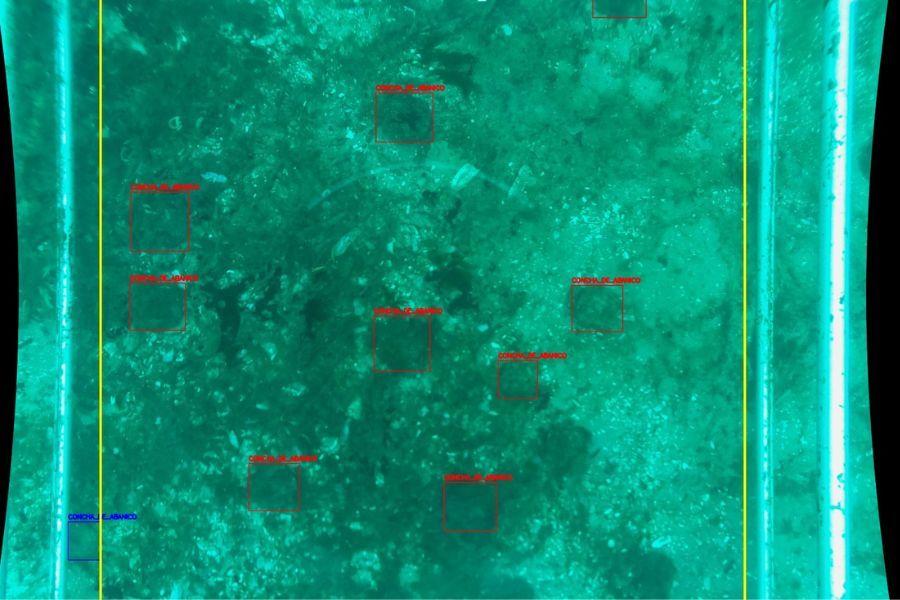 Technology viewer detecting fan shell on the seabed. Source: Nereuz.
In Peru, the fan shell is one of the most cultivated and exported species. Nereuz began working with producers from the north of the country. His first proposal was to use underwater robots with cameras and artificial intelligence to estimate biomass —the volume of a species—using transects, but it proved impractical for producers.
The team then developed a lighter and lower cost mechanism that is inserted into the sea, takes photographs and generates samples per square meter.
“They no longer have to take risks to dive in and do the monitoring. The tool captures the images, sends them to the platform and generates a productive report just like the one they work on. We simplified a very empirical work and obtained a specific solution for the estimation,” Ventura explained.
The first step in the process is to capture the species in a photograph or video, then the team labels the species manually and customizes the data set to train the model, explains Nadia Quispe, systems engineer and responsible for the artificial intelligence area at Nereuz.
“We work with cutting-edge models such as YOLO, an efficient object detection model that can be applied in real time for detection and counting. Once we have the customized model, we apply tracking techniques to avoid duplication,” he explained.
The system can be integrated with cameras or drones that automatically capture images, or used through the Sampling AI platform, where users upload photos and videos that are processed to generate biomass reports and size estimates.
The tool has already been applied to monitor hedgehogs, sea suns, anemones, rainbow trout and prawns, and has devices for transect sampling, quadrants and floating cages.
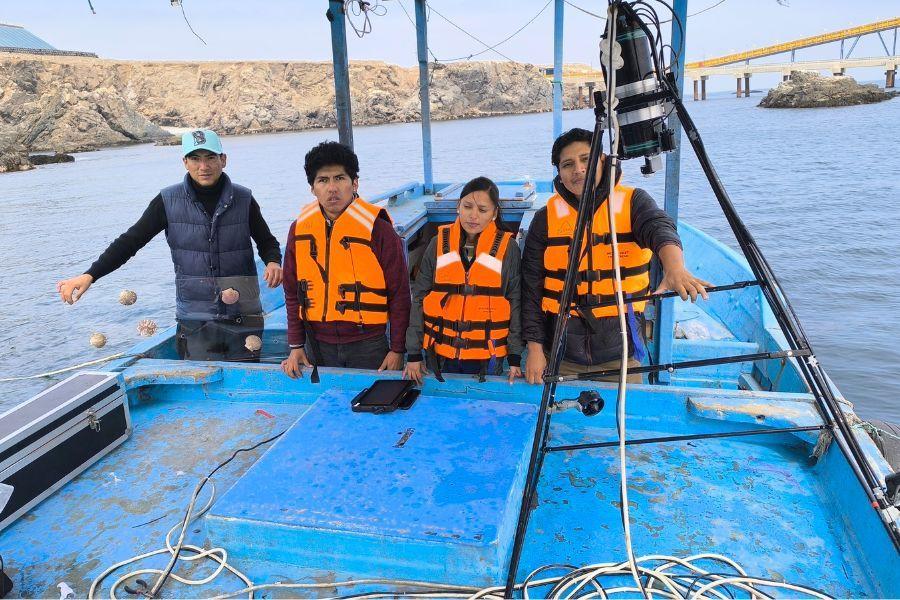 Device for monitoring aquaculture resources by quadrant. Source: Nereuz.
Expansion to other ecosystems
Although Nereuz was born focusing on aquaculture and aquatic resources, in the last year it has received requests from other sectors.
“We have been called from the conservation and environmental monitoring sectors. We see the potential in other species and ecosystems. The biggest challenge is working in water; outside of it it is easier, although there are other connectivity and electricity challenges,” said Ventura.
The company has been called upon to monitor birds in a Protected Natural Area, where in addition to estimating biomass, they identified flight patterns. They also conducted a demo to evaluate the impact of mining on penguins and were contacted to monitor alpacas, key to the Peruvian textile industry.
For Ventura, the technology is especially useful in ecosystems that are difficult to access or where monitoring involves risks for park rangers or biologists. “Having these alternatives helps a lot,” Ventura said.
Women in the blue economy
For two weeks, a group of 10 teams from Latin America and the Caribbean, including Nereuz, met in La Paz to receive workshops and mentoring in finance, marketing and communication as part of the Women in Ocean Food program.
“Our vision is to create a world where women lead food and ocean innovation by creating companies that restore oceans and communities,” explained Mariana Flores, Hatch Blue's Community Manager in Latin America during the Women in Ocean Food event.
Gracie White, director of Global Ocean Investments, noted that the program intervenes in early stages, when many women are left out of the process to receive investments.
For Ventura, participating in this event was key to defining the direction of the start-up, which currently consists of searching for international markets.
Currently, they are making their first sales and are exploring alliances, including with the largest seaweed producer in America, in Venezuela.
During the meeting, awards were awarded for the best pitch for TIDE, from Venezuela; for the most investable company for Argentina, Erisea; and the best collaborator went to Gabriela Villouta, from Chile's Bioproc, for her contribution to strengthening the regional network of women entrepreneurs.


Comentarios (0)