
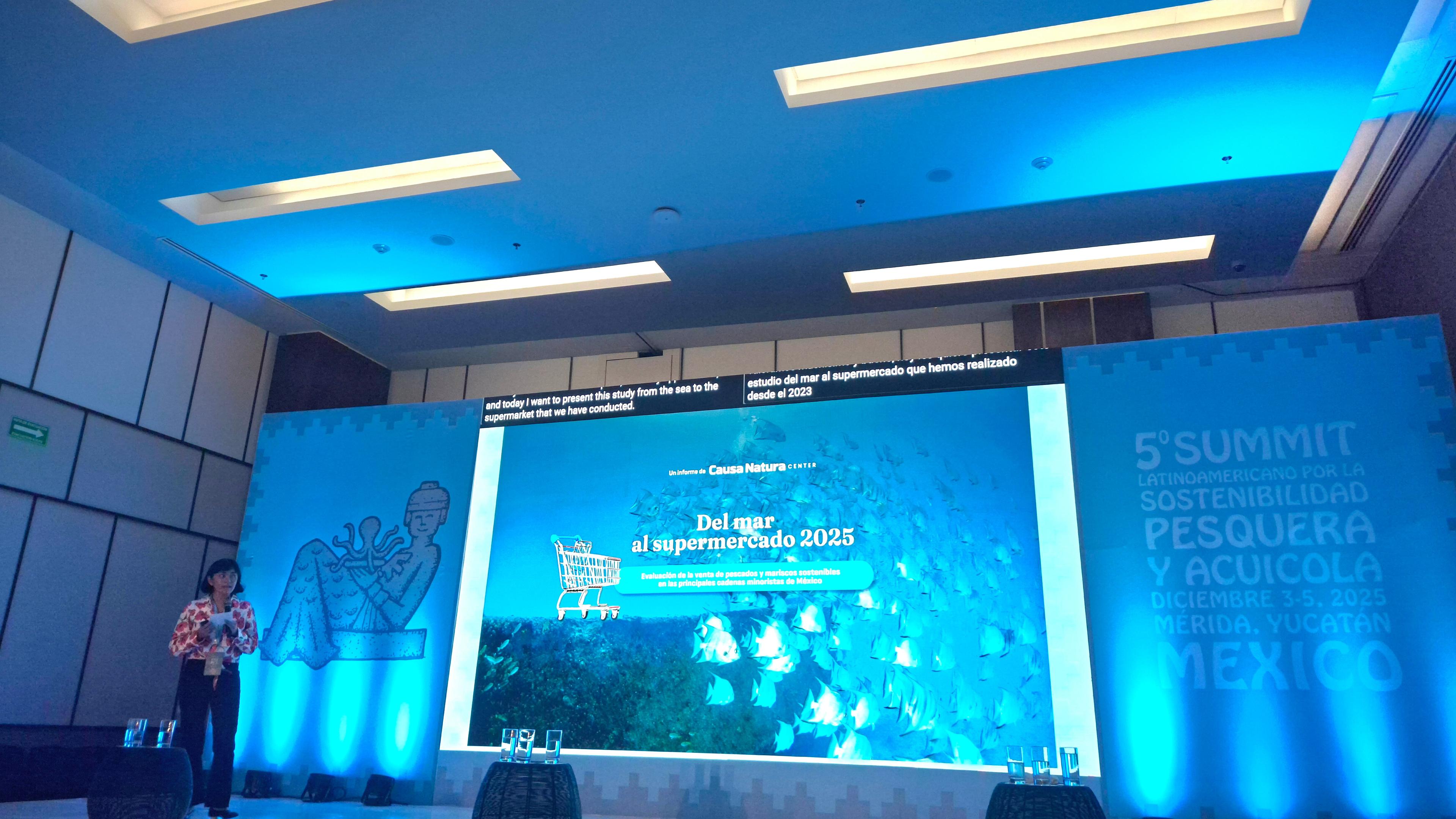
At the 5th Latin American Summit for Fisheries and Aquaculture Sustainability, Harumi Hayashida, coordinator of the Applied Research unit at Causa Natura Center, shared the report From the sea to the supermarket 2025. This is an X-ray of the role played by the country's six major retail chains in evaluating their commitment to sustainability in the sale of fish and seafood.
The evaluation reveals that some retailers have begun to transform their practices, while others are maintaining enormous lags affecting both ocean health and the economy of fishing communities.
In Mexico, an average person consumes 12 kilos per year, but the context becomes complex because around 40% of production is still illegal, 60% of fisheries operate within their sustainable limits and 80% of those who fish do so in informal conditions, without social security or basic labor rights. This combination creates a scenario where the role of retailers is key to fisheries sustainability.
“Supermarkets are an important player in the chain and we believe they can do a lot to reverse these numbers,” said Harumi Hayashida, from Mérida, Yucatán.
 Data found in the report From the sea to the supermarket 2025.
The report uses a methodology that involves a metric ranging from zero to 10 points that review six criteria: sustainable supply, traceability, labeling, impact on sustainability, environmental impact and labor human rights.
As part of the results, it was possible to observe that Walmart remains in the lead with the highest rating, accompanied by robust sustainable sourcing processes, independent audits and systems that allow tracing the origin of its products with greater precision.
Chedraui positions itself as a relevant actor in the region, thanks to early sustainability policies and its collaboration with civil organizations to prevent the sale of endangered species.
Costco, for its part, takes advantage of international alliances and certifications such as Aquaculture Stewardship Council (ASC) and Marine Stewardship Council (MSC) in addition to requiring that fisheries improvement projects have public verification on specialized platforms.
Soriana, on the other hand, remains without public commitments to guide its purchasing decisions or actions that strengthen traceability. And La Comer faces a different problem because it offers one of the most extensive catalogs in the market, but information on the origin and fishing methods of its products is limited, making it difficult to know if it complies with environmental regulations or if it markets species subject to protection.
“We know that there is still no complete traceability from the sea to the supermarket, however, it is already an advance that they do have at least systems to ensure the legal origin of their products with invoices that have the sheets of notification of arrival, harvest, fishing offices and also that they have auditing systems to verify this information,” he added.
Harumi Hayashida highlighted that labeling is another important element for an informed purchase and although most canned and frozen products comply with NOM-051, essential information is still missing on many packages such as scientific name, country of origin or method of capture.
 Main findings in the report presented during the 5th Latin American Summit for Fisheries and Aquaculture Sustainability.
The report shows that all chains have incorporated practices that reduce their ecological footprint, from food rescue programs and plastic reduction to the transition to renewable energy, which in some cases already represent between 50 and 70% of operating consumption.
Although there are advances in some areas, during the presentation, Harumi described that among the pending issues, attention must also be paid to respect for the labor rights of those involved in fishing.
“Consumers are the ones with the least information, so this report is to raise that awareness. With regard to labor rights, we cannot talk about sustainability, but there are companies in which labor and human rights, issues of safety, equity, inclusion are important, and so we have to try to include this in supermarket policies,” he said.
*This article was written by Itzel Chan, who covers coastal communities thanks to the support of the Report for the World program.


Comentarios (0)