
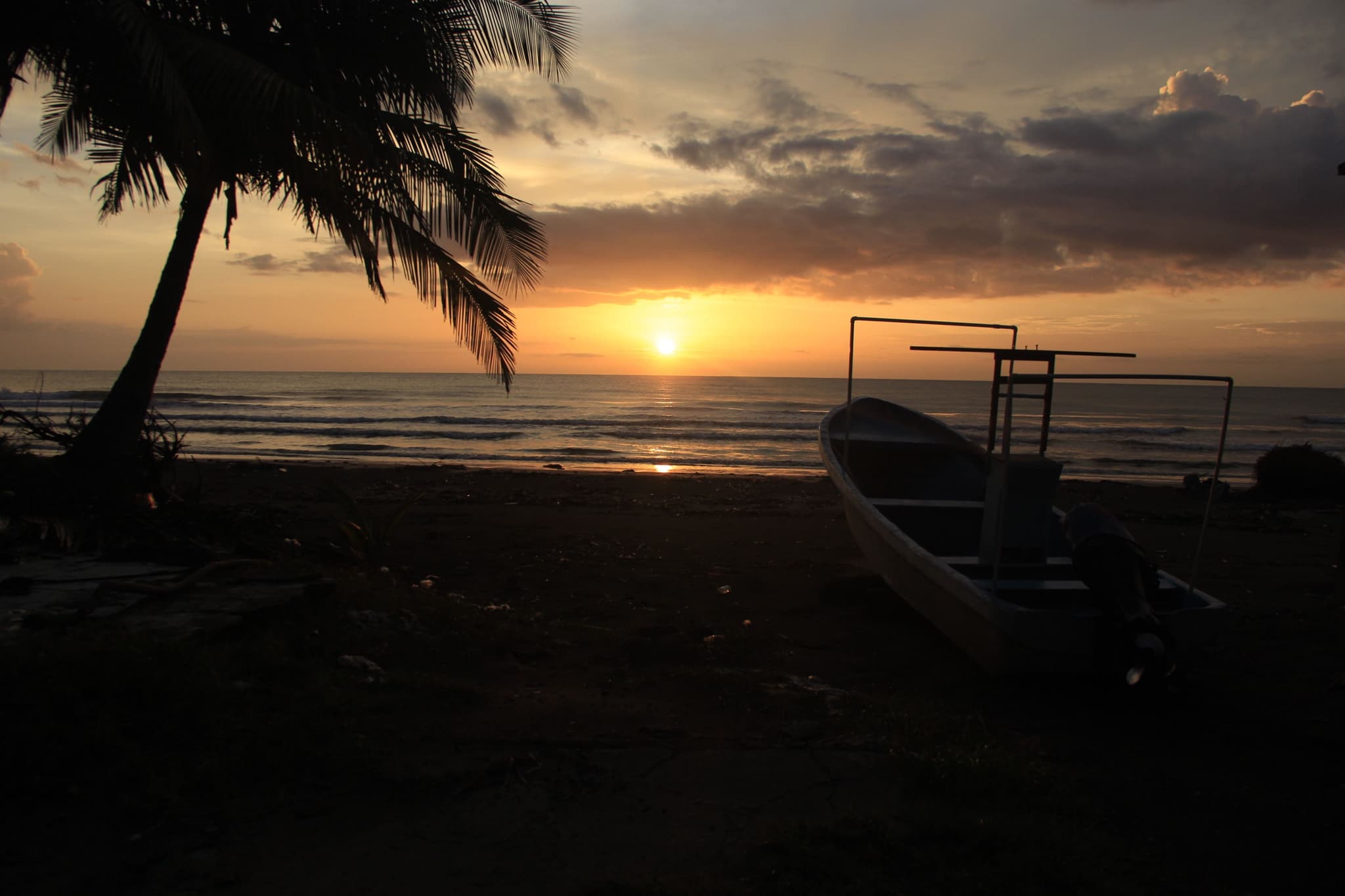
At dawn, the sun emerges over the ocean in front of Las Barrancas, a small fishing community of about 300 people, located south of Boca del Río, in the municipality of Alvarado, Veracruz. In this community, a group of women made history and succeeded in getting the Supreme Court of Justice of the Nation to order the Executive Branch to issue regulations for the General Law on Sustainable Fisheries and Aquaculture, which had been pending since 2008.
On this coast, which is gradually disappearing due to coastal erosion—driven by climate change, the alteration of rivers and major infrastructure works—where beaches, mangroves and the sea support the lives of dozens of families, some people have had to go to Yucatán to work during the octopus season due to the scarcity of local employment. Those who remain in the territory keep alive a fishing tradition, a way of life that resists the passage of time and environmental pressures.
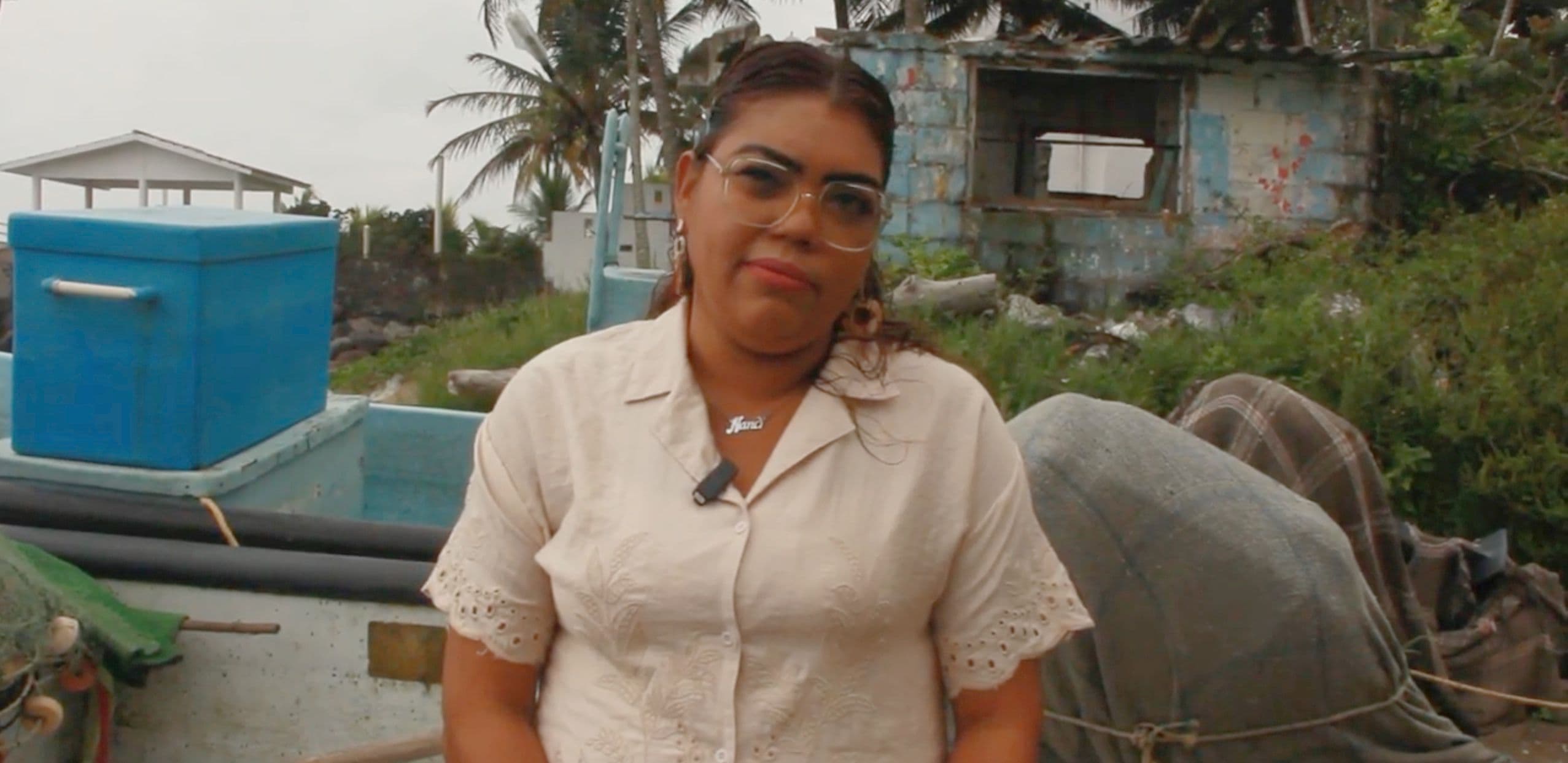
Nancy Ochoa Tello, an Afro-Mexican woman and fourth-generation fisherman, learned this trade from the hands of her grandfather, who taught her to fish and to know the territory where they carry out this activity. Based on this link with fishing, Nancy explains the problems that led the community to file an indirect amparo lawsuit in June 2023. “Because of the problems experienced by the fishing sector in artisanal coastal fishing,” he explains, “it is overexploited fishing, that we have an unhealthy environment, that our fisheries are disappearing.”
In front of the family boat, Nancy says that one of the main forms of artisanal fishing is the “hand line”, a traditional method that consists of a line equipped with a hook that facilitates the individual and selective capture of fish. “Since our ancestors, it has been selective fishing,” he says.
The contradiction arises in the current regulatory framework, which sanctions selective fishing gears because they are not explicitly incorporated into commercial fishing concessions. “Nowadays, for not being inside a fishing permit, they sanction us, they prohibit us from doing our activity, which is our livelihood.”
For Nancy, this restriction is incomprehensible in the face of the benefits of artisanal practice. “(It's) the healthiest activity, the one that allows us to continue to have fisheries.”
What worries him is the impact of industrial and mass techniques on the coastal environment. And it warns of the collapse of marine habitats. “The environment, the reefs, are running out, which are those cradles where our species reproduce.”
You may also like: Divers abandoned on the high seas: the invisible risk of poaching in Yucatán
Four generations of fishing families
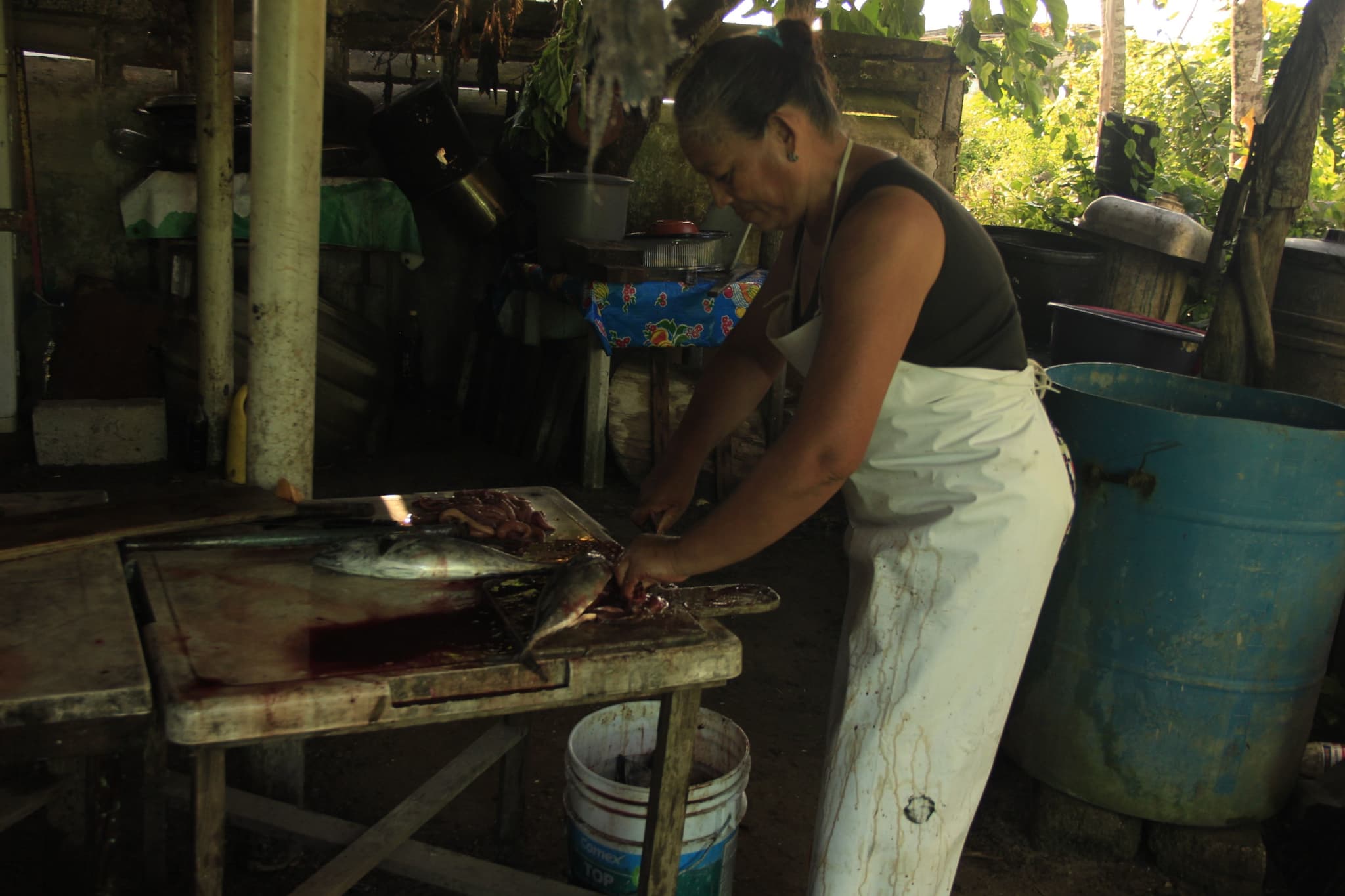
Doña Elia, dressed in a white apron and waterproof boots, deftly wields a sharp knife to remove the entrails of fish known locally as “pretty”. In Las Barrancas, this cleaning task is known as “aligning” the fish, an essential process to get the most out of the food before taking it to the kitchen. This marine species also gives rise to the name of the local organization made up of the women of the community: Las Bonitas, made up of female fisherwomen from Las Barrancas, who filed an amparo to claim the lack of regulations in the Fishing Act.
The process of “aligning” fish is based on a deep sense of sustainability: the removed viscera are not wasted, they are kept in plastic bags in the freezer to be used later as bait for the next few days at sea.
Doña Elia, her husband Silverio, and Nancy have consolidated a family dynamic around fishing that preserves collective knowledge. Together they prepare the traditional minilla, which is sold directly to the consumer, avoiding intermediaries to ensure the livelihood of their home.
For them, fishing is part of the history of their community and their family. In the case of Nancy, this is an activity that they have carried out for four generations.
“We depend on fishing as an economic activity, but above all as our identity, our origin, our root, what we want is for it not to disappear,” he shares.
The Amparo That Made History
To learn how the case was legally constructed and what the fishermen brought to court, lawyer Yoatzin Popoca Hernández, who accompanied the community during the process, explains the scope of the trial and the absence of rules that motivated the lawsuit.
“The absence of specific fishing regulations, limited and tailored to the General Law on Sustainable Fisheries and Aquaculture, constituted a direct violation of the right to a healthy environment, to food, to culture and to the management of natural assets of indigenous peoples and comparable communities,” he says.
The General Law on Sustainable Fisheries and Aquaculture was published in 2007. Its sixth transitory article established a period of six months for the President of the Republic to issue the regulations. That deadline expired in 2008. For Popoca, the obligation remained pending during different governments. “That guideline was never met.”
The legal problem raised by the lawsuit was related to law enforcement. Popoca sums it up this way: “The law provides the basis, but the regulation contains the 'how', and without the 'how', the law is a dead letter”. The regulation that currently exists dates back to 1999.
After a long legal battle, on February 20, 2026, a Collegiate Court determined that, due to the transcendence of the matter, it was up to the Supreme Court to analyze the existence of the omission. Popoca explains that the Court established that the State must have secondary rules that allow the effective application of the regimes established by laws. “The Supreme Court determined that this regulatory omission is not only a formal violation of due process, but it directly violates the right to a healthy environment and directly affects artisanal fishermen who depend on these ecosystems.”
The resolution also establishes the conditions that must be considered during the drafting of the regulation. These include the relationship of fishing communities with their ecosystems, the principles of precaution and prevention, equity between generations, the best available scientific evidence, and communities' rights to access information and participation.
Popoca argues that community participation will be a central part of the next stage: “The Executive cannot be allowed to make the regulations in the dark, because we would run the risk of legislation being legislated in favor of industrial hoarding.”
“The regulation must fairly regulate closed periods and guarantee decent economic subsidies so that families have enough to eat while species regenerate; it is unfair to prohibit the activity without providing alternatives,” he explains.
In addition, the lawyer says that artisanal fishermen face difficulties in obtaining permits. “Today they operate in absolute helplessness. There is an enormous institutional disparity. Artisanal fishermen — who use environmentally friendly fishing gear — are denied permits under the bureaucratic pretext that 'no permits are available', while industrial vessels, with highly harmful and polluting fishing techniques, obtain concessions without problem.”
The ruling ordered the Federal Executive to draft the regulations. The deadline is 180 calendar days after the judgment takes effect.
Read: The sea is eating away at a town in Oaxaca; the second community displaced by coastal erosion in Mexico
Involving fishing communities
Yoatzin Popoca says that it is very important to recognize that the community of Las Barrancas, Alvarado, was the spearhead. “He took on this long process with enormous uncertainty, but the victory is here.”
And now, it's up to the authorities to listen to the communities. “Today we fishermen and women fishermen raised their voices and it was possible that before the Supreme Court of Justice there was a ruling in favor of having fishing regulations, but that the voice of fishing communities should be heard,” Nancy says.
The Court's decision will open a process to draft regulations that develop the provisions of the General Law on Sustainable Fisheries and Aquaculture.
One of the issues that Nancy considers necessary to incorporate into the new regulation is the way in which inspections and surveillance of fishing activity are carried out.
“The issue of inspection and surveillance is very important, but it must be taken into account by the industrial sector and the artisanal sector, and not just coastal fishing,” he says.
In Veracruz, the records of public programs make it possible to identify a part of the people associated with fishing activity. In March 2026, the Government of Veracruz reported that 5,395 female fishermen from Alvarado would receive federal support from Bienesca. The state register of that program included 24,815 people.
At the state level, the National Fisheries and Aquaculture Program 2020-2024 registered 40,815 people dedicated to fishing and aquaculture in Veracruz. The document breaks down that figure into 29,679 coastal fishermen, 907 deep-sea anglers and 10,229 people dedicated to aquaculture.
From Las Barrancas, Nancy proposes working groups and consultation forums with fishermen, cooperatives and people from all over the country who work independently.
“Let fishermen be the first to give their point of view”, he concludes.
This work was carried out with the support of Studio Canek and Earth Journalism Network
Don't miss: The resilience of Cabo Pulmo: after losing a third of its corals, it is recovering little by little


Comentarios (0)