
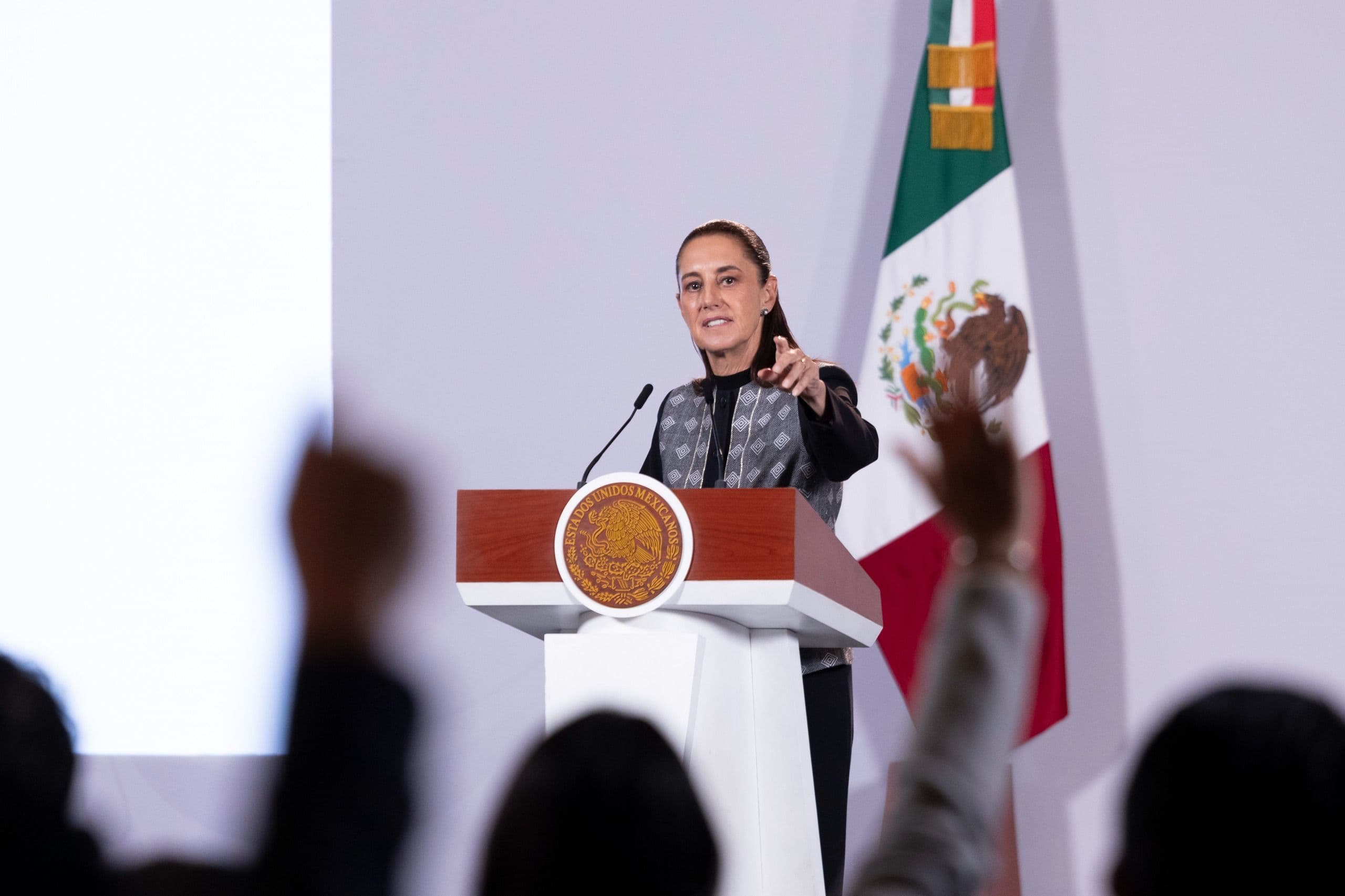
President Claudia Sheinbaum minimized the environmental impact of the Amigo LNG project, a natural gas liquefaction plant designed in Guaymas, Sonora, to export gas from the United States on ships across the Gulf of California to Asia.
“We are not going to commit a barbarity to negatively impact the Gulf of California. We know, are, have been defenders of the environment and natural resources all our lives and we are not going to commit irresponsibility,” said Sheinbaum during the morning conference this Wednesday.
“Then, a very intense study was carried out and you can see the order of magnitude: 0.05% of the surface of that area and only 4% increase in the number of ships, which are going to use the same entry path as other ships that are already entering that area,” he said.
The president argued that the liquefaction terminal would expand the country's natural gas storage capacity. “Today we have about three days of storage capacity and part of that storage is in the ducts themselves, not even in storage centers.”
Sheinbaum said that the objective of the project is, “as far as possible, to reduce the import of natural gas into the future with new combined cycle plants and to increase generation with renewable energy sources.”
He also acknowledged that “some of it is going to go for export, it's gas that comes from Texas” and “another part comes for the domestic market.” However, he did not say that 96.2% of the total produced will be for export and the remaining 3.8% for domestic consumption, according to the documentation that the company Amigo LNG, a subsidiary of Singapore's LNG Alliance and Epcilon LNG of the United States, submitted to the Security, Energy and Environment Agency (ASEA).
You may also like: Invasive species, another threat posed by gas ships in the Gulf of California
“It's already an impacted area”
Last week, the president announced that the Ministry of Energy (Sener) and the Secretariat of Environment and Natural Resources (Semarnat) would present the full report, permits and environmental studies of the project at the morning conference this Wednesday. But Semarnat was not present.
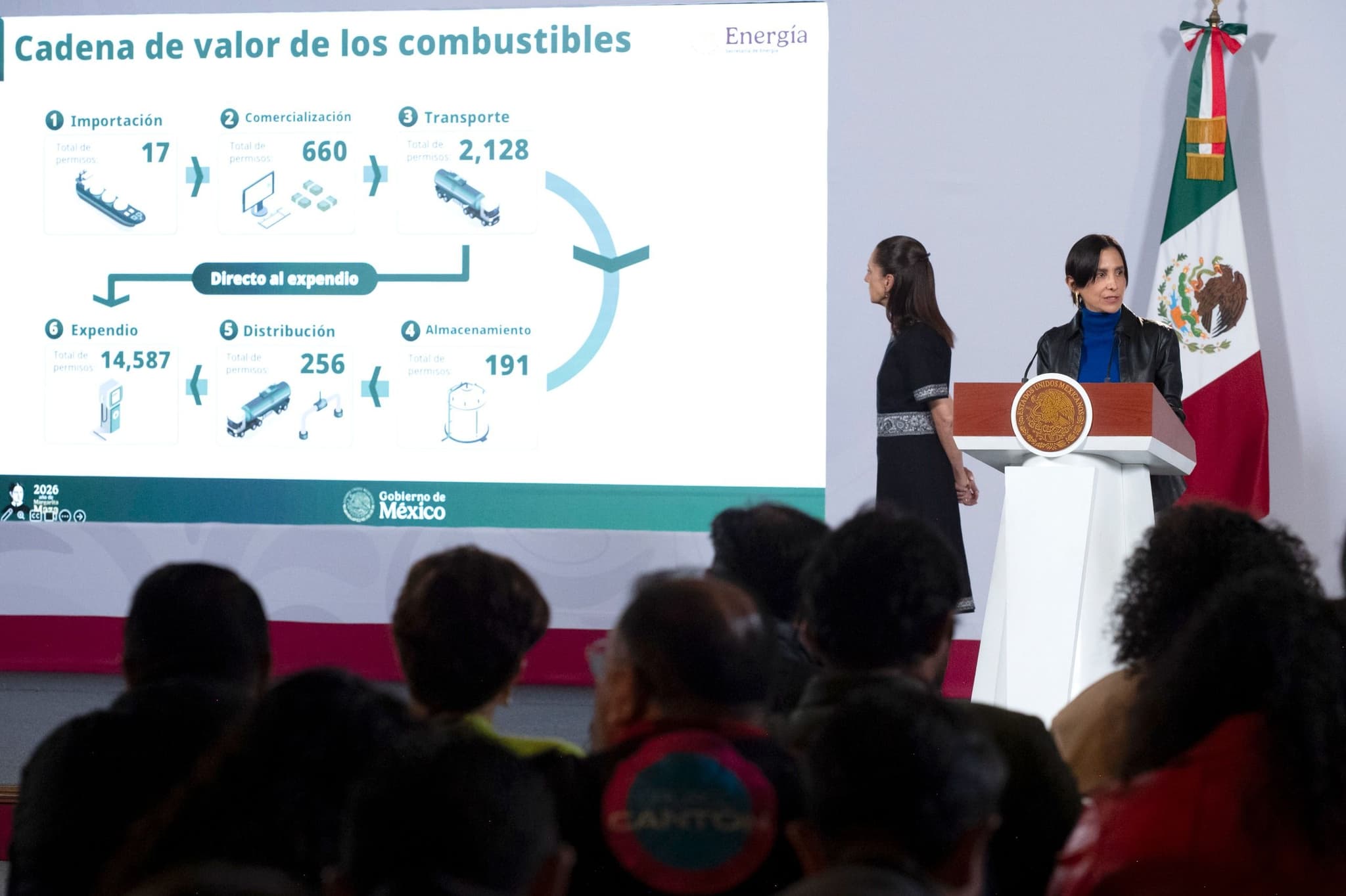
For this reason, at the beginning of the morning, Sheinbaum pointed out that the topic would not be addressed due to the absence of the head of Semarnat, but he finally gave the floor to the Secretary of Energy, Luz Elena González Escobar, who presented general data on the plant.
González Escobar also minimized the project by pointing out that the liquefaction plant would have an area of 41.7 hectares, equivalent to 0.05 percent of the municipal territory of Guaymas and that it will be installed in an area already impacted.
“This plant is intended to be installed in the General Rodolfo Sánchez Taboada Industrial Fishing Park, which is an area that is well known and that industrial cargo, foreign trade, cabotage and fishing companies have been operating for years. In other words, it's already an impacted area,” he said.
“What is proposed in the project is that, in terms of marine traffic, gas will come out through a maximum of five ships per month, that is, 60 ships per year, which represents only 4% of the vessels that are already transiting the area,” he also said.
He added that the plant will have a storage capacity of up to 290,000 cubic meters of natural gas, similar to that of other terminals operating in the country.
“We have five other natural gas terminals in the country, two in Tamaulipas, one in Baja California Norte, one in Baja California Sur and another in Manzanillo. And the capacities are more or less the same and it also allows us to have storage in this area,” he said.
Don't miss: UNESCO Committee puts the spotlight on liquefied natural gas projects in the Gulf of California

They question the defense of the project in La Mañanera
After Wednesday morning, the organization Environmental Defense of the Northwest (DAN), which is taking legal action for the irregularities of the project and the possible ecological effects, considered that what was stated by the Federal Government minimizes the risks of the project.
“The president herself used the adjective, it's irresponsible. Opening the door to the fossil industry in the Gulf of California, no matter how many minimum numbers they give, is irresponsible,” said Cecilia García, Director of Communication at DAN.
García noted that scientists from different countries, nine United Nations rapporteurships and special procedures, as well as the UNESCO World Heritage Committee, have expressed concerns about the environmental risks of this type of project in the region.
“A liquefied gas terminal in the Gulf of California is environmental nonsense, as well as a contradiction in the presumed new energy transition policy,” he said.
The DAN representative also questioned Sheinbaum's argument about the terminal's usefulness in expanding natural gas storage capacity in Mexico. “There is no official document that AMIGO LNG facilities can serve the Mexican State as strategic storage facilities,” he said.
He added that, according to his review of the company's communications with the United States Department of Energy to request an extension of the deadline for starting operations, AMIGO LNG's arguments refer to commercial commitments with Asian countries and not to the storage needs of the Mexican market.
“If the Secretary of Energy has an agreement regarding storage for emergency use in Mexico, it should make it transparent. It doesn't have it, because it's a project with no benefits for Mexicans,” he said.
Garcia also rejected that the impact of the terminal can be assessed solely by the area it would occupy or by the additional number of ships. “Minimizing the expanse of territory in the state of Sonora and at sea, as well as minimizing the increase in heavy maritime traffic to 'only 60 more ships a year' is to minimize the exceptional universal value of the Gulf of California.”
He also recalled that the Gulf of California was inscribed in 2005 on the UNESCO World Heritage List and warned that it is already on the list of endangered sites. He considered that the terminal would add pressure to its conservation and questioned the president's judgment in the face of the cumulative impacts in the region.
“In the opinion of the President, who calls herself an environmentalist, the Gulf of California is still experiencing a little more impacts. This criterion is contrary to the scientific consensus that has already expressed concern about converting the Gulf of California into a new marine strait for gas transport,” he concluded.
The AMIGO project is under arrest by court order. The Mexican Center for Environmental Law (CEMDA) reported that a court ordered the Security, Energy and Environment Agency (ASEA) to rescind the environmental authorization, determining that the agency failed to comply with a judicial suspension related to the environmental assessment procedure.


Comentarios (0)