
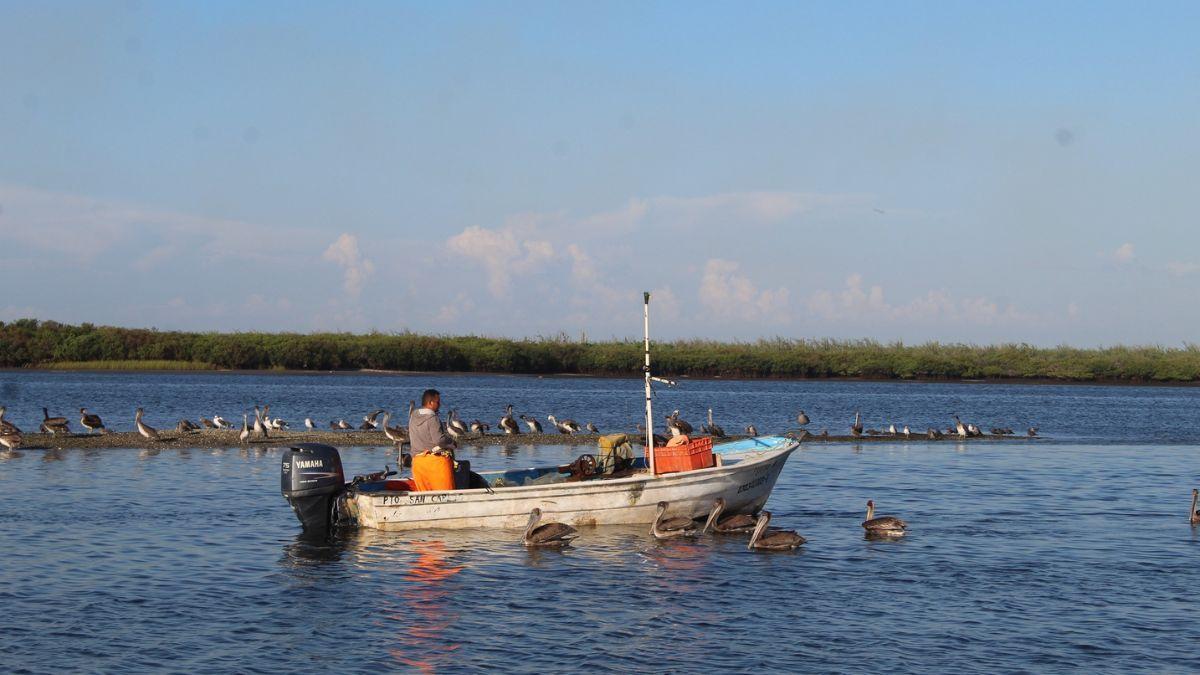
The fishing embargo on Mexico did not stop trade completely. Certificates of Admissibility (COA) have opened a way for Mexican fish products to reach the United States.
In Baja California Sur, cooperatives and exporting companies began the year with uncertainty. On January 1, the United States embargo against 21 Mexican fisheries came into effect following the determination of the U.S. authority that Mexico did not prove the “comparability” required by the Marine Mammal Protection Act (MMPA) in terms of mitigating bycatch of marine mammals.
Florencio Aguilar, president of the board of directors of the Puerto Chale cooperative, located in San Juanico, recalls that the announcement of the embargo raised concern.
“The NOAA provision had scared us a lot last year (announcement in September). But in the end, all they could do was draw up a certificate of admissibility for all species,” he says.
The COA is a mechanism administered by the Marine Fisheries Service (NFMS), under NOAA, and the United States Department of Commerce, which allows products from foreign (not just Mexican) fisheries to enter the U.S. market; it requires that each shipment subject to an embargo be evaluated individually.
The operational explanation of the certificate for Mexican exporters came at a virtual seminar organized by NOAA, a scientific agency of the U.S. government that monitors the oceans, according to Leo Adán Murillo Aguilar, who is in charge of buying fish and seafood in an exporting company.
“At the NOAA meeting, the lady who spoke said: they're going to have to fill out the admissibility forms. So we're entering (that market), so we can... We couldn't ask, because there was no question and answer session, everything was very fast and in English,” adds Murillo Aguilar.
In that same session, according to its version, the U.S. authority attributed the origin of the embargo to the lack of official Mexican information: “He told us that the government was not providing the information or the complete documentation.”
Despite the entry into force of the embargo, exports continued under the new COA scheme. “On Friday the 2nd we worked doing the first export,” he explains. Since then, each shipment requires an additional procedure. “All those who got involved, all with a certificate pass. To all, fish and seafood. Everything has to be certified.”
The change is not minor because it involves reorganizing administrative times, inter-institutional coordination and greater documentary burden.
The process requires that the documentation be managed in a limited time window: “For the certificate of eligibility you have until 11 in the morning here at the Conapesca offices in Ensenada, because they have to send it to Mazatlán... Mazatlán has 3 hours to answer me... and the office here closes at 3 in the afternoon.”
The pressure is accentuated when it comes to fresh produce. “The fresh one is already dead in ice. And that one you spend three days here, because it's getting old,” he explains.
If the certificate is not issued in time, the product must remain in storage. “If the certificates aren't on time... I have to save, I spend more people's resources, I spend more ice.”
Those additional costs don't disappear in the commercial chain. “If there's a loss here, then obviously you have to adjust it to the purchase price,” he says.
The consequence, adds Florencio Aguilar from the Puerto Chale cooperative, is that the impact may fall on the producer.
The economic dimension becomes tangible in the season of sole, a white fish.
“77 tons at 50 pesos on average represent 3 million 874,950 pesos”. Thus, 29 pangas and their respective crew members can earn 133,000 pesos in two months.
The US market is decisive in absorbing these volumes. “We were very concerned, because a lot is being sent to the United States,” says the exporter. The domestic alternative is limited: “The domestic market... cannot accommodate even half a ton, almost no sole is consumed here.”
In this context, the embargo has not completely closed the commercial door, but it has changed the conditions of access. Each shipment depends on administrative validation that can be delayed due to errors in scientific names, documentary inconsistencies or institutional response times.
Uncertainty persists. “Nothing is known”, summarizes Murillo Aguilar about the duration of the scheme. He adds: “I don't know until when they're going to say: you know what? , they won't come in anymore.”


Comentarios (0)