
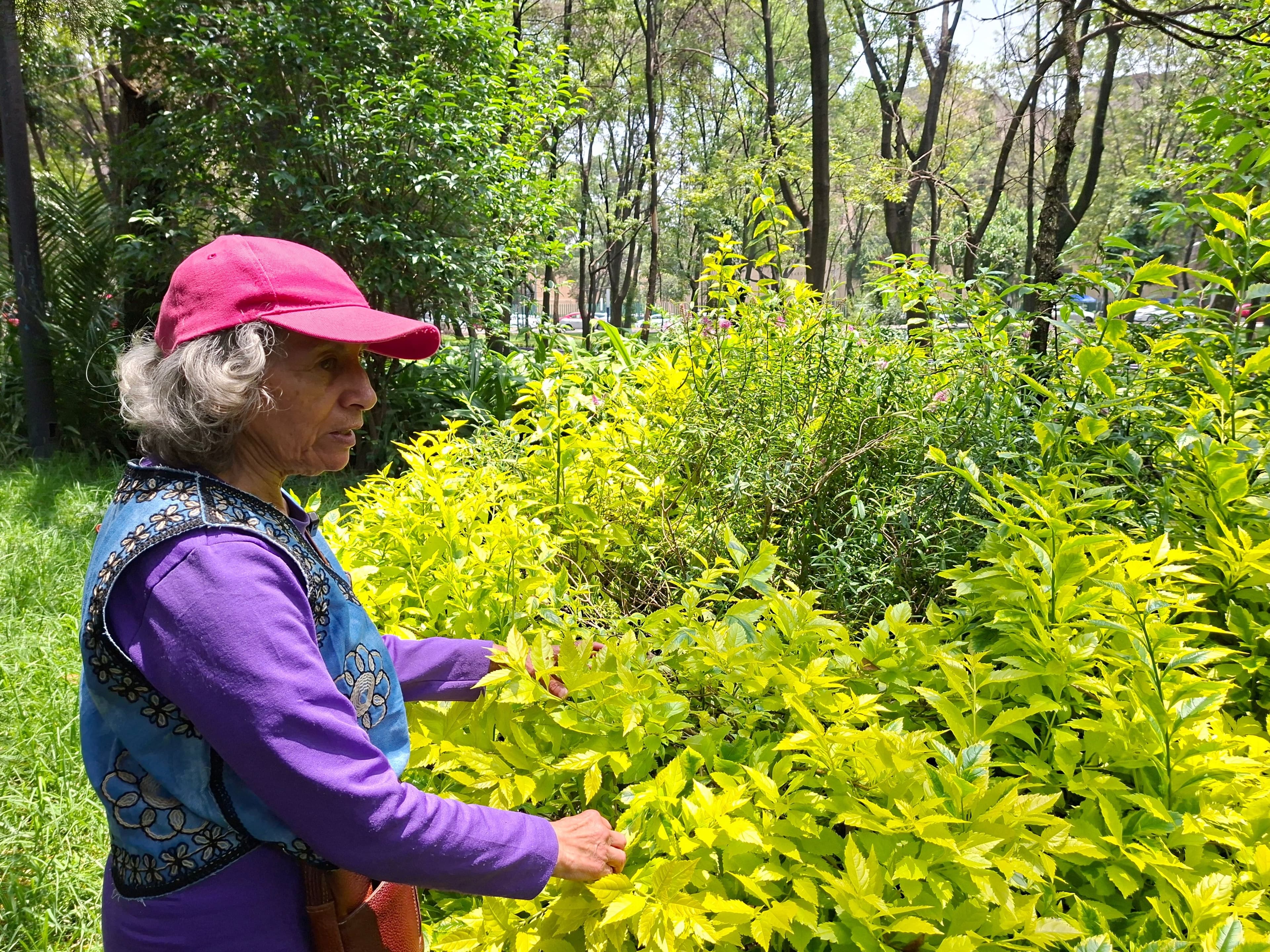
Beneath the soil of the Ramón Lopez Velarde garden in the Cuauhtémoc Mayor's Office, Mexico City, there are thousands of almost invisible organisms that support the life of plants, trees and the ecosystem of which they are part.
“It's a universe of organisms. Lots of types of bees, flies, moths, ants, worms, bacteria, fungi, everything that's under the ground, that we don't perceive, but it's a universe of organisms,” says biologist Ivonne Olalde Omaña, who works in the Botanical Garden of the Institute of Biology of the UNAM, in the collections area.
On the surface, that life may appear in the form of a butterfly that crosses between shrubs. A bird that stops on the branches. The squirrels and rodents that roam the garden. Underground, the network extends between roots, fungi, bacteria, insects and other organisms. It is precisely this ecosystem that is behind a protection promoted by neighbors of the Roma Sur colony to protect it, after decades of neglect.
The Ramón López Velarde Garden has a specific legal status: it is recognized as an Environmental Value Area (AVA) with the category of Urban Forest. The decree published in 2024 established obligations for the Government of Mexico City and the Secretariat of the Environment (SEDEMA), related to their care, including the development of a Management Program, the definition of rules and criteria for activities carried out in space and the creation of a Citizen Governing Council.
The breach of obligations gave way to a judicial process initiated by residents of the Roma Sur colony. Specifically, members of the Ramón López Velarde Park Defense Committee, with the support of the Claudia Cortés Collective, who filed an amparo lawsuit. The matter reached the Tenth Collegiate Court for Administrative Matters of the First Circuit, under the file Amparo in Revision 933/2025.
The court issued a favorable ruling for neighbors on May 28, 2026, followed by a clarification on August 6. The ruling orders the Head of Government to issue the agreement to create the Council and the head of SEDEMA to publish the Management Program and establish the rules and criteria for activities carried out within the Environmental Value Area.
Leticia Hernández is one of the neighbors who is involved in the defense of the garden. “I have been a neighbor of the Roma Sur neighborhood for practically 60 years, and I'm here because I've known the park since I was a child. When I stopped being a salaried employee, I decided to come to support the park more. I am here every day, although at different times and times. The most time I can dedicate to it is three hours a day and the minimum is 20 minutes. And it's every day.”
She explains that the council must be made up of citizens who “know the space and who identify problems, and who, in a team with the authority, rules of coexistence within the space are established”.
Leticia wants to be part of that council and to preserve for the future the memory she has collected during her years in the garden. “I'm going to request that they consider me because of the experience I have and the historical heritage, so that I can transmit it to the next ones and leave them a history of the park so that I can start with good foundations.”
You may also like: Chuburná fights to save the dunes of a real estate project
The memory of the garden
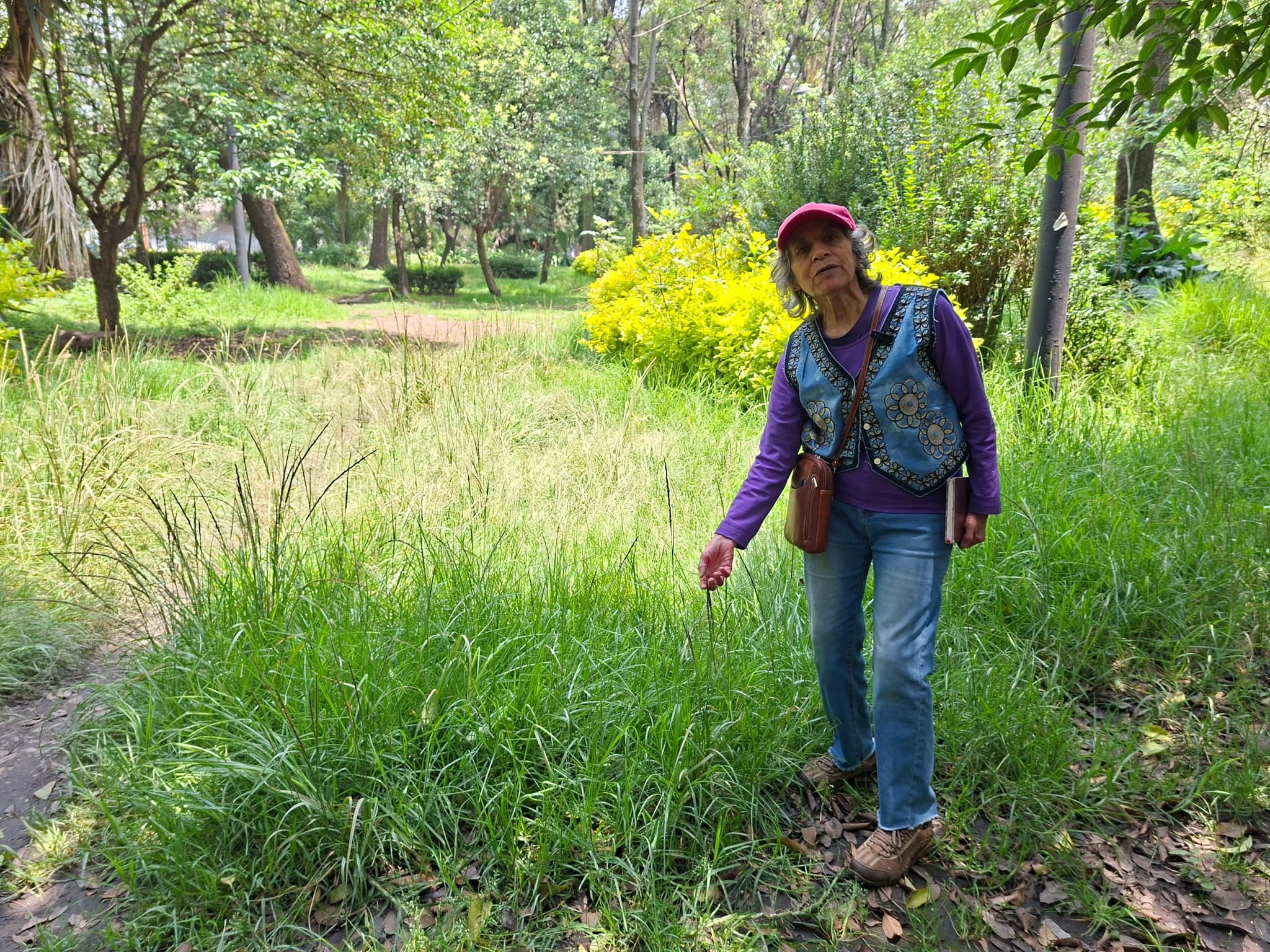
It's the morning of August 26, 2026. Leticia is on one of the mounds in the garden, surrounded by plants, shrubs and flowers in shades of red and purple. While pruning a shrub she planted herself, she remembers that after the 1985 earthquake that place was covered with stones and materials. Over the years it began to transform it and become a place with vegetation.
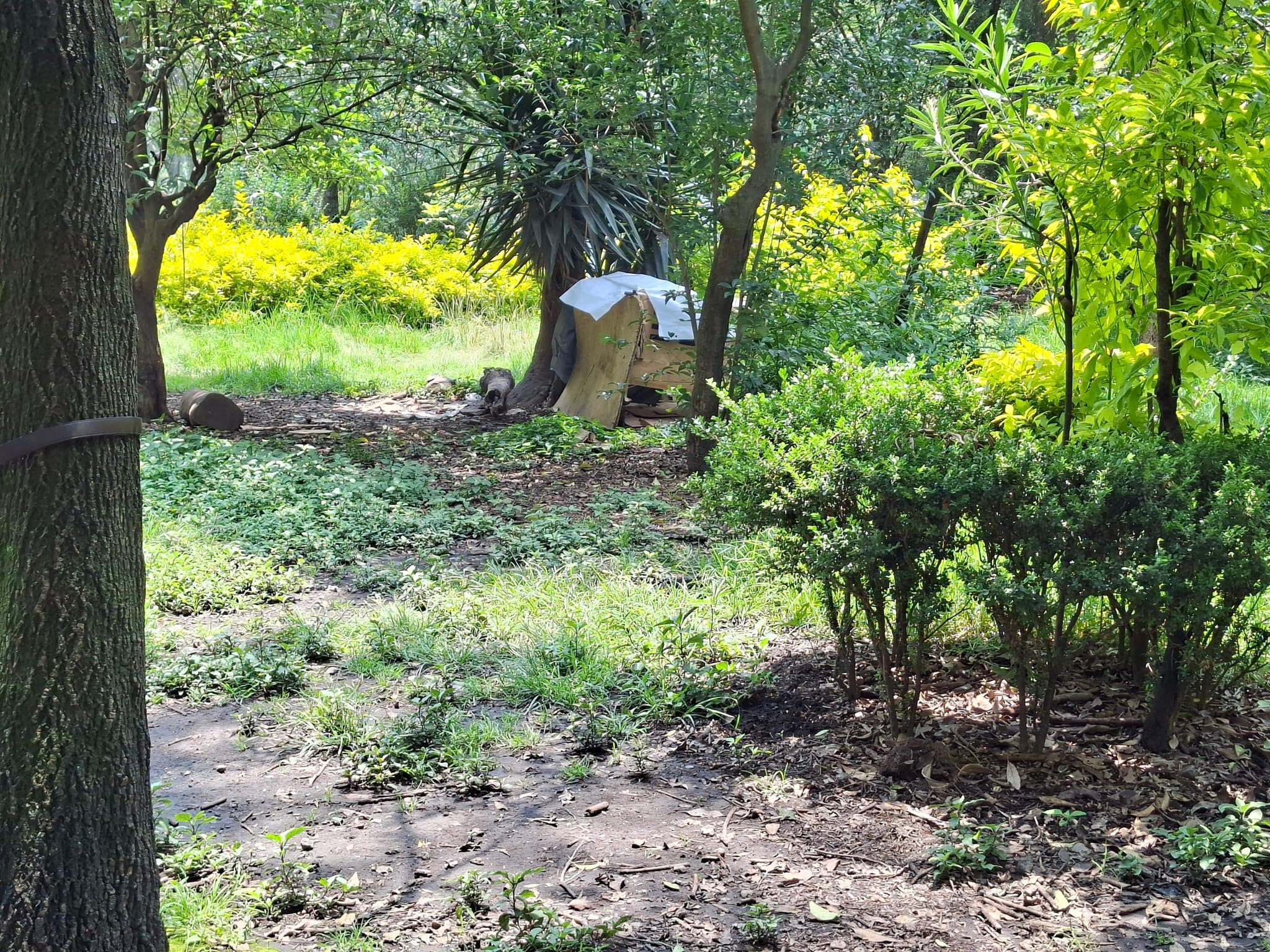
Leticia observes a butterfly that begins to surround her. Meters later it shows stains on the walls, traces that this garden has been used as a public toilet. The abandonment is evident.
Coming down the mound, a young man in a street situation approaches a tree to urinate. Leticia approaches and asks her not to do it. He explains that the concentration can affect the tree, because it contains a very high amount of nitrogen, urea and salts, which “burns” tissues and damages the soil if it accumulates.
For her, taking care of the garden also means intervening in these everyday situations. Your journey includes observing trees and plants, identifying changes, tending to vegetation and talking to the people who use the space. During these years he has also built his own record of the transformations of the place: the trees, the birds, the vegetation, the roads, the irrigation system and the modifications made in different areas. “In 2010, the census was 3,267 trees.”
Mrs. Leticia keeps memories of changes in vegetation and fauna. He mentions that before the construction of the Metrobús there were trees along Cuauhtémoc Avenue: “It was a wooded area, there were approximate distances, let's say 50 meters, there was a tree, and they were very large trees because they were spontaneous trees. When they did the work on the Metrobús, they removed them all, cut them down.”
It also remembers birds that stopped appearing as often. “The swift came a lot, there were swallows for food arriving in the surrounding area, now there are no more swallows.” Among the birds that are part of the records that Hernández has accumulated during his travels is the carpenter. “Because without the carpenter you can use the trees, because he is the one who cleans them, above all.”
His concern about the park extends to daily soil management. One of the problems it identifies is the sweeping of green areas and the way in which pruning is carried out. “Green areas should not be swept away because that is what forms the ground, and here they are constantly removing. The question of pruning must be appropriate.”
For Leticia, soil condition is related to trees' ability to deal with pests and stressful conditions. “If the soil is tended to, the tree has its defense mechanisms, but if it doesn't have irrigation, if it doesn't have leaf litter, if it's constantly stressed, because it's weakened, it can't defend itself.”
Don't miss: Celestún asks for increased vigilance against Mayan octopus poaching; an estimated 150 fishermen involved
A connected network between vegetation points
Park life begins much earlier than a person who is simply walking through it can see.
Ivonne Olalde, who has dedicated herself to the management of urban trees and the propagation of native plants, argues that each green area can play a role within a larger network of natural spaces.
“These green spaces, when well planned, work like a network as if it were an infrastructure.” And he points out the importance of maintaining connections between the different vegetation points of the city. “A garden that does have native plants helps me to ensure that from the natural areas that are still preserved, around the city, both vegetation and all associated organisms could infiltrate the city.”
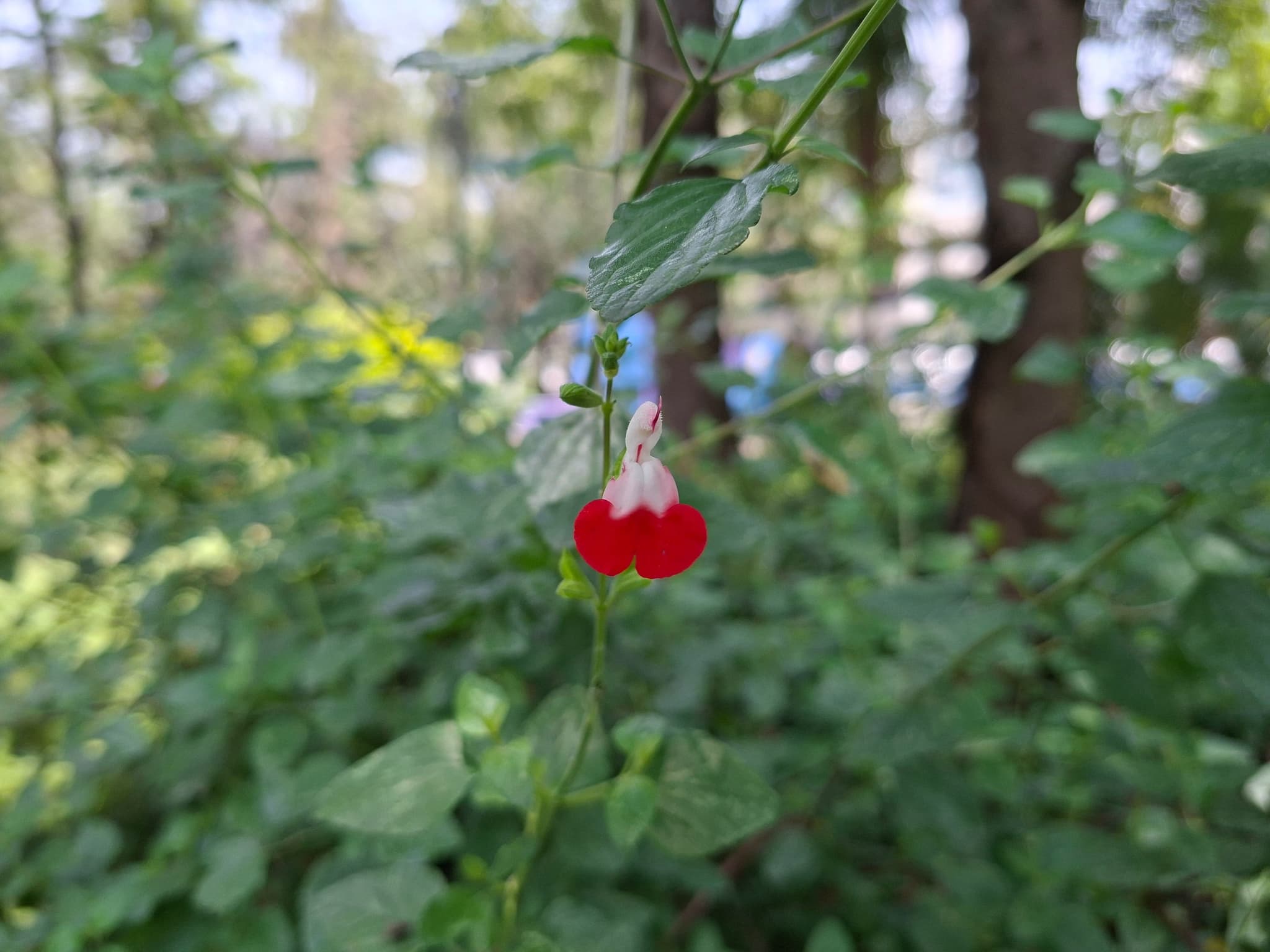
He explains that the composition of vegetation also determines what other forms of life can settle around it. “If I have a garden with exotic species, that is, that are not from the area, I break the chain of insects and worms, and bacteria and fungi, and all the organisms that are associated with plants.”
At Ramón López Velarde, this network is located in a space surrounded by urban infrastructure, housing, traffic and an intense movement of people. For Olarte, each fragment of vegetation can play a role within that green infrastructure. “Each piece of the park could have a different purpose and requires different management and all of this needs planning.”
The Ramón López Velarde Garden is part of a larger network of green areas in Mexico City. According to the Inventory of Urban Green Areas of the Ministry of the Environment (SEDEMA), the city has 11,739 records of green areas, which together cover approximately 6,731 hectares. Among them, there are 1,441 parks, with a combined area of close to 1,118 hectares, according to the 2017 inventory. The Ramón López Velarde has an area of 74,825.9 square meters, equivalent to 7.48 hectares.
In the Cuauhtémoc mayor's office, the inventory identified 47 parks that together occupied 25.6 hectares. The Ramón López Velarde Garden alone accounts for about 30% of this area. Due to its extension, it is among the largest green spaces in the area.
The SEDEMA database also records other types of spaces: 163 squares, 147 public gardens, 75 trees and nine avenues. The protection categories include 26 records of Protected Natural Areas and five of Areas of Environmental Value. These last categories have a different treatment within the inventory and their surfaces are not part of the total calculation of urban green areas.
Years of resistance to real estate depredation
The history of care to preserve the garden begins before the current configuration of the colony. Hernández relates the garden to the presence of ahuehuetes associated with the ancient lake landscape. “Huehuetlán” means an immensity of ahuehuetes, in other words, there were a lot of ahuehuetes because they were still reminiscent of the lake. So, they were born spontaneously. Here in this park there are trees of that nature that were not planted by human beings.”
Among the specimens it identifies there is an ahuehuete. “The one across the street is an ahuehuete, it's even part of the city's heritage. And he has a brother here on this side who's a little younger.” The memory also includes species that have disappeared from the garden. “There were six crabs, and there was only one left six years ago.” The number of trees was recorded in a census carried out in 2010 by the then Cuauhtémoc delegation.”
For Olalde Omaña, the importance of green areas is related to the proportion they occupy within cities. “Since they are small surfaces compared to what is covered with cement or already urbanized, it's very important because these small spots give us a lot of ecosystem services,” he says and lists some of those services: “the infiltration of water, which shade, release oxygen and capture carbon dioxide.”
Thus, the location of the garden increases the value of conserving a plant surface. “López Velarde Park is surrounded by a housing unit, the 21st century hospital, in addition to the fact that there is a high concentration of vehicles in that area, and a lot of traffic of people through the hospital. So, this little green speck, is of great importance.”
The garden has an underground irrigation network that Hernández considers to be a relevant infrastructure for maintaining vegetation. According to his story, the network begins in the Magdalena Mixhuca area and López Velarde is at the end of the route. “The last place is the park. So very little is coming to us now. And it is also argued that it has leaks.” The repair of that infrastructure is part of the needs it identifies for the garden.
“That has to be reviewed because this network system is very valuable because it covers the entire park, but a significant budget is required to service it,” he says.
Another part of Hernández's memory corresponds to the surface that ceased to be part of the park during the 90s. “They occupied more than two hectares. And it was the children's area, it was a children's play area where the oldest trees were.” The roads have also changed materials. “This road was grainy tezontle, the base was tepetate and above that grainy tezontle and they thought it was better to put this.” Hernández believes that the current material modifies soil conditions. “It's in no way like what natural soil is.”
The daily use of the space includes the presence of dogs. Hernández estimates thousands of canine visits per week. This figure corresponds to your estimate and not to an official count located in the public records consulted. “The problem is the disorder that has been generated with them, not by them themselves, but by the owners.”
The regulation of the use of space is part of their proposal. “The park is public, of course, like any other green area, but public means free, there must be order to preserve the spaces,” he says. “I worked hard to get it back,” he explains.
During their day, no kind of authority emerges. Before leaving, Leticia observes the shrubs she planted, checks the trees and continues her tour of the garden. The next day it will do the same. His relationship with Ramón López Velarde has been built like this, walking the same space for years and accumulating memories about his trees, his birds, his plants and his transformations.
It may interest you: The struggle of women fisherwomen from Veracruz who managed to get the Supreme Court to order the regulation of the Fisheries Law


Comentarios (0)