
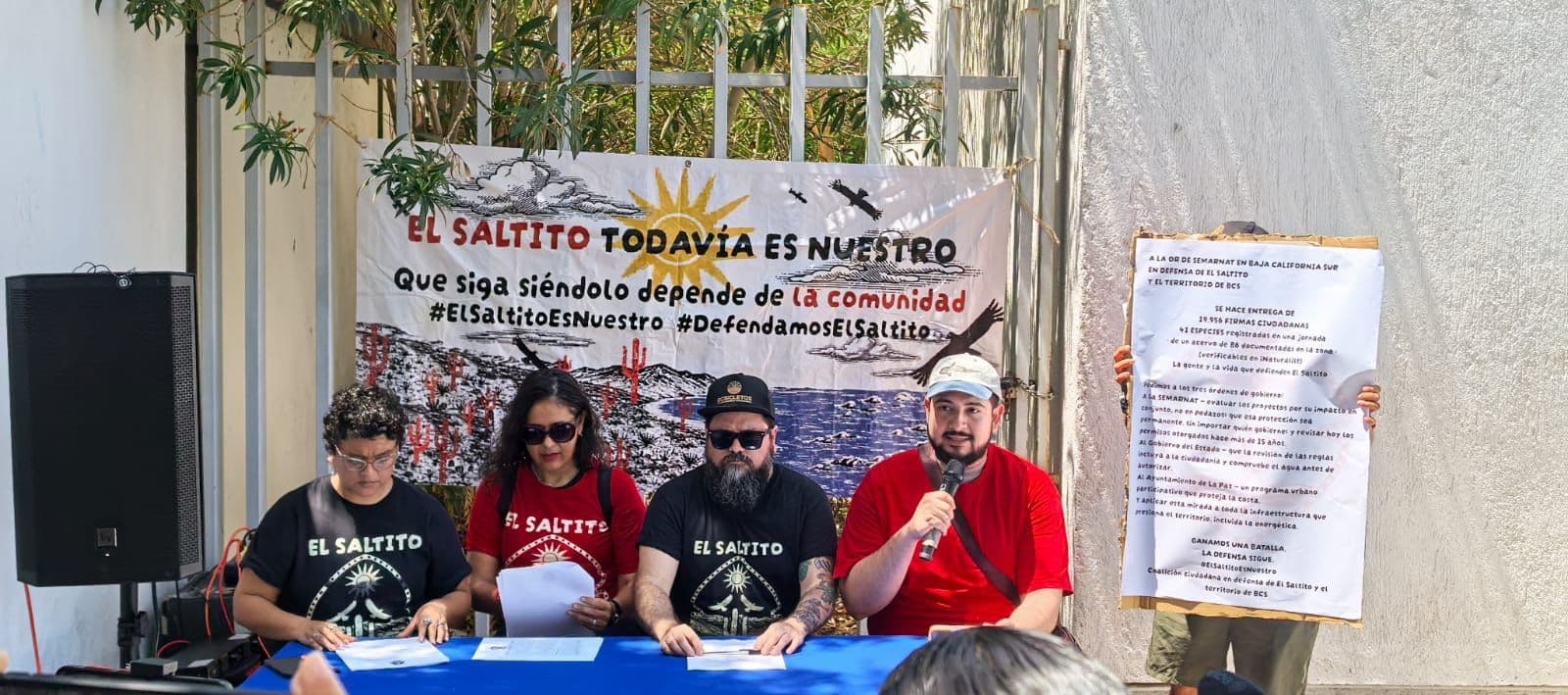
The withdrawal of two procedures related to the tourist development of El Saltito, in La Paz, Baja California Sur, stopped, for now, the procedure to disassemble more than 109 hectares of vegetation, but it did not end with the possibility of real estate projects being carried out in this coastal area.
Organizations and citizen groups warned, this August 10 at a press conference, that environmental authorizations remain in force for projects that, according to their estimates, together cover about 1,500 hectares between El Saltito and neighboring land.
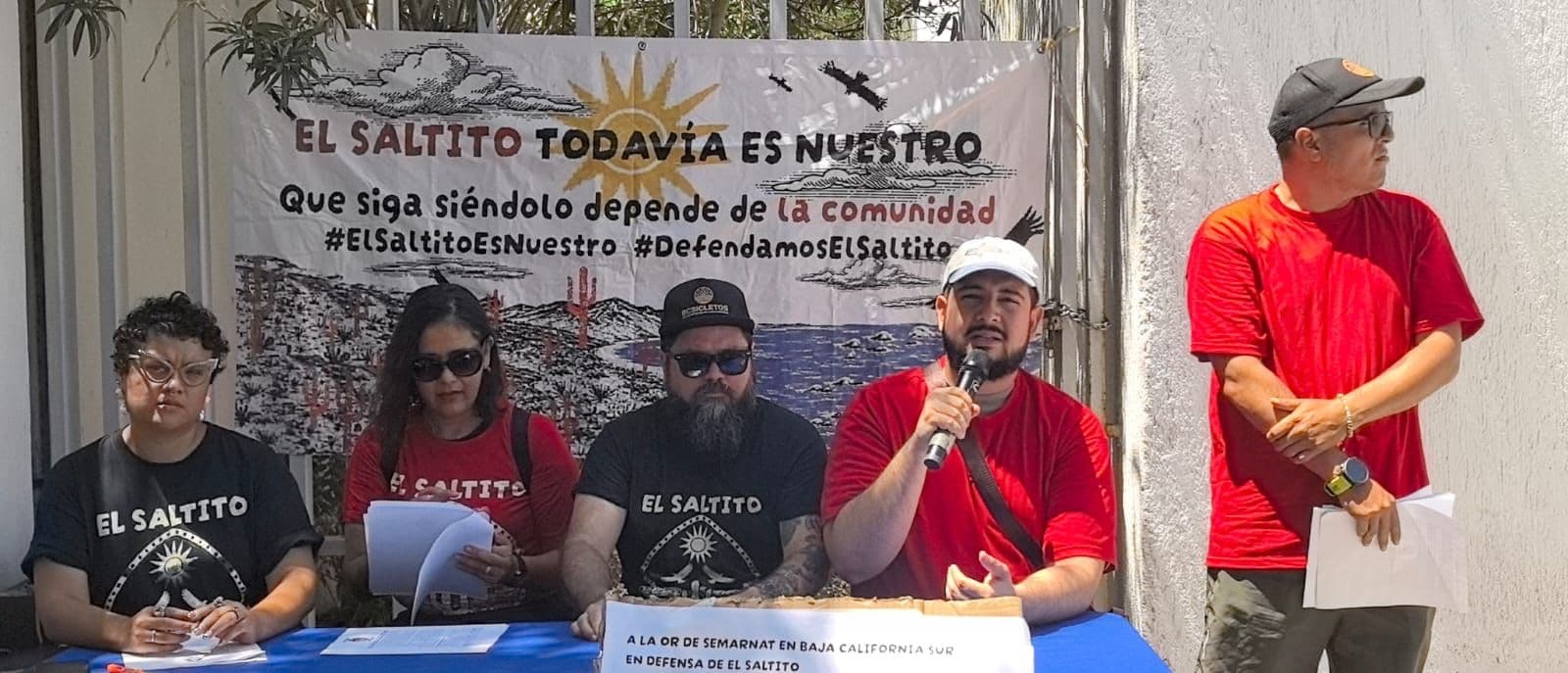
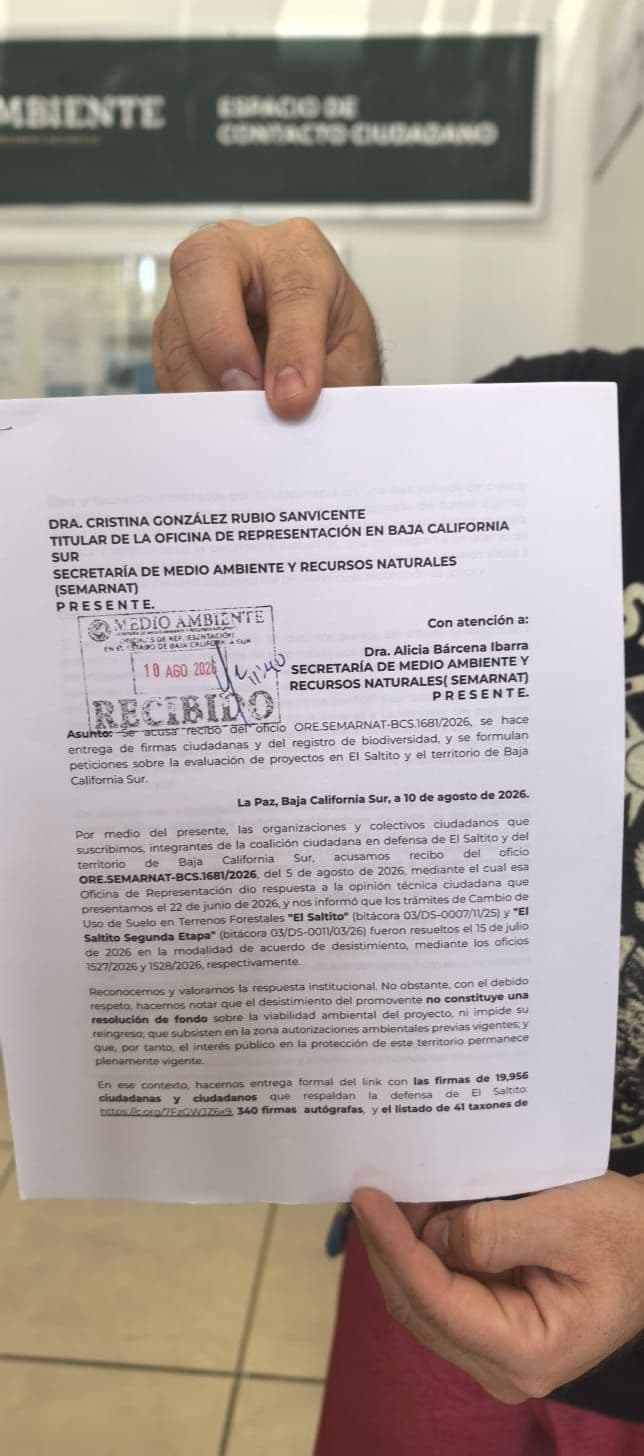
During an event in front of the offices of the Secretariat of Environment and Natural Resources (Semarnat) in Baja California Sur, the coalition delivered a letter with 19,956 citizen signatures and a list of documented species in the area that would be affected.
The message from the organizations was that withdrawal represents a brake, but not a definitive protection.
“It's not a cancellation or a refusal on the part of the authority. A withdrawal means that the developer withdrew, for now and at this time, this review before Semarnat of the clearing of more than 110 hectares,” explained Gabriela Ramírez, from Cómo Vamos La Paz.
Also read: Forestry procedures removed from El Saltito, but Environmental Impact Manifestation is still in force
The project can return
The most recent controversy was caused by the El Saltito Second Stage procedure, identified with the blog 03/DS-0011/03/26, through which Semarnat was asked to change land use in forest lands (CUSTF) on 109,622 hectares.
The sponsor was Banco Ve Por Más, S.A., in its capacity as trustee of Trust 1157.
The request was related to a development that included residential lots, a golf course, artificial bodies of water, roads and tourist infrastructure, as well as a hotel with a beach club.
Although the procedure for changing land use was removed, Gabriela Ramírez explained that the risk does not disappear because, according to information submitted by the organizations, other environmental authorizations remain and the land is still in the hands of the developer.
“The land is still in the hands of the developer with authorizations. What does it mean? That you can re-enter this land use change at any time, when you decide, because environmental authorizations are still in force.”
The member of Cómo Vamos La Paz pointed out that an environmental authorization corresponding to a 709-hectare project remains in force, in addition to another 752-hectare project called Azul de Cortés and a third neighboring project, Boca del Saltito 4, of 47 hectares.
“It's important to celebrate that, for now, El Saltito is still ours; however, the project is not dead, it's still in force and has an environmental authorization of 1,500 hectares,” said Ramírez.
Don't miss: Damages heritage work supported by the government on the island of BCS; INAH reports to FGR
Citizen science documents 86 species
One of the arguments in defending El Saltito has been its biodiversity.
On August 2, around 50 people took part in an observation walk organized by the coalition and naturalist guides. For approximately three hours, 41 species of flora and fauna were recorded, despite the fact that the exercise was carried out before the rainy season.
The records were added to a public collection that, according to the organizations, currently documents 86 species in the area through open citizen science platforms.
Jacqueline Valenzuela, director of the Center for Renewable Energy and Environmental Quality, explained that the documentation seeks to establish a baseline on ecosystem conditions before any intervention.
“Prior documentation allows us to have a baseline to show what the ecosystem and also social value of a territory that is in danger has been, because there is no turning back once a territory is deforested; there is no going back once a territory is intervened.”
The information is relevant because the request for land use change contemplated the removal of desert vegetation on more than 109 hectares, with thousands of specimens of species characteristic of the sarcocaule scrub.
Read: Community of La Paz is organized to stop tourism project in El Saltito
“Who is La Paz being developed for?”
For groups, the case of El Saltito transcends the discussion about a single development and raises questions about La Paz's tourism and real estate growth model.
Carlos Mancilla, a member of BCSicletos, said that large scale developments increase the demand for services in a city that is already facing pressure on basic resources.
“Authorized projects such as El Saltito, historically, involve more demand for water, energy and services in a territory where those needs already exist for the current population and remain unsolved.”
Mancilla argued that withdrawal must be understood within a broader discussion about who receives the benefits and who absorbs the costs of real estate growth.
“The fundamental question is not how much development there is in La Paz, but rather what development we need and for whom. A city that grows by expelling its own people is not more prosperous, it's simply an unequal and unjust city.”
Nearly 20,000 signatures and new demands on Semarnat
During the event, Adrián Trasviña, from Vigilantes Peninsulares, read the letter given to Semarnat, accompanied by nearly 20,000 citizen signatures and the list of species documented in El Saltito.
The main request to the federal authority is to modify the way in which projects in this area are analyzed. Instead of reviewing each development separately, they request to consider the cumulative impacts on the same territory.
“We call on the three levels of government; to Semarnat, to evaluate projects in the area for their cumulative impacts and not in pieces; for this protection to be permanent, regardless of who governs, and to review today the permits granted more than 15 years ago,” he asked.


Comentarios (0)