
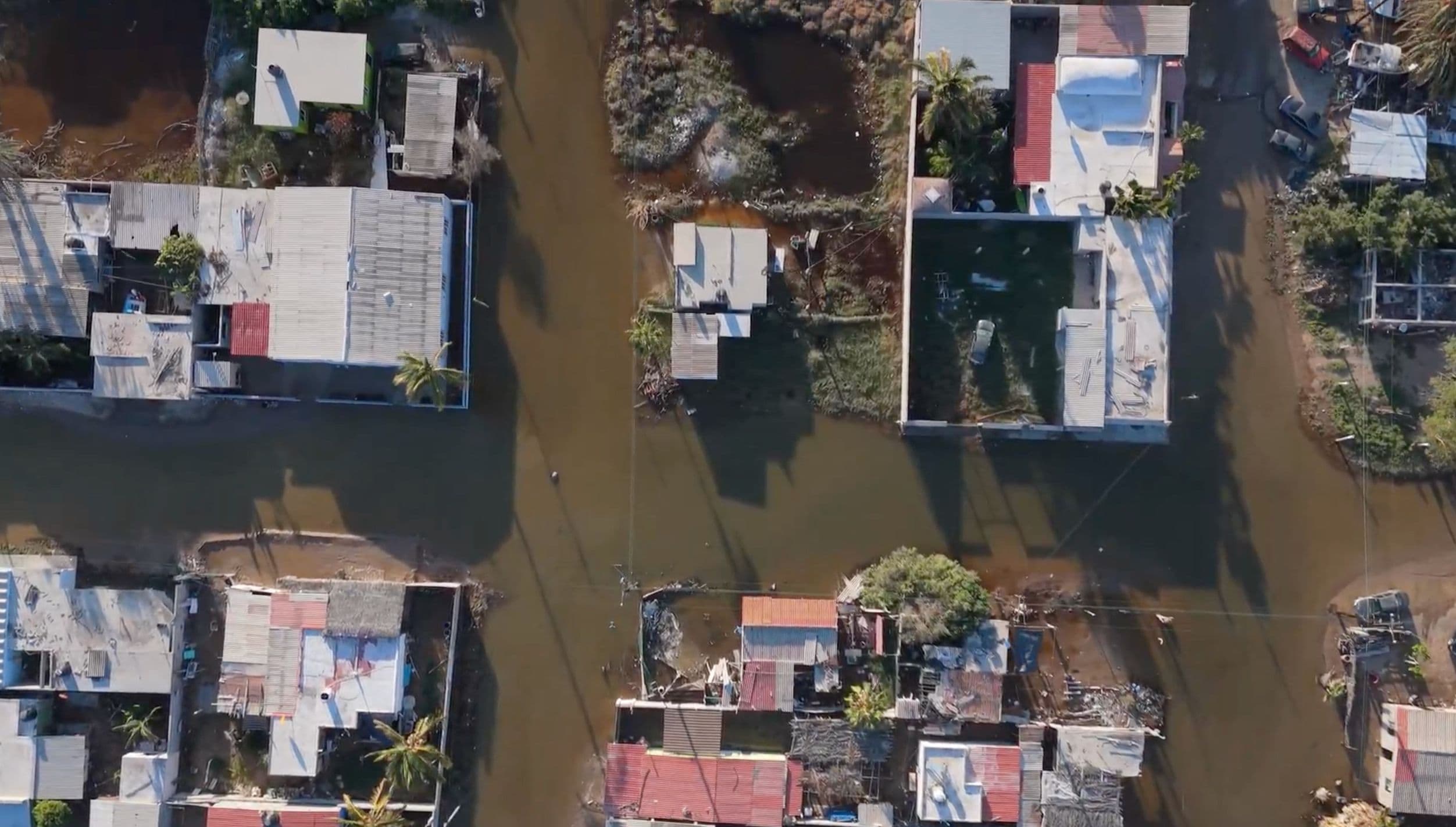
“It was seconds, it didn't give us a chance to lift anything,” Guadalupe Liliana Montañez Cruz recalls, describing how water entered the houses in the neighborhood of “Los Camaradas”, in Puerto San Carlos, municipality of Comondú, Baja California Sur, until it reached a height of approximately 70 centimeters, on September 28. A week later, many homes are still flooded.
The impact of the “Polo” meteorological phenomenon once again revealed the vulnerability of this coastal community of Comondú, where the rupture of the containment edge allowed water to advance towards inhabited areas.
The emergency surprised families with no time to rescue their belongings or get to safety. Today, while some families try to clean their houses and remove what little was left between the mud and the water, others are still living in the middle of the flood because they had nowhere to go.
Outside, the water still reaches above their knees. “There are people who are still living here in their houses with total losses because this had no warning,” Guadalupe says.
The emergency did not end when the water came out of the houses. Guadalupe says that there are still families looking for ways to get food, walk with their feet submerged for hours and endure the bad odors of drains and septic tanks.
“No pantry has come this way. Not an aid of food or water or anything. You can't imagine the rotting smell that comes from all the drains, from the pits in the bathrooms. It's horrible what we're going through these days.”
Meanwhile, children stopped attending classes because they lost their supplies and books. Some families had to take them to higher ground, while their parents remain in their homes trying to recover what was left. But for Guadalupe, one of the biggest concerns is that, after the emergency, they still don't know what will happen to them.
Although the authorities spoke of a possible relocation and of reviewing whether it is still feasible to build a retaining wall, they have not presented them with a definitive solution.
“We are forgotten, what happened to us, we didn't have anyone's help. All the aid that has come in terms of food or something is from people who have their foundations, who are not from the government, because the government has not given us and has not helped us and has not come to visit us”, he concludes.
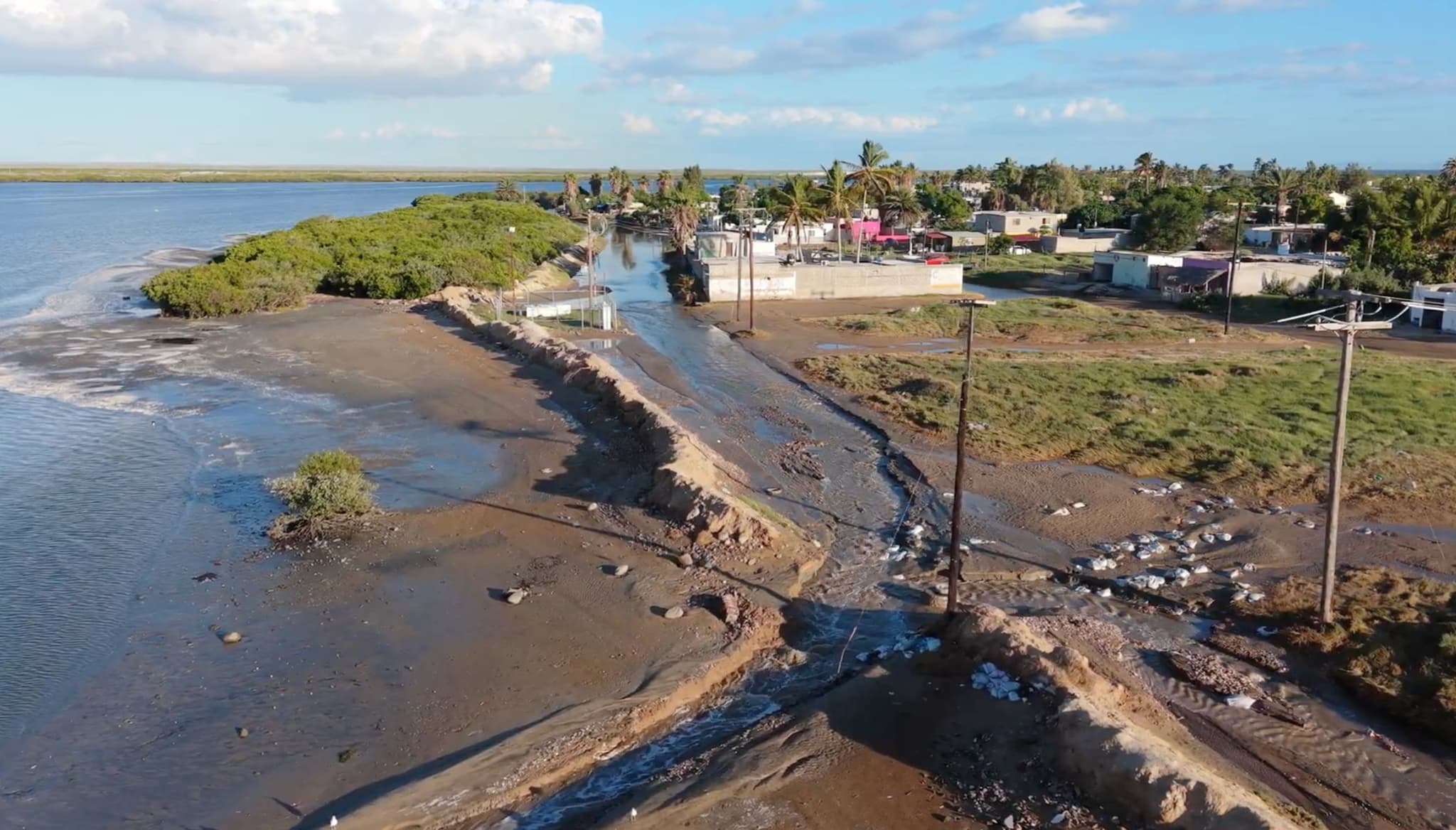
In the neighborhood of “Los Camaradas”, one of the areas identified by its inhabitants as among the most affected in Puerto San Carlos, families not only face material losses, but also the uncertainty of not knowing if they will be able to remain in their homes or where they can settle down.
“They haven't given us an answer, we don't know anything at all what's going to happen to us.”
Also read: Los Cabos after the storm: an hour of rain exposes the urban deficiencies of Baja California Sur
The State Risk Atlas already warned of the vulnerability of Puerto San Carlos
The possibility that Puerto San Carlos would face increasing floods due to the advance of the sea and storm surges was already contemplated in the State Risk Atlas of Baja California Sur, prepared by the Autonomous University of Baja California Sur (UABCS) and published in 2024.
In table 22, dedicated to identifying high-risk colonies and areas in the state, the document classifies all neighborhoods in Puerto San Carlos at very high risk due to floods, storm surges and rising sea levels associated with climate change.
But the warning goes beyond identifying the danger. In the critical points section, the Atlas points out that rising sea levels, combined with a greater likelihood of storm surges caused by tropical cyclones, will favor larger floods in the community.
He even warns that there will come a time when artificial dams will not be enough to contain the sea.
The document estimates that this problem involves a population of 5,742 inhabitants. In addition, among its recommendations, it proposes to establish a program of action in the short and medium term to protect coastal communities or even consider their migration to high areas, and it specifically mentions the case of Puerto San Carlos.
In other words, two years before the floods faced by families today, the technical instrument already identified the risk for the entire town and stated that protection based solely on containing the sea could be insufficient.
The warning is relevant in the face of the current situation: while the mayor of Comondú, Roberto Pantoja Castro, recognizes that the City Council only has dirt, sand and shell to reinforce the border, the Atlas already raised the need to study alternatives for protection and a possible relocation of the population.
On November 2, 2026, the Integral Risk Management Research Laboratory (LIGIR) of the Autonomous University of Baja California Sur (UABCS) resumed this concern. In a publication on the torrential rains and extraordinary tides recorded during October and November, he noted that the impacted areas were already identified in the Atlas with moderate to high risk levels and questioned the fact that the agencies responsible for Civil Protection did not make sufficient use of this tool.
The laboratory recalled that the Atlas was developed in 2023 and delivered in 2024, and called for keeping it updated and using it as a preventive tool.
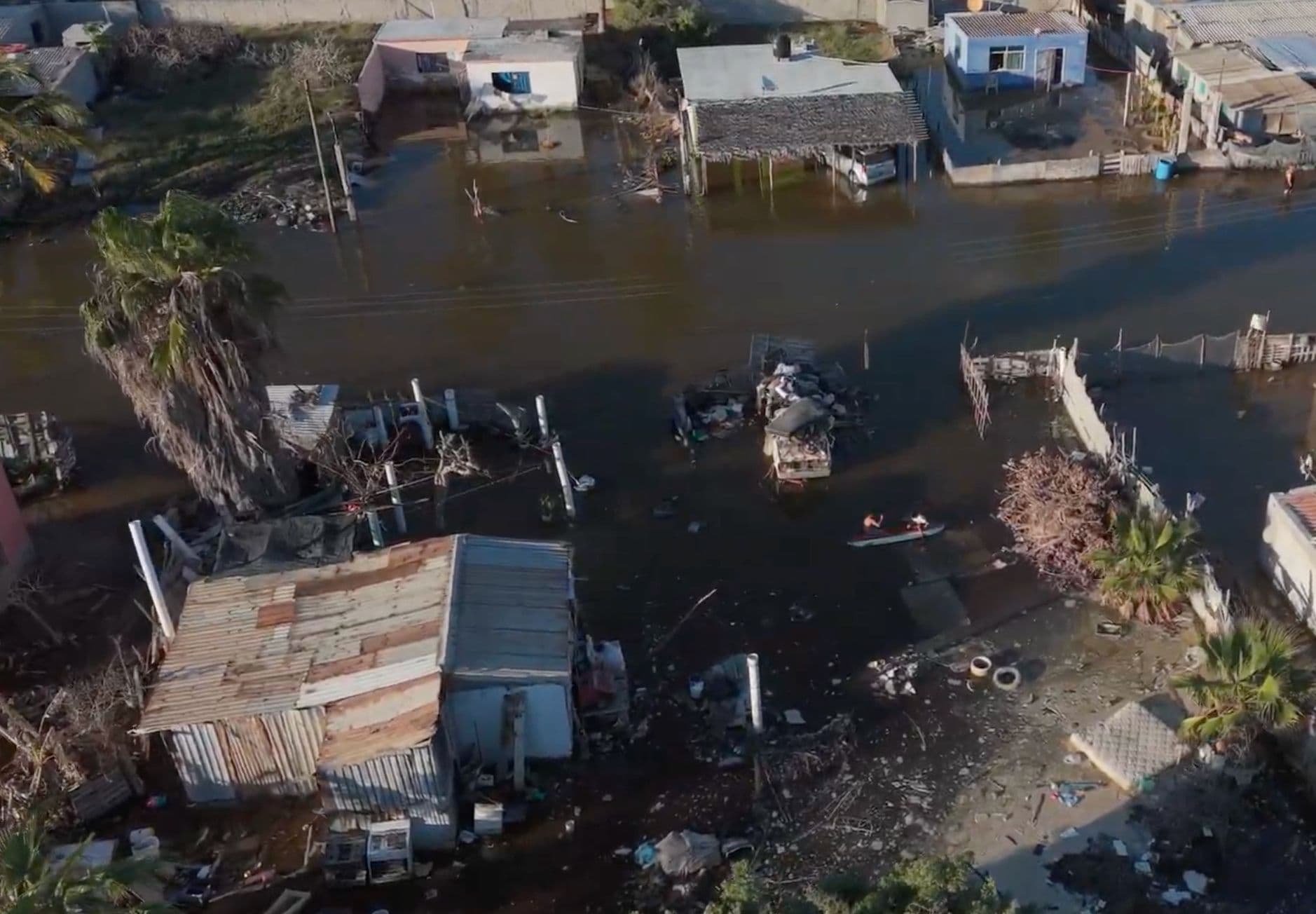
Puerto San Carlos, decades in front of the sea and without protection that resists
The flood that hit Puerto San Carlos, in the municipality of Comondú, during the passage of hurricane “Polo” in September does not represent a new problem for its inhabitants. For more than a decade, there have been records of ruptures of the containment board, seawater entering homes and neighborhood requests to replace land protection with a concrete structure.
The history even dates back to September 2014, when strong storm surges caused by hurricane “Norbert” broke several sections of the retaining wall and flooded approximately one third of the homes in the community. In that emergency, around 500 people were taken to shelters.
A year later, on September 26, 2015, the border broke again in the area known as Punta Palapas. The inhabitants were already aware that the reinforcements with earth were not enough and were asking for concrete protection. This occurred despite the fact that reconstruction work had been announced in 2014 with an investment of close to 10 million pesos.
The original board, built by the villagers themselves during the 1950s, has received different reinforcement works over the years. However, the floods continued.
In October 2025, after the storm “Priscilla” passed, it collapsed again, just one day after the City Council announced work to reinforce it.
In September 2026, with the hurricane “Polo”, the sea once again surpassed and broke sections of this protection, allowing water to enter inhabited areas again. The damage lasted for the following weeks and, at the end of October, new floods were reported.
Don't miss: Water reaches the Malecón in La Paz: high tides and warming of the Gulf of California cause coastal flooding
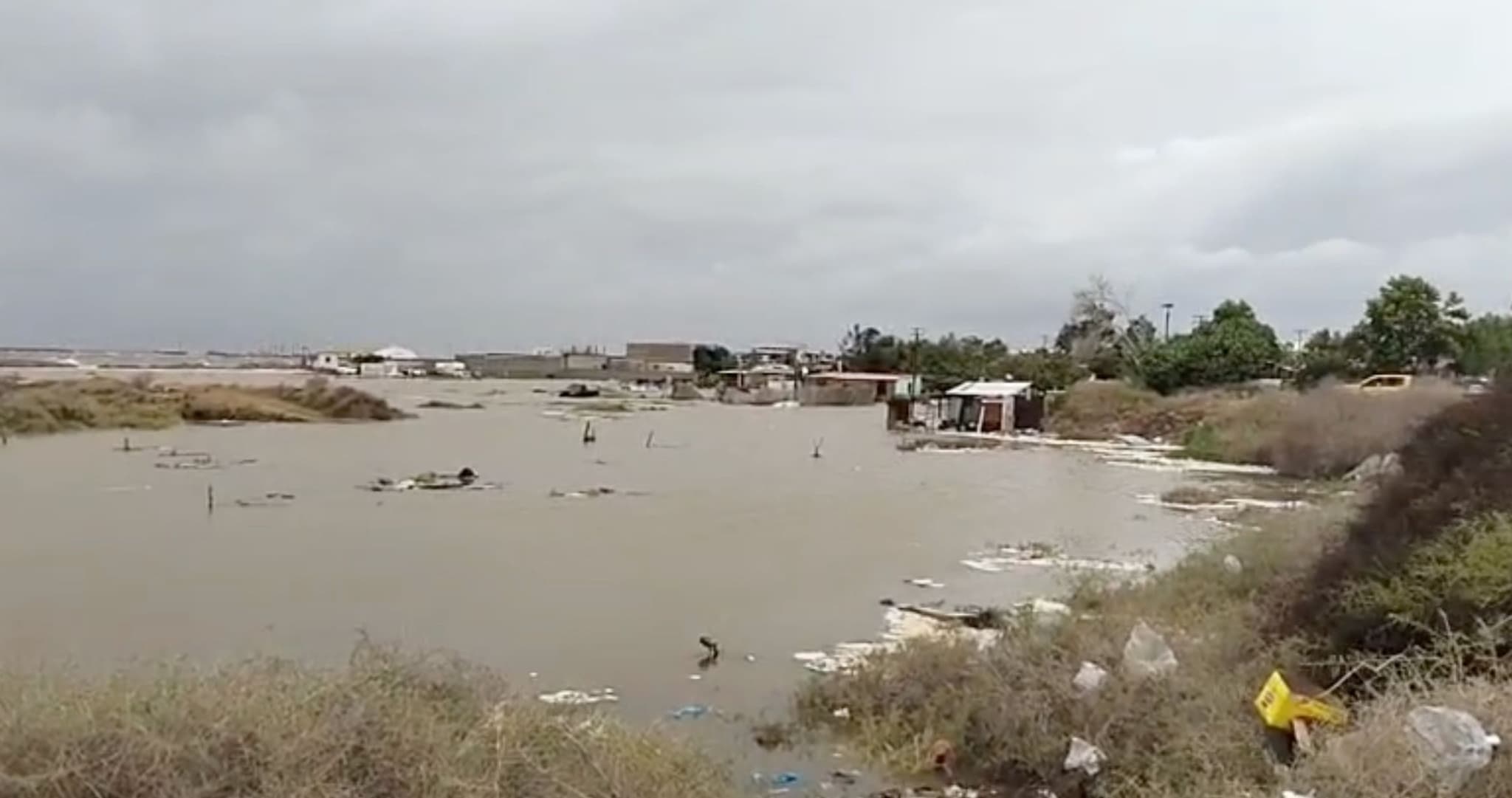
Authorities overwhelmed by increasingly severe floods
The floods in Puerto San Carlos not only demonstrated the vulnerability of houses built in low-lying areas, they also revealed a situation that has been going on for decades: the community is still exposed to the entrance of the sea and the authorities continue to use the same materials to try to contain it.
“Everything we have reinforced we do with the material we have, which is earth, sand, shell. We don't have any more, that is, we don't have any other type of material that we can use,” said the mayor of Comondú, Roberto Pantoja Castro, in an interview.
The mayor himself admitted that these works have been carried out repeatedly, but they have failed to prevent the tides from eroding the edge and allowing water to enter again.
“We have done it on several occasions, but it has to be said, the tide is slowly going to be eating the board and eating it and the seawater is entering.”
City Council and State Government report on work and management
Roberto Pantoja Castro reported that the City Council maintains machinery, dump trucks, fuel and operators to remove accumulated water in affected areas. He also noted that, once levels decrease, they will carry out filling work on damaged streets.
Regarding coastal protection, he explained that the Public Works and Civil Protection areas reviewed the possibility of building a concrete wall, but considered that it could cause rainwater to be trapped inside the community. As an alternative, he proposed the relocation of families to land close to the thermoelectric plant, with the condition of carrying out topographic studies and establishing agreements with the owners.
For his part, Governor Víctor Castro Cosío reported that he will seek the intervention of the National Water Commission (Conagua) to carry out technical studies in Puerto San Carlos and determine the works necessary to address the damages. He also mentioned the possibility of managing federal resources and analyzing protection or relocation alternatives for housing located in risk areas.
Read: The richest pollute more, but communities face the consequences of the climate crisis: Oxfam
Despite official work, families are still in polluted waters
While the City Council reports on water removal and reinforcement of the board, and the State Government is proposing studies to define possible works, affected families continue to face the consequences of the flood.
For the inhabitants, interventions after each emergency have not prevented water from re-entering nor have they solved the lack of protection, supports and spaces to shelter.
Guadalupe questions that the authorities have held meetings and tours in some parts of Puerto San Carlos, but have not gone to the areas where the most affected families remain.
She explains that the meeting with the mayor took place in the square and that they also visited the area where the hole opened, but they did not reach the sector where she lives.
Added to the lack of support is the absence of a space where families who are unable to return to their homes can stay. The hostel that operated as a school was enabled for only one week, as the building had to resume its school activities.
Some people sought refuge with family members, but others are still in their homes, surrounded by water.
The situation is also marked by pollution. Guadalupe describes that the water remains mixed with waste from drains and septic tanks, while the inhabitants have to walk through it to get food. “Our feet are soaked all day long because we go out to look for our food,” she laments.


Comentarios (0)